On eBird ↗
Taiwan Blue-Magpie
Live sightings near you, the range map, bar charts of when it is seen, and Macaulay Library photos and recordings.
Taiwan Blue-Magpie
Urocissa caerulea
The Taiwan blue magpie (Urocissa caerulea), also called the Taiwan magpie, Formosan blue magpie (Chinese: 臺灣藍鵲; pinyin: Táiwān lán què), or the "long-tailed mountain lady" (Chinese: 長尾山娘; pinyin: Chángwěi shānniáng; Taiwanese Hokkien: Tn̂g-boé soaⁿ-niû), is a species of bird of the crow family. It is endemic to Taiwan.
From the article Taiwan blue magpie on Wikipedia (CC BY-SA), quoted section by section
Description
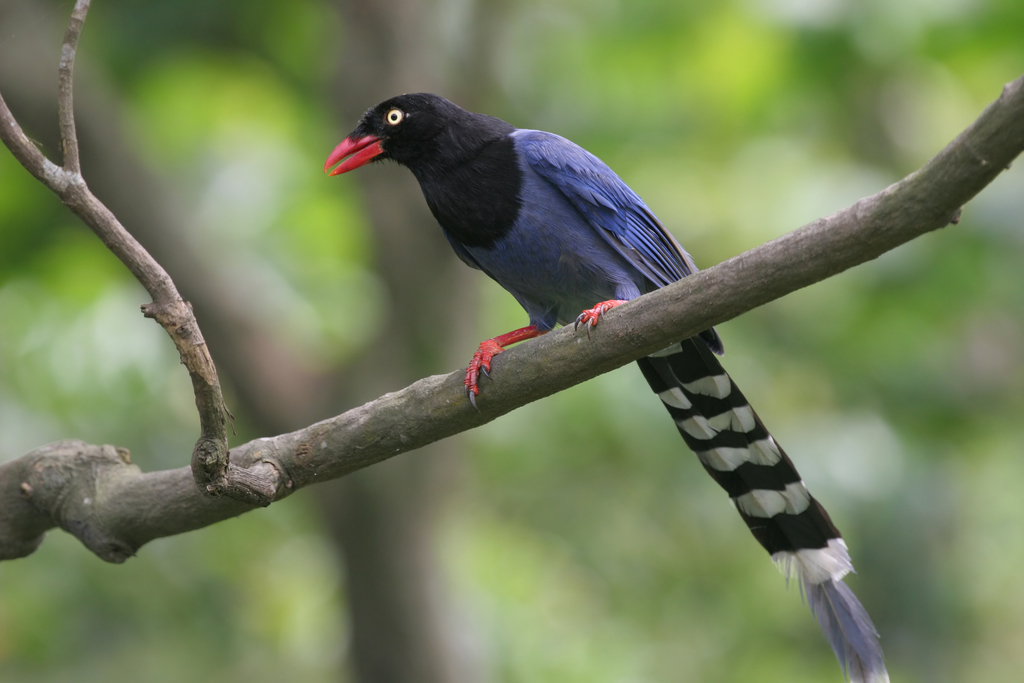
It is 63–68 cm (25–27 in) in length. The tail measures around 34–42 cm (13–17 in) in length, and the wings are 20 cm (7.9 in) long. It weighs 254–260 g (9.0–9.2 oz). The plumages of the male and female are similar. The head, neck and breast are black. The eyes are yellow, and the bill and feet are red. The rest of the plumage is mostly blue. The wings and tail feathers have white tips. The underwing-coverts are dark grey, and the flight feathers are light grey. The uppertail-coverts have black tips. The central pair of tail feathers are the longest. The other tail feathers have black bands. Chicks are greyish, with a short tail and greyish-blue eyes.
Range & habitat
The Taiwan blue magpie is endemic to Taiwan. It lives in broadleaf forests at elevations of 300–1,200 m (980–3,940 ft).
Wikipedia: “Distribution and habitat”
What it does
Taiwan blue magpies are not very afraid of people. They can be found near human residences in the mountains or newly cultivated lands. They are gregarious and are usually found in groups of three to twelve. The birds often fly in a line, following each other. This is sometimes called "long-tailed formation". Similar to other members of the crow family, they have a raucous call which is described as a high-pitched cackling chatter, kyak-kyak-kyak-kyak. Other calls include ga-kang, ga-kang, kwee-eep and gar-suee.
Food and feeding. Taiwan blue magpies are scavengers and omnivores. Their diet includes snakes, rodents, small insects, carrion, eggs and chicks of other birds, plants, fruits, and seeds. They also feed on food waste of humans. They sometimes store leftovers on the ground and cover them with leaves for future retrieval. Sometimes they store food in the leaves or branches.
Breeding. The breeding season is from March to July. The Taiwan blue magpie is monogamous. Females incubate eggs while males help with nest building and feeding. Their nests are built on high branches of trees. The nest is in the shape of a bowl and is made of twigs. Usually there are 3–8 eggs in a clutch. Eggs are light green in color, with brown marks. Hatching takes 17–19 days. There are 3–7 chicks per nest. …
Wikipedia: “Behavior”
Listen
Looking for field recordings…
Where it lives
Recorded sightings
—
geo-referenced records in GBIF, from museums, herbaria and field observers.
Drag the globe to turn it. Dots are where records exist, not a range map; darker means more records.
In the stacks
Searching the stacks…
Every page naming Urocissa caerulea in the Biodiversity Heritage Library →
This page is assembled live from iNaturalist, GBIF, Wikipedia, the Source Library and the Internet Archive. It is not yet part of the hand-edited codex. iNaturalist taxon 8415.