- Plants
- ›Vascular Plants
- ›flowering plants
- ›monocots
- ›grasses, sedges, cattails, and allies
- ›Bromeliads
- ›Tillandsioids
- ›Tillandsia
- ›Diaphoranthema
ballmoss
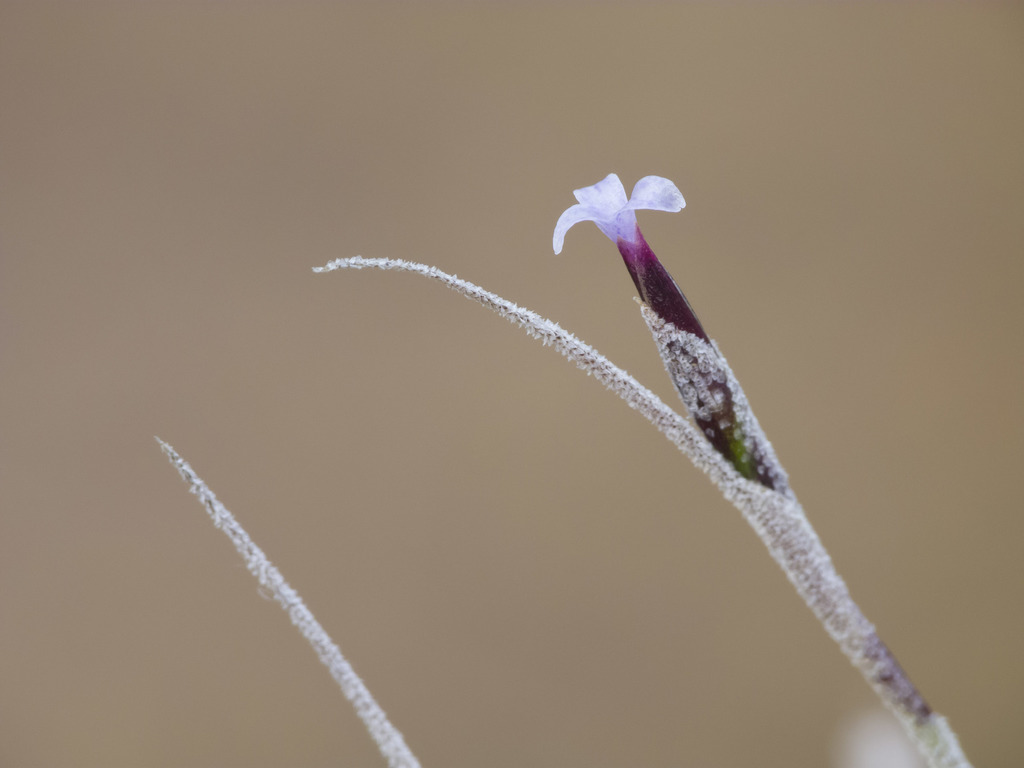
Tillandsia recurvata
Tillandsia recurvata, commonly known as small ballmoss or ball moss, is a flowering plant (not a true moss) in the family Bromeliaceae that grows upon larger host plants. It grows well in areas with low light, little airflow, and high humidity, which is commonly provided by southern shade trees, often the southern live oak (Quercus virginiana). It is not a parasite like mistletoe, but an epiphyte like its relative Spanish moss.
Tillandsia recurvata derives mainly physical support and not nutrition from its host; it photosynthesizes its own food, absorbing water that collects on its leaves. It obtains nitrogen from bacteria, and other minerals largely from blown dust. Though not a harmful parasite in the same sense as plants such as mistletoes that feed on the sap of the host, ball moss may compete with a host tree for sunlight and some nutrients, and by restricting available surface area for new branch sprouts; however, except on stressed host trees (e.g., in some urban settings) it rarely has a noticeable effect on growth or health.
From the article Tillandsia recurvata on Wikipedia (CC BY-SA), quoted section by section
At the table
Tillandsia recurvata can be used as animal fodder. The Pima of Mexico occasionally eat T. recurvata and T. erubescens flowers due to their high sugar content.
== References ==
Wikipedia: “Uses”
Where it lives
Recorded sightings
—
geo-referenced records in GBIF, from museums, herbaria and field observers.
Drag the globe to turn it. Dots are where records exist, not a range map; darker means more records.
In the stacks
Searching the stacks…
Every page naming Tillandsia recurvata in the Biodiversity Heritage Library →
This page is assembled live from iNaturalist, GBIF, Wikipedia, the Source Library and the Internet Archive. It is not yet part of the hand-edited codex. iNaturalist taxon 84002.