- Animals
- ›Arthropods
- ›Hexapods
- ›Insects
- ›Winged and Once-winged Insects
- ›Beetles
- ›Water, Rove, Scarab, Long-horned, Leaf, and Snout Beetles
- ›Scarabaeiform Beetles
- ›Scarabs, Stag Beetles, and Allies
- ›Scarabs
- ›Rhinoceros Beetles
- ›True Rhinoceros Beetles
- ›Dynastina
- ›Dynastes
- ›Dynastes
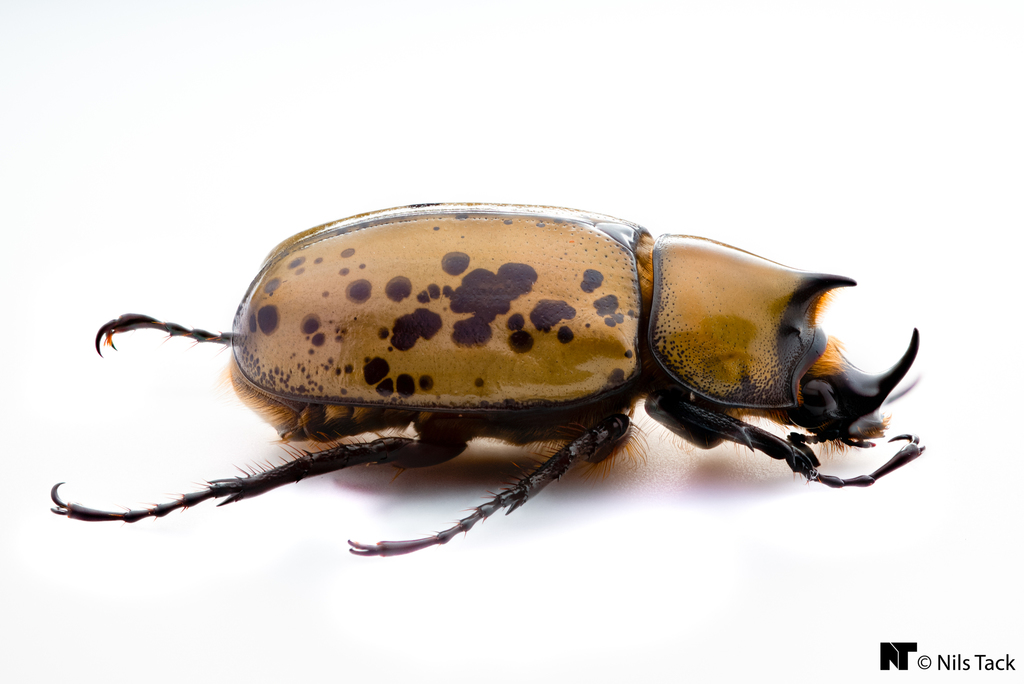
Eastern Hercules Beetle
Dynastes tityus
Dynastes tityus, the eastern Hercules beetle, is a species of rhinoceros beetle that lives in the Eastern United States. The adult's elytra are green, gray or tan, with black markings, and the whole animal, including the male's horns, may reach 60 mm (2.4 in) in length. The grubs feed on decaying wood from various trees.
From the article Dynastes tityus on Wikipedia (CC BY-SA), quoted section by section
Description
Adults of both sexes are 20–27 millimeters (0.8–1.1 in) wide, and males are 40–60 millimeters (1.6–2.4 in) long, including a long horn (the pronotal horn) which projects forwards from the thorax of the male; a second horn (the clypeal horn) projects upwards from the head. Dynastes tityus is therefore "among the longest and heaviest beetles in the United States". The horns are used in battles between rival males competing for a mate; the size of the horn reflects the availability of food when the beetle was growing. Despite the size of the horns, Dynastes tityus are harmless to humans. The elytra are green, gray, or tan, usually with black mottling. The pattern of spots is unique to each individual. Beetles that are found in the soil or in rotten wood often appear very dark, with the spots on the elytra obscured. This results from moisture which the shell has absorbed; when the elytra dry out, they return to their paler color. Moisture is stored on the outer layer of the elytra, called the epicuticle, which changes the angle at which light reflects off of the underlying layer, the exocuticle, which is composed of photonic crystals. …
Range & habitat
The genus Dynastes is theorized to originate in South America. The North American lineage appeared after the closure of the Panama Isthmus 3.5 million years ago. This lineage has been further dispersed by the Transverse Volcanic Belt and the Sierra Madre del Sur into eastern and western species in North America. D. tityus lives in the eastern and southeastern United States, from New York state, Illinois and Indiana in the north to Florida and the Gulf of Mexico in the south, with eastern Texas and western Arkansas marking the western limit of its range. The larvae of eastern Hercules beetles live in decaying wood. They prefer to reside and develop within the large cavity at or near the bases of the tree through which they can tunnel into the soil. The adults are observed to live in the vegetation and under moist leaf-litter. The fallen leaves and logs can protect the beetle from predation risks. They are also found to live on ash trees where the trees help them attract and locate mates.
Wikipedia: “Distribution”
In human culture
Mating can last up to 50 minutes in D. tityus. Subsequent batches of eggs are oviposited in the same site until its resources are exhausted. The larvae are large C-shaped grubs with white bodies and chewing mouthparts, which feed on decaying wood and litter within rotten trees and produce distinctive rectangular fecal pellets about 10 mm (0.39 in) long. After 12–18 months, the larvae pupate in late summer. Adults remain underground through the winter, initially remaining in their pupal cell. They emerge in the summer and live for 6–8 months. The adults' diet is not well known, but they have been observed lapping up the sap of ash trees. Oviposition happens during the summer and females lay up to 100 eggs in large cavities at or near the bases of the tree. Mature oaks and hardwoods are preferred. Females may share the same site to lay the eggs if there are enough accumulations of woody debris as food resources. The eggs are generally laid within or very close to the decaying wood so that the larvae would have enough nutrients without traveling too far. Thus, female investment towards the eggs happens before laying. No further parental care behavior is reported. The beetles undergo metamorphosis, which includes egg, larval, pupal and adult stages. Females lay the white-yellow eggs inside the soil during the summer. …
Wikipedia: “Life history”
Listen
Looking for field recordings…
Where it lives
Recorded sightings
—
geo-referenced records in GBIF, from museums, herbaria and field observers.
Drag the globe to turn it. Dots are where records exist, not a range map; darker means more records.
In the stacks
Searching the stacks…
Every page naming Dynastes tityus in the Biodiversity Heritage Library →
This page is assembled live from iNaturalist, GBIF, Wikipedia, the Source Library and the Internet Archive. It is not yet part of the hand-edited codex. iNaturalist taxon 83804.