On eBird ↗
Piapiac
Live sightings near you, the range map, bar charts of when it is seen, and Macaulay Library photos and recordings.
Piapiac
Ptilostomus afer
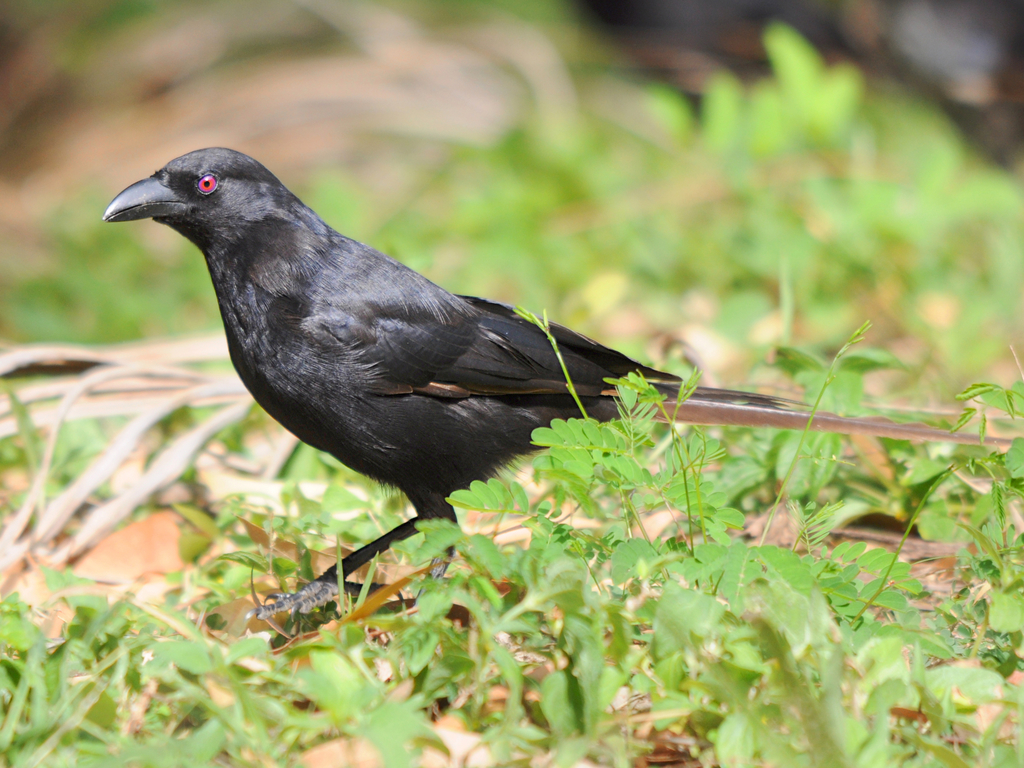
The piapiac (Ptilostomus afer) is an African member of the crow family, and is the only member of the genus Ptilostomus. According to recent findings, it is most closely related to the Central Asian ground jays (Ericson et al., 2005).
From the article Piapiac on Wikipedia (CC BY-SA), quoted section by section
Description
In size it is a little smaller and slimmer than the European magpie (Pica pica) though the bill is relatively thicker. It is 35–42 cm (14–17 in) in length and weighs 121–130 g (4.3–4.6 oz). The overall colouring is black with the feathers quite silky in texture and having a purplish gloss in good light. The base of the tail tends to be more brown in colour than the rest of the body. Unusual for a passerine it has 10 rather than 12 tail feathers. The nasal plumes are somewhat upturned on top of the bill but fully cover the nostrils. The bill itself is black in the adult but partly reddish-pink towards the base in juvenile specimens. The bird's legs and feet are black and the iris is variable, but tends towards violet, purple or mauve with a bluish-purple outer ring. The voice is usually described as a shrill squeaking often with the jackdaw-like overtones. There is also a croaking alarm call given in anger where the head bobs.
Range & habitat
The range of the species is the tropical equatorial region of central Africa from Senegal on the west coast, eastwards in a broad band to Sudan and southern Ethiopia. Within this range, its favoured habitat is towards more open country of cultivated land with fields and pasture and small associated towns and villages.
Wikipedia: “Distribution and habitat”
What it does
Food is obtained in flocks of ten or more birds moving together on the ground including insects and other invertebrates but will take a degree of carrion, possibly attracted as much by the associated insects this attracts as much as the meat itself. Some fruit is also taken in trees, with the oily fruit of the oil palm (Elaeis guineensis) being a favourite. Able to run fast with some agility, it tends to hop at slower speed and will catch insects disturbed by the feet of cattle, sometimes hitching a ride on their backs and darting out to catch the prey.
Wikipedia: “Feeding”
Listen
Looking for field recordings…
Where it lives
Recorded sightings
—
geo-referenced records in GBIF, from museums, herbaria and field observers.
Drag the globe to turn it. Dots are where records exist, not a range map; darker means more records.
In the stacks
Searching the stacks…
Every page naming Ptilostomus afer in the Biodiversity Heritage Library →
This page is assembled live from iNaturalist, GBIF, Wikipedia, the Source Library and the Internet Archive. It is not yet part of the hand-edited codex. iNaturalist taxon 8371.