- Plants
- ›Vascular Plants
- ›flowering plants
- ›Dicots
- ›pinks, cactuses, and allies
- ›pink family
- ›Caryophylloideae
- ›Caryophylleae
- ›Dianthus
- ›Dianthus caryophyllus
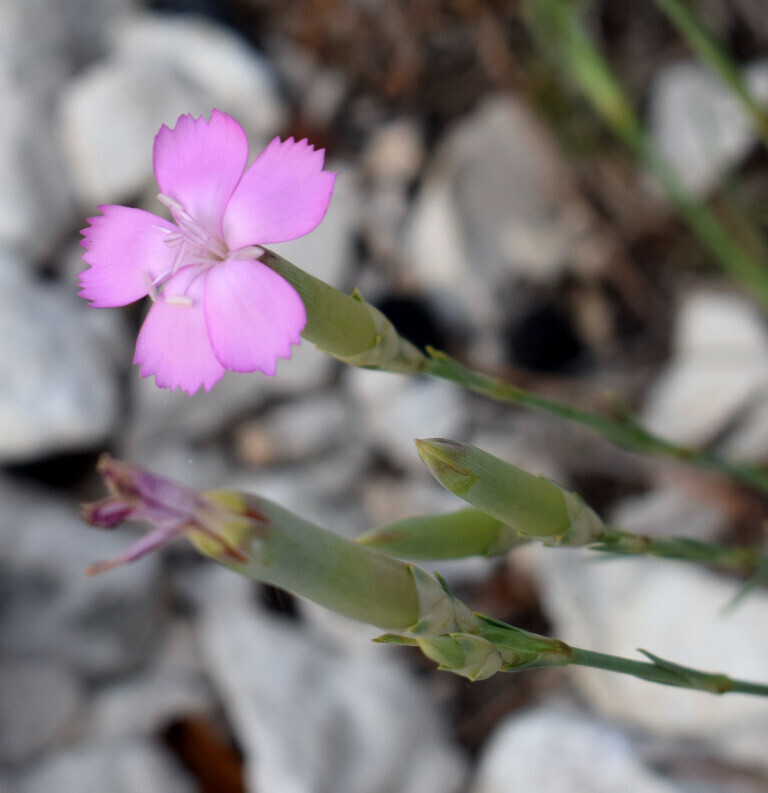
clove pink
Dianthus caryophyllus
Dianthus caryophyllus ( dy-AN-thəs KAIR-ee-ə-FIL-əs), commonly known as carnation or clove pink, is a species of Dianthus native to the Mediterranean region. While its exact natural range is uncertain due to extensive cultivation over the last 2,000 years, wild carnations are most common in the Mediterranean region. Carnations are prized for their wide variety of colors, delicate fringed petals, and fragrance, often described as spicy, clove-like, or reminiscent of a combination of cinnamon and nutmeg, hence the common name "clove pink". This aroma has made carnations a popular choice for use in perfumes, potpourri, and scented products. Culturally, carnations are associated with affection, distinction, and maternal love, with variations depending on color and area within its wide geographical range.
From the article Dianthus caryophyllus on Wikipedia (CC BY-SA), quoted section by section
Description
Dianthus caryophyllus is a herbaceous perennial plant growing up to 80 cm (32 in) tall. The leaves are glaucous greyish green to blue-green, slender, and up to 15 cm (6 in) long. The flowers are produced singly or up to five together in a cyme; they are around 3–5 cm (1¼–2 in) in diameter, and sweetly scented. The original natural flower color is bright pinkish-purple, but cultivars of other colors, including red, pink, yellow, white, and green, have been developed. While sometimes dyed blue for cut bouquets, there are no known carnation cultivars that produce a true blue flower. The fragrant, hermaphrodite flowers have a radial symmetry. The four to six egg-shaped, sting-pointed scale leaves surrounding the calyx are only ¼ as long as the calyx tube.
Range & habitat
The wild carnation is found in the Mediterranean countries of Portugal, Spain, Italy, Croatia, Albania, Greece and Turkey.
Wikipedia: “Distribution and habitat”
At the table
Carnations require well-drained, neutral to slightly alkaline soil, and full sun. Numerous cultivars have been selected for garden planting. Typical examples include 'Gina Porto', 'Helen', 'Laced Romeo', and 'Red Rocket'. They are used for medical purposes, such as for upset stomach and fever. Their fragrance was historically used for vinegar, beer, wine, sauces and salads. Crossbreeding D. caryophyllus with D. capitatus results in a hybrid that is resistant to bacterial wilt from Paraburkholderia caryophylli. However, the flower is less attractive and so more breeding and backcrossing is needed to improve the flower. Carnation cultivars with no fragrance are often used by men as boutonnières or "buttonholes".
Wikipedia: “Cultivation and uses”
In medicine
For the most part, carnations express love, fascination, and distinction, though there are many variations dependent on color.
Along with the red rose, the red carnation can be used as a symbol of socialism, social democracy, democratic socialism, and the labour movement, and historically has often been used in demonstrations on International Workers' Day (May Day). In China, the carnation flower is the most frequently used flower in weddings. In Portugal, bright red carnations were used when in 1974 the authoritarian Estado Novo regime was overthrown; therefore, this transition (brought about by a combination of a coup d'état with civil resistance) is known as the Carnation Revolution. Light red carnations represent admiration, while dark red denote deep love and affection. White carnations represent pure love and good luck, while striped (variegated) carnations symbolise regret that a love cannot be shared. In the Netherlands, white carnations are associated with Prince Bernhard. He wore one during World War II and in a gesture of defiance some of the Dutch population took up this gesture. After the war the white carnation became a sign of the Prince, veterans and remembrance of the resistance. Purple carnations indicate capriciousness. …
Wikipedia: “Traditional meanings”
Where it lives
Recorded sightings
—
geo-referenced records in GBIF, from museums, herbaria and field observers.
Drag the globe to turn it. Dots are where records exist, not a range map; darker means more records.
In the old herbals & bestiaries

In the stacks
Searching the stacks…
Every page naming Dianthus caryophyllus in the Biodiversity Heritage Library →
This page is assembled live from iNaturalist, GBIF, Wikipedia, the Source Library and the Internet Archive. It is not yet part of the hand-edited codex. iNaturalist taxon 83063.