- Plants
- ›Vascular Plants
- ›flowering plants
- ›monocots
- ›lilies, supplejacks, and allies
- ›greenbrier family
- ›Smilax
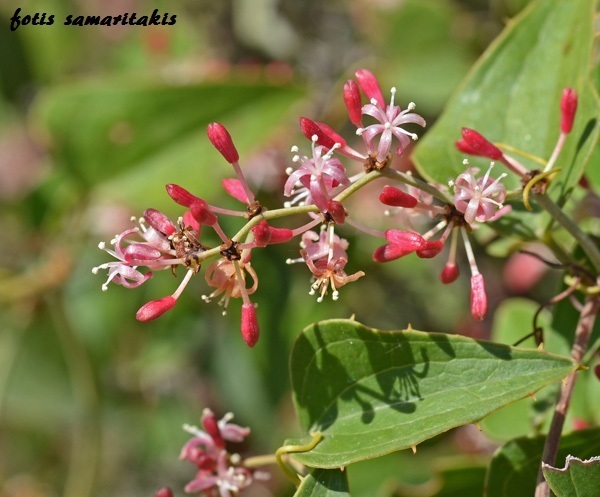
Rough Bindweed
Smilax aspera
Smilax aspera, with common names common smilax, rough bindweed, sarsaparille, and Mediterranean smilax, is a species of flowering vine in the greenbriar family.
From the article Smilax aspera on Wikipedia (CC BY-SA), quoted section by section
Description
Smilax aspera is a perennial, evergreen climber with a flexible and delicate stem, with sharp thorns. The climbing stem is 1–4 metres (3 ft 3 in – 13 ft 1 in) long. The leaves are 8–10 centimetres (3.1–3.9 in) long, petiolated, alternate, tough, leathery, and heart-shaped, with toothed and spiny margins. It is a monocot with reticulate venation. The midrib of the underside of the leaf is also provided with spines. The flowers, very fragrant, are small, yellowish or greenish, gathered in axillary racemes. The flowering period in Mediterranean regions extends from September to November. The fruits are globose berries, gathered in clusters, which ripen in autumn. They are initially red, later turning black. They have a diameter of 8–10 millimetres (0.31–0.39 in) and contain one to three tiny and round seeds. They are insipid and unpalatable to humans, but they are a source of nourishment for many species of birds.
Range & habitat
This species is widespread in Central Africa (Democratic Republic of Congo, Kenya, Ethiopia), Mediterranean Europe (Cyprus, Albania, Croatia, Greece, Italy, Malta, Montenegro, France, Portugal, Spain), temperate Asia ( Israel, Jordan, Lebanon, Syria, Turkey) and tropical Asia (India, Bhutan, Nepal). It is also naturalized in other regions.
Wikipedia: “Distribution”
Where it lives
Recorded sightings
—
geo-referenced records in GBIF, from museums, herbaria and field observers.
Drag the globe to turn it. Dots are where records exist, not a range map; darker means more records.
In the old herbals & bestiaries

Notable Commentaries on the History of Plants
Leonhart Fuchs · 1549 · p.750

Notable Commentaries on the History of Plants
Leonhart Fuchs · 1542 · p.752

On Medical Materials in Six Books
Dioscorides · 1550 · p.620

De medicinali materia libri sex
Dioscorides · 1552 · p.628

On the Names of Plants
Hieronymus Bock (Tragus) · 1552 · p.886

Commentaries on the Six Books of Dioscorides on Medical Matter
Pietro Andrea Mattioli · 1563 · p.691

Discourses on the Six Books of Dioscorides
Dioscorides; Pietro Andrea Mattioli (comm.) · 1568 · p.1452

Six Groups of the History of Plants
Rembert Dodoens · 1583 · p.415

The Plants of Egypt
Prospero Alpini · 1592 · p.131

History of Rare Plants
Carolus Clusius · 1601 · p.125

Rariorum Plantarum Historia (with Fungorum Historia)
Carolus Clusius · 1601 · p.130

Rariorum Plantarum Historia (with Fungorum Historia)
Carolus Clusius · 1601 · p.131
In the stacks
Searching the stacks…
Every page naming Smilax aspera in the Biodiversity Heritage Library →
This page is assembled live from iNaturalist, GBIF, Wikipedia, the Source Library and the Internet Archive. It is not yet part of the hand-edited codex. iNaturalist taxon 82903.