- Plants
- ›Vascular Plants
- ›flowering plants
- ›Dicots
- ›honeysuckles, moschatels, and allies
- ›honeysuckle family
- ›Valerians and Allies
- ›Valerianella
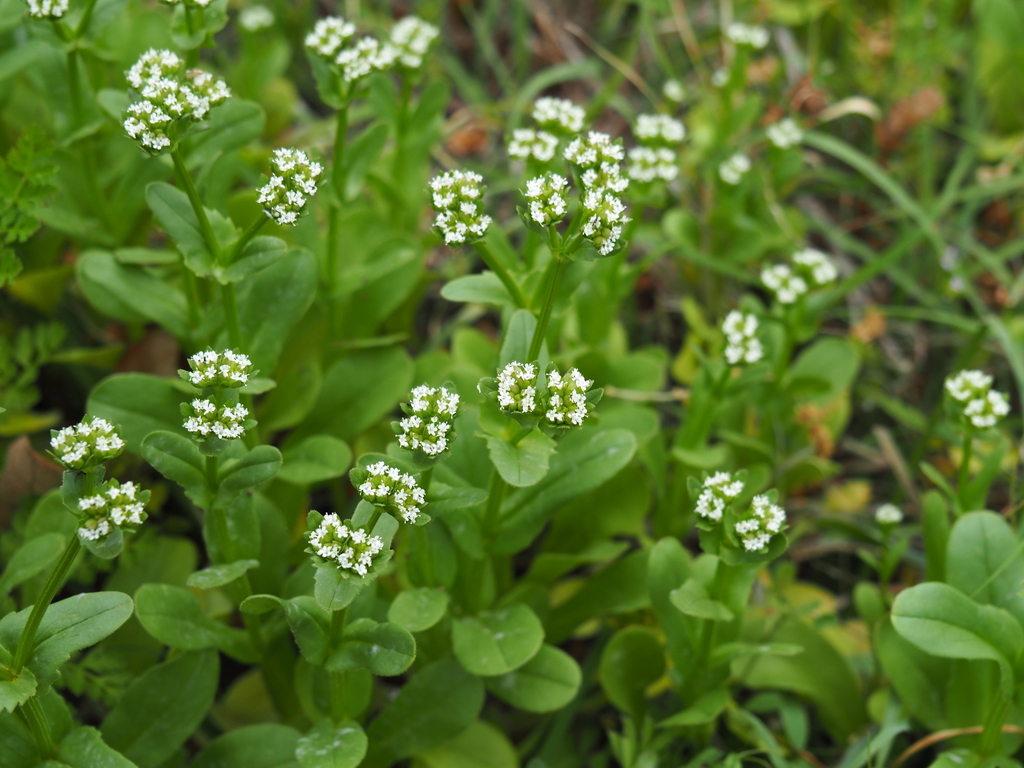
beaked cornsalad
Valerianella radiata
Valeriana woodsiana (synonym Valerianella radiata), common name beaked cornsalad, is a plant native to the United States. It is an annual self pollinating flowering plant and besides being edible there are no known uses. Valerianella radiata flowers from April to May.
From the article Valeriana woodsiana on Wikipedia (CC BY-SA), quoted section by section
Description
Valeriana woodsiana typically grows to a height of 0.6 m (2 ft). Flowers are perfect. It has 5 white flower petals that are arranged bilaterally symmetrical with fused sepals. The leaves are simple, entire, and toothed with opposite arrangement of two leaves per node on stem. It has 3 stamens, one pistil with three carpels, an inferior ovary with 3 locules and one ovule per locule, slightly 3-lobed stigmas and produces dry fruit 2–2.5 mm long. Valerianella radiata has a corolla length of less than 2 mm. The fruit is usually yellowish and glabrous to finely pubescent and the fertile cells are slightly narrower than sterile cells. A groove forms between the narrow and fertile sides of the fruit. It is a self-fertile plant due to having both male and female organs. Stems are hollow and ascend to erect, dichotomously branching (an important diagnostic character), angled, and glabrous to sparse pubescence on stem wing margins. Basal leaves are sessile, short-petiolate, spatulate, obovate with bases fused around the stem, glabrous along margins and midvein of the undersurface. Inflorescences are clusters that are small, dense, and usually paired on branch tips that have lanceolate bracts to narrowly elliptic.
Range & habitat
Valeriana woodsiana is native to the deciduous forest regions of the eastern United States. This species is commonly found in creek beds, roadsides, ditches, clearings, hilltops, and pasture lands. Valeriana woodsiana can be found in areas ranging from moderate shade to full sunlight exposure. It may be present in Japan as an introduced plant.
Wikipedia: “Distribution and habitat”
At the table
Young raw leaves and the roots of the plant are edible. Roots of plant are an unlikely food source due to their minuscule size.
Wikipedia: “Edibility”
Where it lives
Recorded sightings
—
geo-referenced records in GBIF, from museums, herbaria and field observers.
Drag the globe to turn it. Dots are where records exist, not a range map; darker means more records.
In the stacks
Searching the stacks…
Every page naming Valerianella radiata in the Biodiversity Heritage Library →
This page is assembled live from iNaturalist, GBIF, Wikipedia, the Source Library and the Internet Archive. It is not yet part of the hand-edited codex. iNaturalist taxon 82819.