- Plants
- ›Vascular Plants
- ›flowering plants
- ›monocots
- ›Agaves, Orchids, Irises, and Allies
- ›iris family
- ›Iridoideae
- ›Irideae
- ›Iris
- ›Lophiris
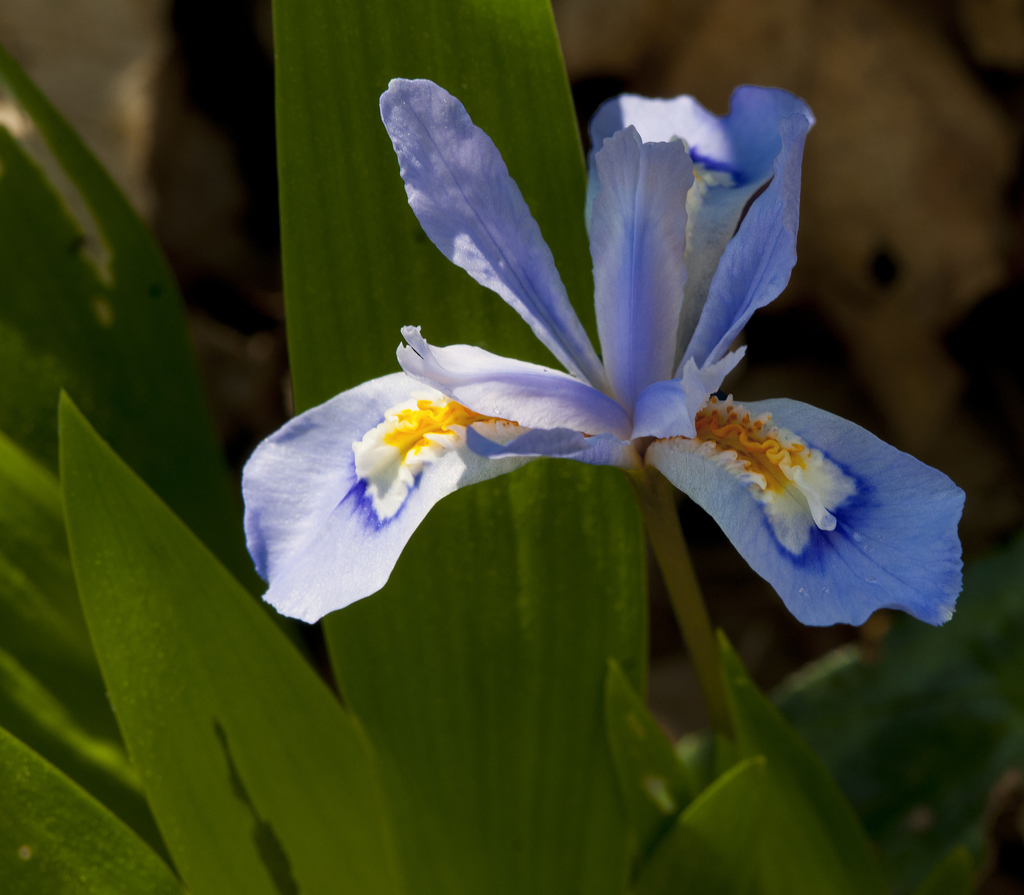
dwarf crested iris
Iris cristata
Iris cristata (also known as dwarf crested iris and crested iris) is a species in the genus Iris, and is part of the subgenus of Limniris. It is a rhizomatous perennial plant, endemic to the eastern United States. It has pale lavender flowers with a white patch and orange or yellow crest. It is a close relative to Iris lacustris (Dwarf lake iris), the only other crested iris native to North America. It is cultivated as an ornamental plant in temperate regions.
From the article Iris cristata on Wikipedia (CC BY-SA), quoted section by section
Description
It has slender, greenish or whitish yellow rhizomes. They are shallow rooted. They spread by sending out long stolons from multiple branches. They can have up to 2–8 cord-like branches. The branches can be 20–30 cm (8–12 in) long and 1–2 mm wide. Under the rhizomes are fleshy-like roots. The branches are brown. The creeping habit can create large masses of plants over time. It has 6–8 basal leaves, which are divided onto 2–3 proximal (close to centre) leaves and 4–5 distal (away from centre) leaves. The proximal leaves are falcate (sickle-shaped), light brown with a darker brown central mid-rib, and the distal leaves are ensiform (sword-like), green or yellowish green, with a few visible veins. They can grow up to between 7.5 and 15 cm (3 and 6 in) long and 1–2.5 cm wide. They elongate after flowering, growing up to 15–40 cm (6–16 in) long. The elongated leaves hide any seed pods produced later. It has short stems, (almost stemless), growing up to between 2.5 and 4.5 cm (1 and 2 in) tall. …
Range & habitat
It is found in northeastern U.S., within the states of Indiana, Ohio, Pennsylvania, and West Virginia. It is also found in north-central U.S., within the states of Illinois, Iowa, Missouri, and Oklahoma. In southeastern U.S., it is found within the states of Alabama, Arkansas, District of Columbia, and Georgia. It is found within the Ouachita Mountains, Allegheny Mountains, Appalachian and Ozark Mountains. The range is south of where the Wisconsinan glaciation spread about 11,000 years ago.
Wikipedia: “Range”
At the table
It has been listed as a medicinal plant. It has been used by the Cherokee North American Indians in herbal medicines. A decoction of the pulverized root was used as salve for ulcers. An infusion (tea) taken for liver. Also a decoction of the root was used to treat a "yellowish urine." The root was also used as an ingredient in a cream applied to skin ulcers. The root has also been used as a spice. In the 19th century, hunters in Virginia used the root, as a thirst aid. It is initially sweet and then the taste of the root becomes pungently acrid. In its native region, it has been marked as a commercially available pollinator plant that attracts bees.
Wikipedia: “Uses”
Toxicity
Like many other irises, most parts of the plant are poisonous (rhizome and leaves), and if mistakenly ingested can cause stomach pains and vomiting. Handling the plant may cause a skin irritation or an allergic reaction, and there is also a risk of dermatitis.
How it is grown
It is hardy to between USDA Zone 3 and Zone 9, and is hardy to European Zone H2, meaning it is hardy down to −20 °C. It prefers to grow in well-drained soils that are neutral or slightly acidic (pH level of 6.1 to 6.5). It also prefers medium to high fertile soils containing humus, although it will tolerate loamy soils. It can tolerate shade or full sun, but prefers cool, semi-shaded positions. It has average to above average water needs during the growing season. It becomes dormant in winter. It can be grown in a mixed flower border, or rock garden. It also can be naturalized, within a woodland garden, creating ground-cover. It can also be grown on peat banks, with other acidic loving plants, including camellias and azaleas. It is normally recommended to add peat (or leaf-mould) and sharp sand (or grit) when planting new plants. The roots are planted (during spring, summer or autumn) so that the top of the rhizome is about 3–5 cm below the soil line. Once planted, they can be surrounded with leaf mulch to help with moisture retention. They can suffer from damage by snails and slugs. They also can suffer damage from deer, but the plants can survive the nibbling, and flowers can also be eaten. Other minor threats include iris borer, verbena bud moth, whiteflies, iris weevil, thrips, aphids, nematodes, bacterial leaf blight and soft rot, crown rot, rhizome rot, leaf spot, rust, …
Wikipedia: “Cultivation”
Where it lives
Recorded sightings
—
geo-referenced records in GBIF, from museums, herbaria and field observers.
Drag the globe to turn it. Dots are where records exist, not a range map; darker means more records.
In the stacks
Searching the stacks…
Every page naming Iris cristata in the Biodiversity Heritage Library →
This page is assembled live from iNaturalist, GBIF, Wikipedia, the Source Library and the Internet Archive. It is not yet part of the hand-edited codex. iNaturalist taxon 82812.