- Animals
- ›Arthropods
- ›Hexapods
- ›Insects
- ›Winged and Once-winged Insects
- ›Beetles
- ›Water, Rove, Scarab, Long-horned, Leaf, and Snout Beetles
- ›Staphyliniform Beetles
- ›Rove, Ant-like stone, and Carrion Beetles
- ›Rove Beetles
- ›Large Rove Beetles
- ›Staphylinini
- ›Staphylinina
- ›Creophilus
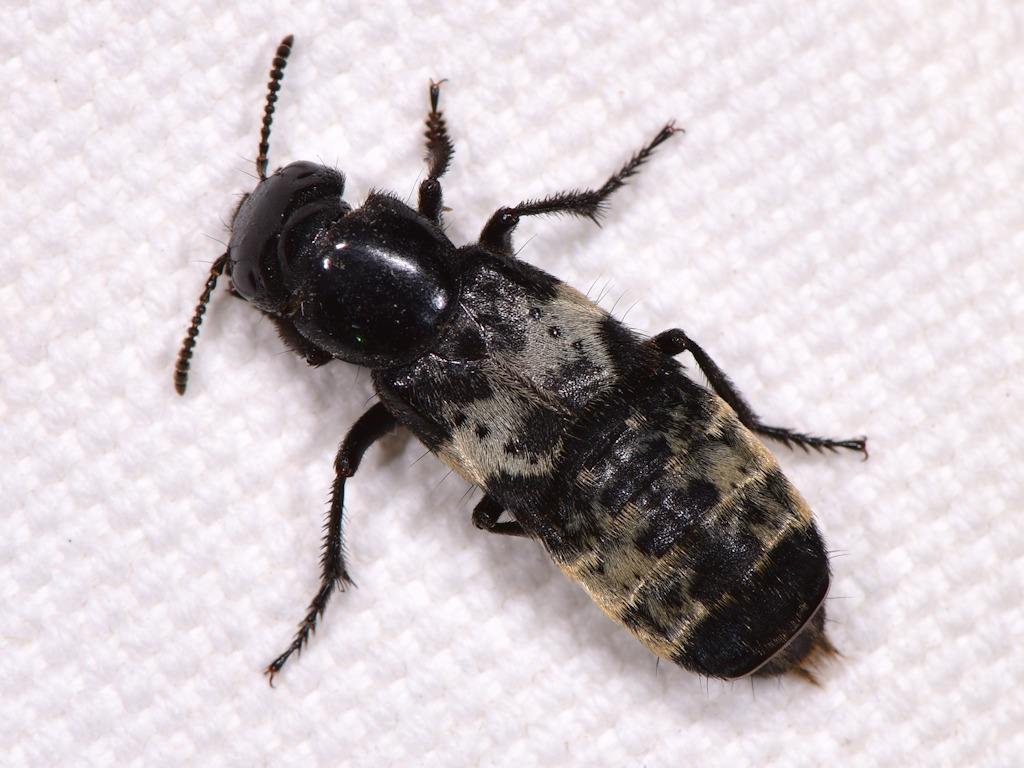
hairy rove beetle
Creophilus maxillosus
Creophilus maxillosus belongs to the order Coleoptera and is most commonly referred to as the hairy rove beetle. The rove beetles are a large family, having almost 2,900 species in North America. This species can be found in woods and wherever carrion is found, usually from the spring to autumn months. These active beetles fly swiftly or run rapidly over the ground with the tip of the abdomen raised like a scorpion's stinger. Although a few...
From the article Creophilus maxillosus on Wikipedia (CC BY-SA), quoted section by section
Range & habitat
These beetles can be found in woods and wherever carrion is found, usually from the spring to autumn months. These active beetles fly swiftly or run rapidly over the ground with the tip of the abdomen raised like a scorpion's stinger. Generally, C. maxillosus are found throughout the eastern U.S. in the fall and spring, but can also be found in the summer. They are usually in wooded habitats such as forest leaf litter, decaying plant material (including fruit), and under dead tree bark. They can also be found in carrion, dung, under stones or rocks, and in fresh water areas in washed-up brown algae.
Wikipedia: “Habitat and geography”
What it does
Larvae of the hairy rove beetle range from 20–25 millimetres (0.79–0.98 in) long and are cylindrical and stout. The adult is a shiny black color and approximately 12–18 mm (0.47–0.71 in) long. They are easily characterized by their elytra, which cover the first few abdominal segments. They have large eyes, and their mandibles close across each other in the front of the head and can inflict a painful stab if harassed or handled carelessly. Golden setae are located on posterior angles of the head and slightly on the anterior angle of the pronotum. These setae can be found on the last few abdominal segments and on elytra. The hairy rove beetle has needle-like jaws that close across in front of head and large, prominent eyes. The antennae are thick, beaded, and composed of 11 segments. The development of eggs is around 4 days, larvae 14 days, and pupae 16 days. The eggs are milky white colored, 2 to 3 mm (0.079 to 0.118 in) long and hatch in about 3 days (depending on temperature). The larval stage lasts around 14 days. The pupae, which is around 11 mm wide lasts 16 days. The estimation of the total duration of Creophilus maxillosus lasts 37 days.
Wikipedia: “Physical characteristics and life cycle”
Listen
Looking for field recordings…
Where it lives
Recorded sightings
—
geo-referenced records in GBIF, from museums, herbaria and field observers.
Drag the globe to turn it. Dots are where records exist, not a range map; darker means more records.
In the stacks
Searching the stacks…
Every page naming Creophilus maxillosus in the Biodiversity Heritage Library →
This page is assembled live from iNaturalist, GBIF, Wikipedia, the Source Library and the Internet Archive. It is not yet part of the hand-edited codex. iNaturalist taxon 82463.