- Animals
- ›Arthropods
- ›Hexapods
- ›Insects
- ›Winged and Once-winged Insects
- ›Dragonflies and Damselflies
- ›Dragonflies
- ›Aeshnoidea
- ›Darners
- ›Aeshna
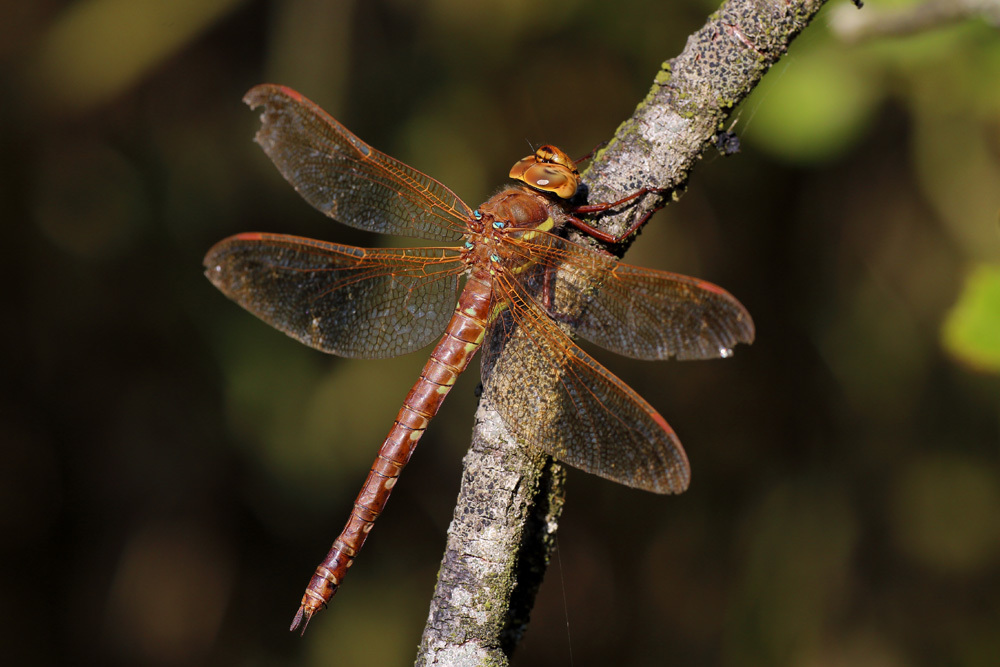
Brown Hawker
Aeshna grandis
The brown hawker (Aeshna grandis) is a large dragonfly about 73 millimetres (2.9 in) long. It is a distinctive species and is easily recognised, even in flight, by its brown body and bronze wings. At rest, blue spots on the second and third segments of the male's abdomen can be noticed; these are absent in female.
From the article Brown hawker on Wikipedia (CC BY-SA), quoted section by section
Description
The brown hawker is a large dragonfly with a body length of 73 mm (2.9 in). The body is brown marked with yellow stripes in the thorax and the wings are tinged brown. The males have small markings of blue and yellow and are noticeably waisted, and the females have small yellow markings. The nymphs are long and streamlined, 40–46 mm (1.6–1.8 in) in length, with banded legs, stripes on the head and thorax, a wide facial mask and a spine on each side of the sixth abdominal segment.
Range & habitat
The brown hawker is found from southern Great Britain and Ireland east through Europe, including much of Fennoscandia into Asia. It is most abundant in central, eastern and northern Europe and extends as far east as the Sakha Republic in Siberia, but it is absent from the Scotland, northern Scandinavia and much of southern Europe. In the north, brown hawkers prefer slow-flowing or standing waters including natural waters such as large pools, lakes, fens and oxbows, as well as man-made waterbodies such as canals, ponds, ditches, reservoirs and peat diggings. It is closely tied to forest or woodland. In the south it is less catholic in its choice of habitats and prefers mature habitats and avoid early succesional habitats.
Wikipedia: “Distribution and habitat”
What it does
The brown hawker lays its eggs in floating or emergent vegetation or timber in standing or slow moving water. It does not typically hunt near water and can be observed hawking in woodland rides late into summer evenings. In Great Britain the main flight period of the brown hawker is between May and September.
Wikipedia: “Behaviour”
Listen
Looking for field recordings…
Where it lives
Recorded sightings
—
geo-referenced records in GBIF, from museums, herbaria and field observers.
Drag the globe to turn it. Dots are where records exist, not a range map; darker means more records.
In the stacks
Searching the stacks…
Every page naming Aeshna grandis in the Biodiversity Heritage Library →
This page is assembled live from iNaturalist, GBIF, Wikipedia, the Source Library and the Internet Archive. It is not yet part of the hand-edited codex. iNaturalist taxon 82106.