- Plants
- ›Vascular Plants
- ›flowering plants
- ›Dicots
- ›Nances, Willows, and Allies
- ›Spurge Family
- ›Euphorbioideae
- ›Euphorbieae
- ›Euphorbiinae
- ›Euphorbia
- ›Chamaesyce
- ›Alectoroctonum
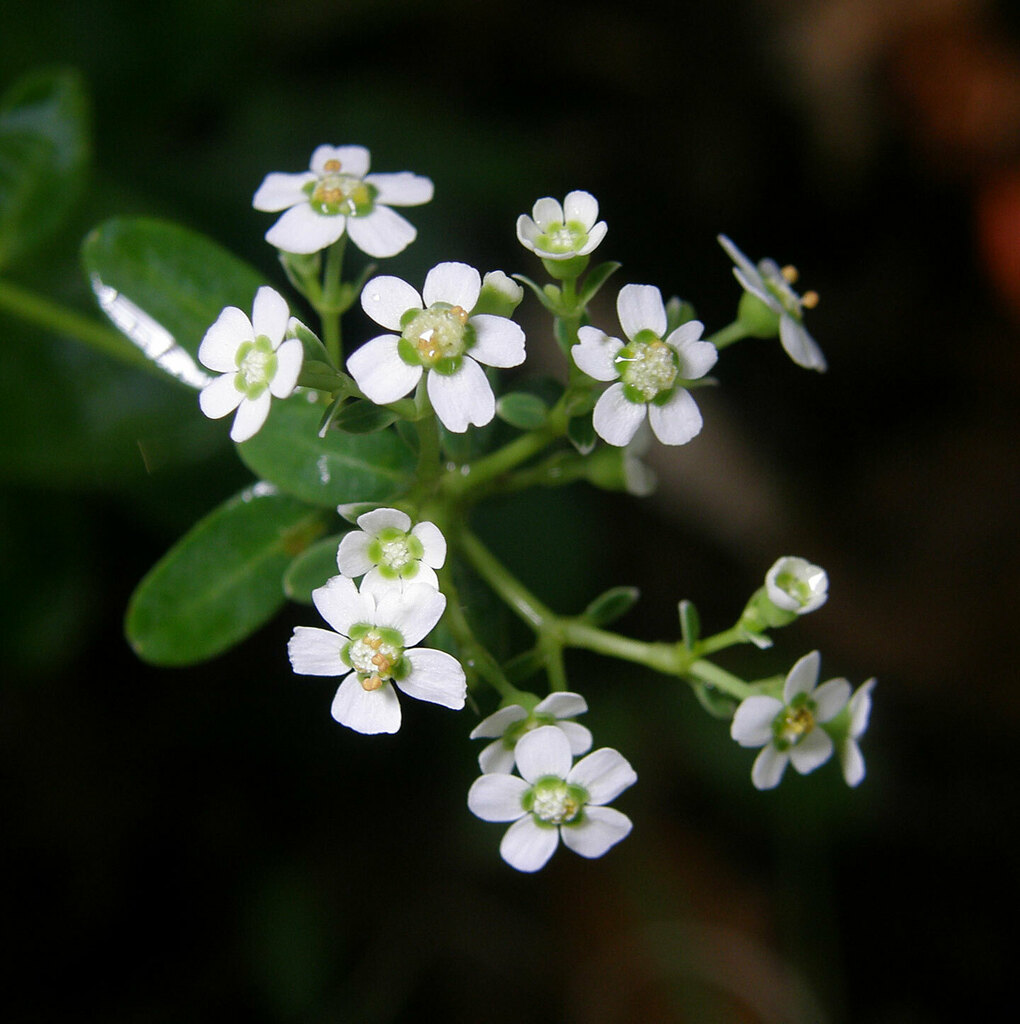
flowering spurge
Euphorbia corollata
Euphorbia corollata is an herbaceous perennial plant in the family Euphorbiaceae that is native to North America. A common name for the species is flowering spurge. It has a milky sap that can cause skin and eye irritation in some people. It grows up to 1 m (3 ft) tall, with smooth stems and light green leaves arranged alternately or in whorls. Leaves are about 10 mm (1/2 in) wide and 75 mm (3 in) long. Each stem terminates in a panicle 20 to 25 mm (3/4 to 1 in) across. Flowers are about 6 mm (1/4 in) across and consist of one pistillate and several staminate flowers surrounded by five white bracts - not petals but formed from the involucre at the base of the flowers. Flowering spurge blooms from June to September.
From the article Euphorbia corollata on Wikipedia (CC BY-SA), quoted section by section
Range & habitat
Flowering spurge grows in most soil types as long as they are well-drained. It is usually found in prairies, pastures, glades, and along roads and train tracks. It has excellent drought tolerance and develops a deep taproot. It is difficult to transplant once established. Flowering spurge is native from Texas north to South Dakota and east to the Atlantic coast.
Wikipedia: “Range and habitat”
At the table
The plant can be used as a laxative, but is poisonous if eaten in quantity.
== References ==
Wikipedia: “Uses”
Where it lives
Recorded sightings
—
geo-referenced records in GBIF, from museums, herbaria and field observers.
Drag the globe to turn it. Dots are where records exist, not a range map; darker means more records.
In the stacks
Searching the stacks…
Every page naming Euphorbia corollata in the Biodiversity Heritage Library →
This page is assembled live from iNaturalist, GBIF, Wikipedia, the Source Library and the Internet Archive. It is not yet part of the hand-edited codex. iNaturalist taxon 81824.