- Plants
- ›Vascular Plants
- ›flowering plants
- ›Dicots
- ›Woodsorrels, Quandongs, and Allies
- ›Woodsorrel Family
- ›Oxalis
- ›Oxalis
- ›Ionoxalis
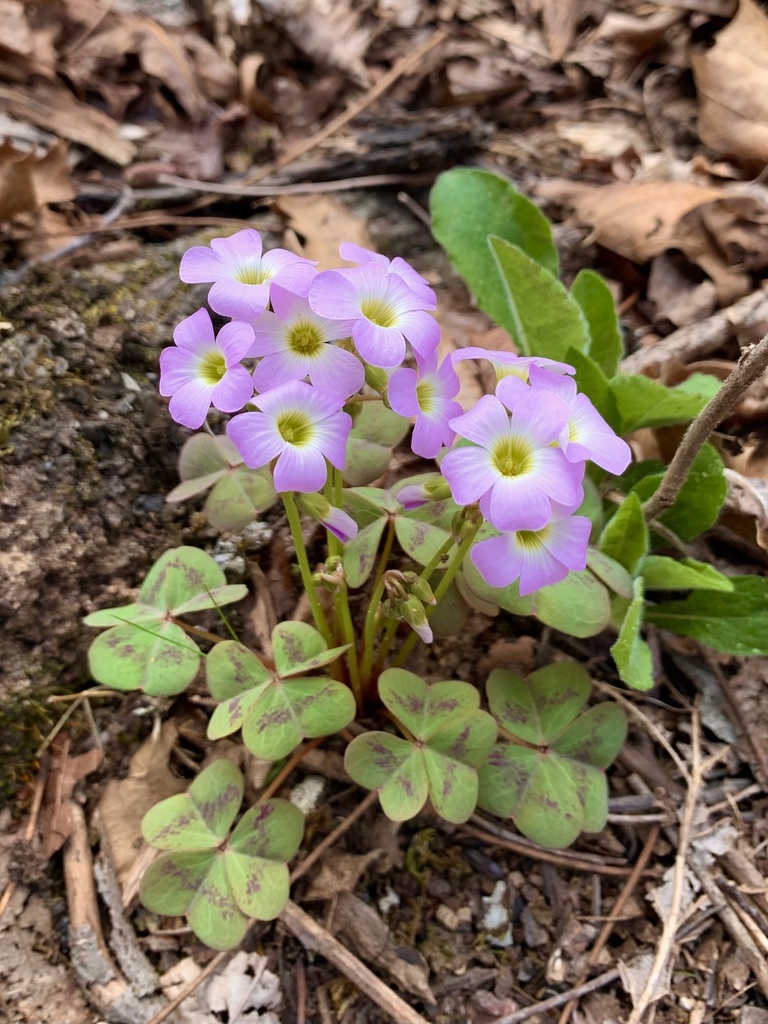
violet woodsorrel
Oxalis violacea
Oxalis violacea, the violet wood-sorrel, is a perennial plant and herb in the Oxalidaceae family. Oxalis species are also known as sour grass, sour trefoil, and shamrock.
From the article Oxalis violacea on Wikipedia (CC BY-SA), quoted section by section
Description
Oxalis violacea emerges in early spring from an underground bulb and produces leaf stems 7–13 cm (2+3⁄4–5 in) tall and flower umbels, or clusters, with up to 19 flowers on stems 9–23 cm (3+1⁄2–9 in) tall. The three-part leaves have heart-shaped leaflets. The plant is similar in appearance to small clovers such as the shamrock. The plant bears lavender to white flowers 1–2 cm (1⁄2–3⁄4 in) wide with white to pale green centers above the foliage, during April or May, rarely to July, and, with rain, sometimes produces additional flowers without leaves from August to October.
Range & habitat
It is native plant in much of the United States, from the Rocky Mountains east to the Atlantic Ocean and Gulf of Mexico coasts, and through Eastern Canada. It has a tendency to cluster in open places in damp woods and on stream banks, and in moist prairies.
Wikipedia: “Distribution and habitat”
At the table
All parts of the plant are edible – flowers, leaves, stems, and bulb. Oxalis is from the Greek word meaning sour, and this plant has a sour juice. It is used in salads. Moderate use of plant is advisable, as it should not be eaten in large quantities due to a high concentration of oxalic acid, ("salt of lemons") which can be poisonous. It was a traditional food source of the Native American Apache, Cherokee, Omaha, Pawnee, and Ponca peoples.
Wikipedia: “Culinary”
In medicine
Oxalis violacea was used as a medicinal plant by Native Americans, including the Cherokee and Pawnee peoples.
Wikipedia: “Medicinal”
How it is grown
Oxalis violacea is cultivated as an ornamental plant, for use as a flowering groundcover or perennial plant in traditional and native plant gardens, and for natural landscaping projects. It spreads rapidly by runners and bulbs. In gardens the plant prefers partial shade and moisture.
Wikipedia: “Cultivation”
In human culture
The genus name, Oxalis, is from the Greek word oxys, which means "sharp" and refers to the sharp or sour taste from the oxalic acid present in the plant. The specific epithet, violacea, is Latin for violet-colored.
Wikipedia: “Etymology”
Where it lives
Recorded sightings
—
geo-referenced records in GBIF, from museums, herbaria and field observers.
Drag the globe to turn it. Dots are where records exist, not a range map; darker means more records.
In the stacks
Searching the stacks…
Every page naming Oxalis violacea in the Biodiversity Heritage Library →
This page is assembled live from iNaturalist, GBIF, Wikipedia, the Source Library and the Internet Archive. It is not yet part of the hand-edited codex. iNaturalist taxon 81796.