- Animals
- ›Arthropods
- ›Hexapods
- ›Insects
- ›Winged and Once-winged Insects
- ›Beetles
- ›Water, Rove, Scarab, Long-horned, Leaf, and Snout Beetles
- ›Staphyliniform Beetles
- ›Rove, Ant-like stone, and Carrion Beetles
- ›Rove Beetles
- ›Burying and Carrion Beetles
- ›Silphini
- ›Necrophila
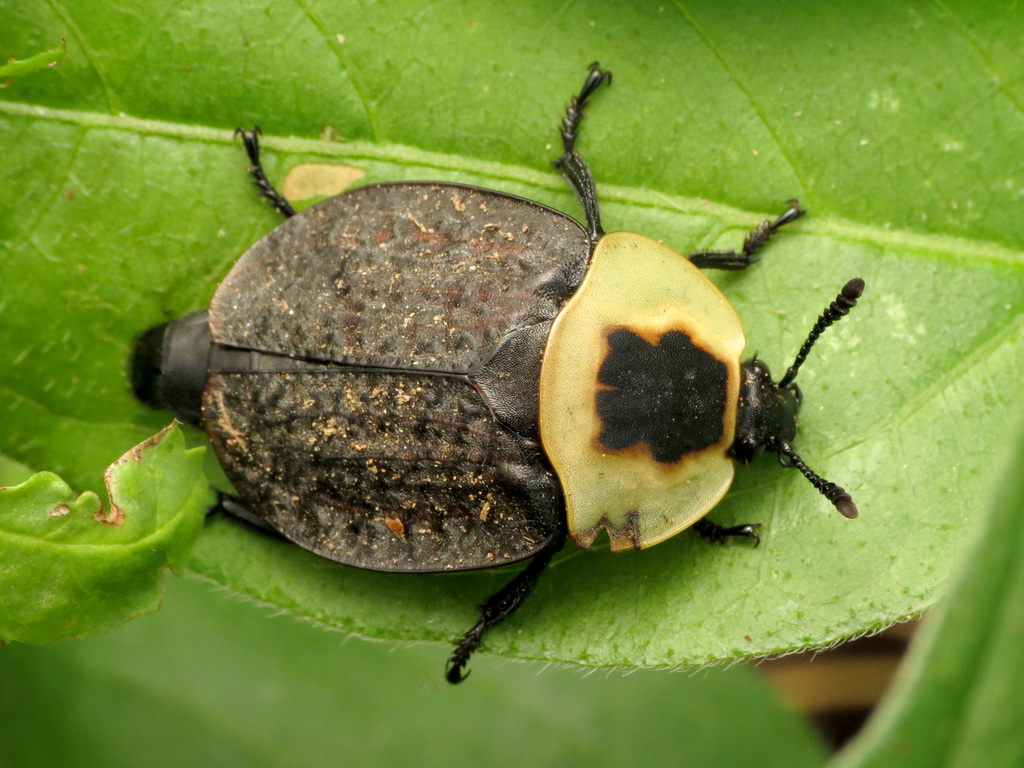
American Carrion Beetle
Necrophila americana
The American carrion beetle (Necrophila americana, formerly Silpha americana) is a North American beetle of the family Silphidae. It lays its eggs in, and its larvae consume, raw flesh (particularly that of dead animals) and fungi. The larvae and adults also consume fly larvae and the larvae of other carrion beetles that compete for the same food sources as their larvae. They prefer to live in marshy and woody habitats. Necrophila americana emerge from their larval state in the early summer. A cuckoo bumble bee, Bombus ashtoni, displays close mimicry with the American carrion beetle. They are important in forensic studies because of their tendency to thrive on large carcasses.
From the article American carrion beetle on Wikipedia (CC BY-SA), quoted section by section
Description
Necrophila americana are distinctive in that they have a relatively large, broadly rounded, and flattened body with a yellow pronotum. It is the only North American silphid with a mostly yellow pronotum, and it is the only species of Necrophila found in North America, as all other species are found in Asia. There is sexual dimorphism, with the males having rounded elytral apices and females having their apices more prolonged. They typically range from 12 to 22 millimeters long. The larvae can be characterized by their black color, two-segmented urogomphi, and the presence of numerous plates on the sensory area of the second antennal segment.
Wikipedia: “Appearance”
Range & habitat
The beetle lives in North America, east of the Rocky Mountains. Its southern boundary is from eastern Texas to Florida and the northern boundary is from Minnesota to southeastern Canada, including New Brunswick and Maine.
Wikipedia: “Range”
What it does
The American carrion beetle has three instar stages, with differing body measurements at each stage. The first stage has a body length ranging from about 10 to 15 millimeters in length, the second stage ranging from 13 to 21 millimeters in length, and the final stage averaging 23 millimeters in length. The life cycle of the beetle is thought to take around 10 to 12 weeks. From spring through fall, during daylight, a few hours after flies begin arriving at a carcass, the adult beetles will arrive as well. They immediately begin eating the already hatching fly larvae, mating, and laying their own eggs. As long as the carcass lasts, the adults will remain eating competitors to give their own larvae a chance to eat and grow. Upon hatching from the eggs, the larvae will eat both the carcass and other larvae that are within it. The fly larvae digest part of the carcass, and the beetle larvae will consume the parts that the fly larvae did not, which typically consists of flesh left on the bones and on the moist inside of the face. Eventually the larvae will fall to the ground, dig into the dirt, and pupate. Adults practice overwintering. The beetle is a ground-dwelling silphid that emerges from its larval state to feed on carcasses in early summer, as its greatest abundance is from June through October. …
Wikipedia: “Life cycle”
At the table
As adults, N. americana can be captured using carcass bait in a pitfall trap. Their appearance has also been documented in a studied site in Indiana multiple times, and they have appeared consistently as their abundance has aligned. They can also be baited using pitfall traps containing isopropanol. While the traps attract other insects, it is possible that these traps simply attract carrion beetles by the volatiles produced by carcasses of other insects. However, this is an unlikely explanation. Rather, isopropanol likely acts as a kairomone since there is no differentiation between the preference from females and males. It is possible that isopropanol is perceived as a chemical produced by decomposing bodies during the bloating stage, which would explain why N. americana is attracted to them.
Resource partitioning. N. americana also practices resource partitioning with other silphids such as Oiceoptoma noveboracense and Thanatophilus lapponicus. These three species are reproductively active at different periods of the year. O. noveboracense is active in the early spring, while T. lapponicus is active late in the summer. This resource partitioning behavior has likely evolved due to limitations in resource availability and must be adapted for rapid reproduction.
Wikipedia: “Food resources”
Listen
Looking for field recordings…
Where it lives
Recorded sightings
—
geo-referenced records in GBIF, from museums, herbaria and field observers.
Drag the globe to turn it. Dots are where records exist, not a range map; darker means more records.
In the stacks
Searching the stacks…
Every page naming Necrophila americana in the Biodiversity Heritage Library →
This page is assembled live from iNaturalist, GBIF, Wikipedia, the Source Library and the Internet Archive. It is not yet part of the hand-edited codex. iNaturalist taxon 81746.