- Animals
- ›Arthropods
- ›Hexapods
- ›Insects
- ›Winged and Once-winged Insects
- ›Butterflies and Moths
- ›Butterflies
- ›Brush-footed Butterflies
- ›Fritillaries and Longwings
- ›Longwings
- ›Heliconius
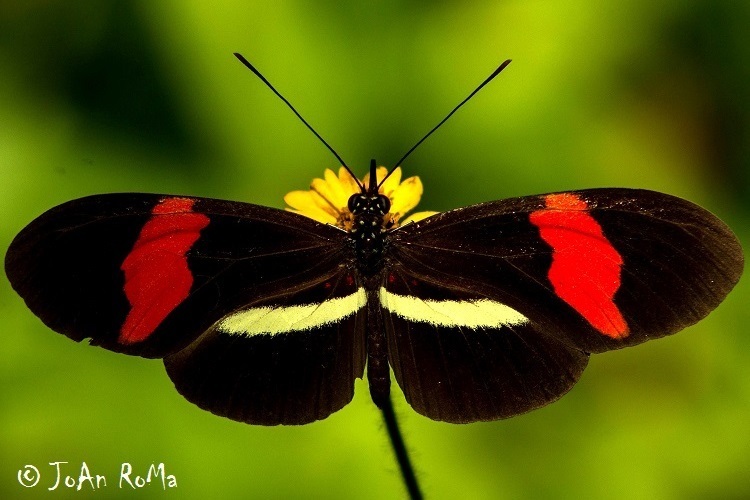
Red Postman
Heliconius erato
Heliconius erato, or the red postman, is one of about 40 neotropical species of butterfly belonging to the genus Heliconius. It is also commonly known as the small postman, the red passion flower butterfly, or the crimson-patched longwing. It was described by Carl Linnaeus in his 1758 10th edition of Systema Naturae.
H. erato exhibits Müllerian mimicry with other Heliconius butterflies such as Heliconius melpomene in order to warn common predators against attacking, which contributes to its surprising longevity. It also has a unique mating ritual involving the transfer of anti-aphrodisiacs from males to females. Its host plants are various passion flower (Passiflora) vine species.
From the article Heliconius erato on Wikipedia (CC BY-SA), quoted section by section
Range & habitat
H. erato is a neotropical species, found from southern Texas to northern Argentina and Paraguay, and resides on the edges of tropical rainforests. It is philopatric, having a particularly restricted home range. In areas of dense population in Trinidad, some home ranges are only separated by 30 yards, but H. erato rarely travels to neighboring home ranges.
Wikipedia: “Habitat and home range”
What it does
The red postman returns to a communal roost every night that contains members of the same species and of other heliconids. The roost is typically situated about 2–10 meters from the ground on twigs and tendrils and is occupied by a small group of butterflies. Adults who have just emerged from the pupa typically roost alone for a few days before roosting with others.
Wikipedia: “Social behavior”
Listen
Looking for field recordings…
Where it lives
Recorded sightings
—
geo-referenced records in GBIF, from museums, herbaria and field observers.
Drag the globe to turn it. Dots are where records exist, not a range map; darker means more records.
In the stacks
Searching the stacks…
Every page naming Heliconius erato in the Biodiversity Heritage Library →
This page is assembled live from iNaturalist, GBIF, Wikipedia, the Source Library and the Internet Archive. It is not yet part of the hand-edited codex. iNaturalist taxon 81744.