- Plants
- ›Vascular Plants
- ›flowering plants
- ›Dicots
- ›myrtles, evening primroses, and allies
- ›myrtle family
- ›Myrtoideae
- ›Melaleuceae
- ›Melaleuca
- ›Melaleuca leucadendra
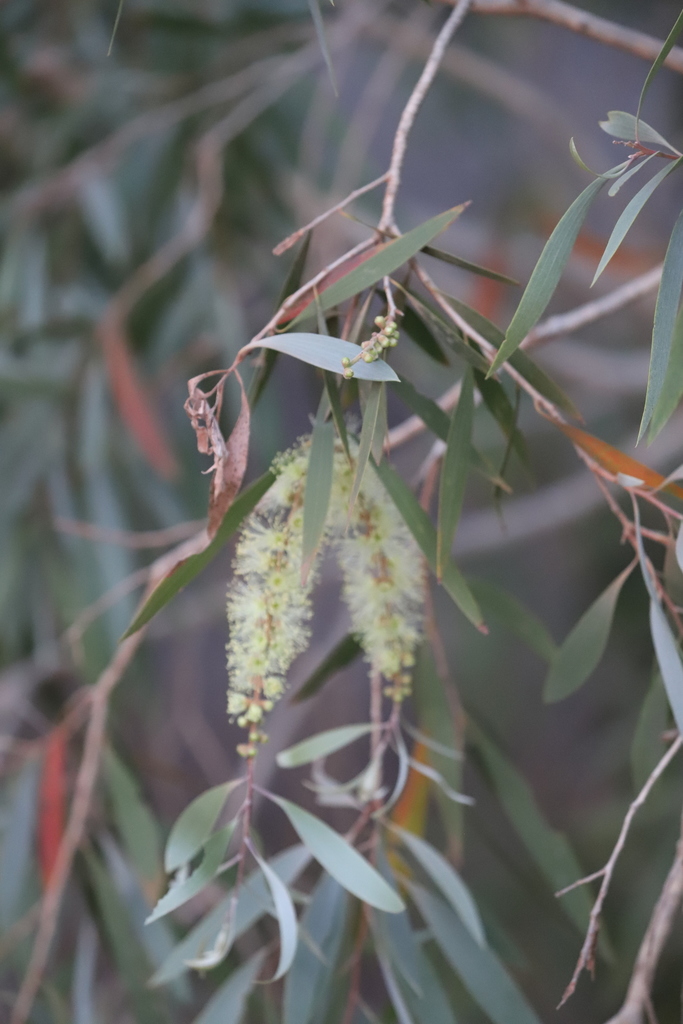
Silver Cajeput
Melaleuca argentea
Melaleuca argentea, commonly known as the silver cadjeput, silver-leaved paperbark, silver cajuput, or mardderr in the Kunwinjku language, is a plant in the myrtle family, Myrtaceae and is endemic to northern Australia. It is a common tree along river banks or around swamps in the tropics. It has papery bark and weeping foliage and has been the subject of important scientific research.
From the article Melaleuca argentea on Wikipedia (CC BY-SA), quoted section by section
Description
Melaleuca argentea is a tree usually to 8 m (30 ft) but sometimes to 20 m (70 ft). The leaves are arranged alternately along the branches and are elliptic, straight or sickle-shaped, 50–130 mm (2–5 in) long, about 7–24 mm (0.3–0.9 in) wide and have 5 to 9 longitudinal veins. Mature leaves are pale, silvery green and the young growth is soft, silvery and covered with silky soft hairs. The leaves are aromatic when crushed. The flowers are arranged in spikes on the ends of branches which continue to grow after flowering, sometimes also in the upper leaf axils. The spikes contain 5 to 20 groups of flowers in threes and are up to 30 mm (1 in) in diameter. The petals are about 3 mm (0.1 in) long and fall off as the flower ages. The stamens are in 5 bundles around the flower with 7 to 9 stamens per bundle. Flowering occurs in most months of the year and is followed by fruit which are woody, cup-shaped to cylindrical capsules, 3–4 mm (0.1–0.2 in) in diameter and loosely spaced along the branches.
Range & habitat
Silver cajuput occurs in the Kimberley district of Western Australia, the Top End of the Northern Territory and north Queensland. Forests of M. argentea occur along swampy drainage lines in similar niches to Melaleuca quinquenervia which they displace in the far northern coastal portions of the wet tropics bioregion.
Wikipedia: “Distribution and habitat”
What it does
The life span of this species has been determined to be greater than 20 years. It first forms seeds at the age of 6–10 years and recovers from fire by regrowing from a lignotuber.
Wikipedia: “Ecology”
How it is grown
This tree described as a "handsome, weeping, silver-leaved tree" is suitable for tropical and sub-tropical areas. It is used as an ornamental tree in Brisbane.
Wikipedia: “Horticulture”
Where it lives
Recorded sightings
—
geo-referenced records in GBIF, from museums, herbaria and field observers.
Drag the globe to turn it. Dots are where records exist, not a range map; darker means more records.
In the stacks
Searching the stacks…
Every page naming Melaleuca argentea in the Biodiversity Heritage Library →
This page is assembled live from iNaturalist, GBIF, Wikipedia, the Source Library and the Internet Archive. It is not yet part of the hand-edited codex. iNaturalist taxon 815988.