- Plants
- ›Vascular Plants
- ›flowering plants
- ›Dicots
- ›Legumes, Milkworts, and Allies
- ›Legumes
- ›Peacock Flower Subfamily
- ›Cassieae
- ›Cassiinae
- ›Senna
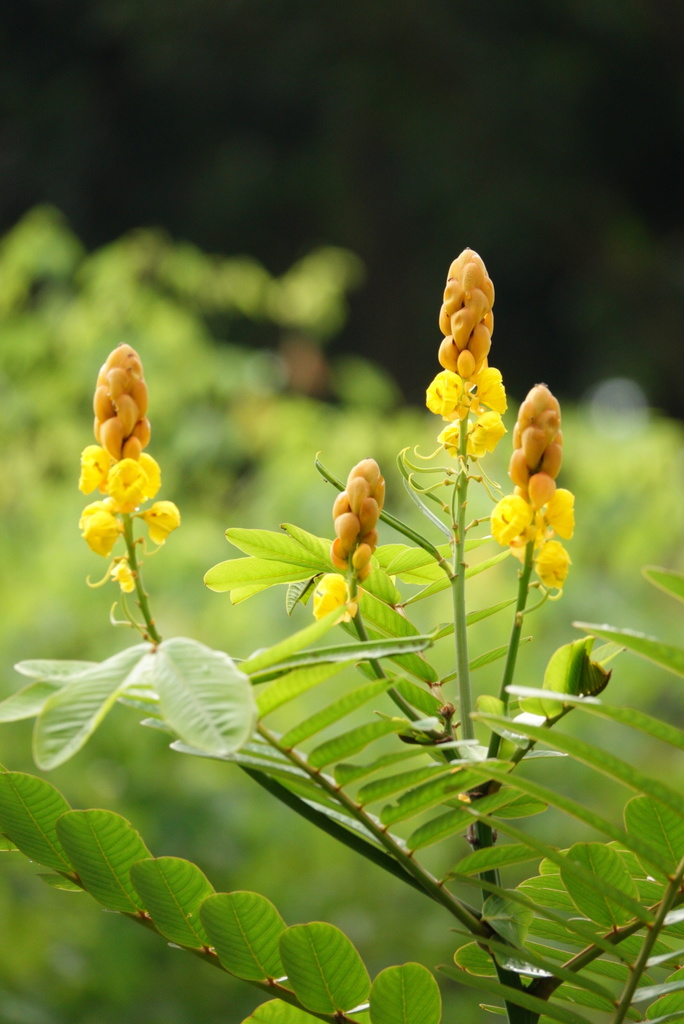
Candelabra Bush
Senna alata
Senna alata is an important Neotropical medicinal tree, as well as an ornamental flowering plant in the subfamily Caesalpinioideae. It also known as emperor's candlesticks, candle bush, candelabra bush, Christmas candles, empress candle plant, ringworm shrub, Roman candle, or candletree. A remarkable species of Senna, it was sometimes separated in its own genus, Herpetica.
From the article Senna alata on Wikipedia (CC BY-SA), quoted section by section
Description
The shrub stands 3–4 metres (9.8–13.1 ft) tall, with leaves 50–80 centimetres (20–31 in) long. The leaves close in the dark. The inflorescence looks like a yellow candle. The fruit, shaped like a straight pod, is up to 25 cm long. Its seeds are distributed by water or animals. The seed pods (fruits) are nearly straight, dark brown or nearly black, about 15 centimetres (5.9 in) long, and 15 millimetres (0.59 in) wide. On both sides of the pods is a wing that runs the length of the pod. A pod contains 50 to 60 flattened, triangular seeds.
Range & habitat
Senna alata is native to most of the Neotropics (from Mexico and the West Indies to Paraguay), and can be found in diverse habitats. In the tropics, it grows up to an altitude of 1,200 metres (3,900 ft). It is brought over to Malesia of the Old World by the Spanish galleon trade in Manila 16th century; however they have been adapted in communities of the southeast Asian, North Australian and African ranges with greater ornamental and medicinal values. It is so naturalized in the Malay Peninsula (known in Malay: gelenggang) that its blooming from mid November-December there has become incorporated in the Kedahan traditional rice planting cycle (piama) as a marker of its beginning dry season.
Wikipedia: “Geographic range”
At the table
Senna alata (also known as Cassia alata) is often called the ringworm bush because of its very effective fungicidal properties, for treating ringworm and other fungal infections of the skin. The leaves are ground in a mortar to obtain a kind of "green cotton wool". This is mixed with the same amount of vegetable oil and rubbed on the affected area two or three times a day. A fresh preparation is made every day. Its active ingredients include the yellow chrysophanic acid. Its laxative effect, due to its anthraquinone content, is also well proven. Senna alata is locally known as akapulko in the Philippines (after the port of Acapulco) where it is used as both an ornamental and medicinal plant due to its laxative, purgative and anti-fungal properties. In Sri Lanka, known as Ath-thora (ඇත්තෝර), it is used as an ingredient in Sinhala traditional medicine. Yoruba of west Africa refer to it as ewe àsùnwòn.
Wikipedia: “Medicinal uses”
How it is grown
This species is easy to grow from the seed. They may either be sown directly or started in a nursery.
Wikipedia: “Cultivation”
Where it lives
Recorded sightings
—
geo-referenced records in GBIF, from museums, herbaria and field observers.
Drag the globe to turn it. Dots are where records exist, not a range map; darker means more records.
In the stacks
Searching the stacks…
Every page naming Senna alata in the Biodiversity Heritage Library →
This page is assembled live from iNaturalist, GBIF, Wikipedia, the Source Library and the Internet Archive. It is not yet part of the hand-edited codex. iNaturalist taxon 81515.