On eBird ↗
Satin Flycatcher
Live sightings near you, the range map, bar charts of when it is seen, and Macaulay Library photos and recordings.
Satin Flycatcher
Myiagra cyanoleuca
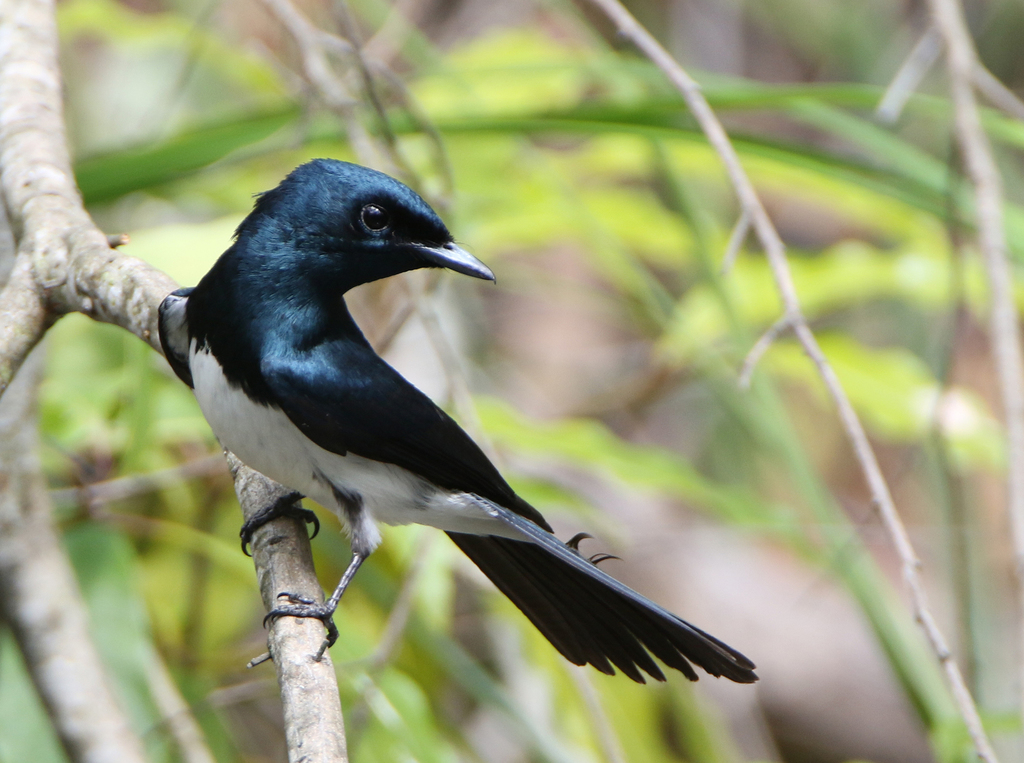
The satin flycatcher (Myiagra cyanoleuca) is a species of bird in the family Monarchidae. Males stand out with their blue-black feathers contrasting their white bellies, and the females with their bright orange throats. It breeds mostly in south-eastern Tasmania and Australia. It is declining throughout the eastern seaboard due to predation from the introduced Red Fox and habitat loss. It is a vagrant to New Zealand.
From the article Satin flycatcher on Wikipedia (CC BY-SA), quoted section by section
Description
The satin flycatcher is a small bird, around 17 cm tall, and weighing around 17g. They have a small, sharp, pointed beak used for catching small invertebrates (insects). The species has sexually dimorphic characteristics; the male birds are a glossy black-blue colour, with a white belly and small crest upon their head, while the females are a dusty brown-grey colour with a bright orange chest and throat, and a white belly. They stand upright, and their tail feathers spread out to form a 'fan' shape.
Range & habitat
The satin flycatcher is most common in south-eastern Australia, where it likes to breed in the warmer months, but will live year-round on the east-coast of Australia in New South Wales, Queensland, and even Papua New Guinea. They also stretch along the southern coast of Australia into South Australia. They are vagrant to New Zealand.
Wikipedia: “Distribution”
Listen
Looking for field recordings…
Where it lives
Recorded sightings
—
geo-referenced records in GBIF, from museums, herbaria and field observers.
Drag the globe to turn it. Dots are where records exist, not a range map; darker means more records.
In the stacks
Searching the stacks…
Every page naming Myiagra cyanoleuca in the Biodiversity Heritage Library →
This page is assembled live from iNaturalist, GBIF, Wikipedia, the Source Library and the Internet Archive. It is not yet part of the hand-edited codex. iNaturalist taxon 8072.