- Plants
- ›Vascular Plants
- ›flowering plants
- ›Dicots
- ›Legumes, Milkworts, and Allies
- ›Legumes
- ›Acacias, Mimosas, Mesquites, and Allies
- ›Mimoseae
- ›Mimosa
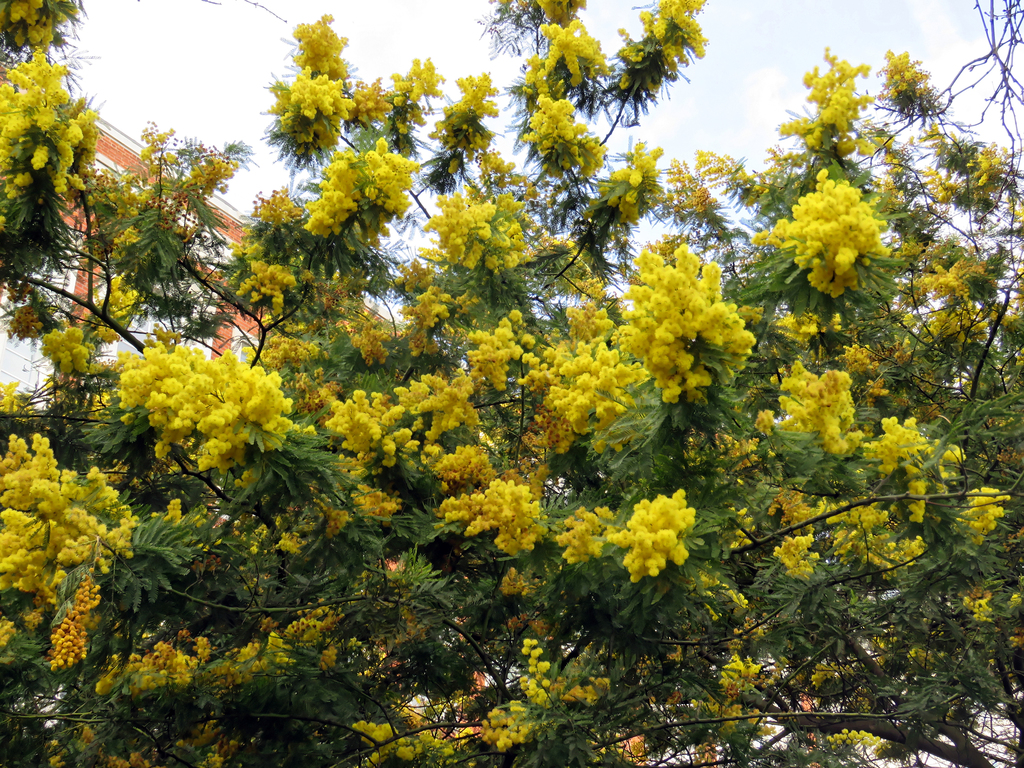
Mimosa scabrella
Mimosa scabrella is a tree in the family Fabaceae. It is very fast-growing and it can reach a height of 15 m (49 ft) tall in only 3 years. Its trunk is about 0.1–0.5 m (3.9–19.7 in) in diameter. It has yellow flowers.
From the article Mimosa scabrella on Wikipedia (CC BY-SA), quoted section by section
At the table
Because of the abundant flowering and presence of honeydew caused by Cochineal infestation in some altitudes the tree has an important place in honey production, especially in Brazil. Its wood is suitable for firewood and can also be used as lumber. Before the advent of the diesel locomotive, M. scabrella wood was grown to fuel railroads in parts of Brazil. The long fibres are used for paper production. In agroforestry M. scabrella shades coffee plants. It is also used in intercropping systems in association with maize and beans. Because M. scabrella is a legume tree it doesn't need fertilization and with the decomposition of the leaves, large amounts of nitrogen become available for other plants. Because M. scabrella has beautiful “feather” leaves, it is often used as an ornamental tree or live fence. Because of its fast growth its often used for reforestation management.
Wikipedia: “Uses”
How it is grown
Mimosa scabrella can be grown at altitudes of 200–2,400 m (660–7,870 ft) with an annual mean temperature between 12 and 23 °C (54 and 73 °F). The annual precipitation should reach from 600 to 3,500 mm (24 to 138 in). The soil should be well drained. Acid soils with pH as low as 4.8 and soils with high aluminum content are tolerated. Waterlogged, compacted or severely degraded soils are not suitable for M. scabrella. Dry periods of up to four months can be tolerated. Mimosa scabrella is susceptible to strong winds. Although M. scabrella is native to Brazil, it is cultivated in many South American, some African and South European countries. In its native range, some 28 species of insects are reported to attack M. scabrella.
Wikipedia: “Cultivation”
Where it lives
Recorded sightings
—
geo-referenced records in GBIF, from museums, herbaria and field observers.
Drag the globe to turn it. Dots are where records exist, not a range map; darker means more records.
In the stacks
Searching the stacks…
Every page naming Mimosa scabrella in the Biodiversity Heritage Library →
This page is assembled live from iNaturalist, GBIF, Wikipedia, the Source Library and the Internet Archive. It is not yet part of the hand-edited codex. iNaturalist taxon 804178.