On eBird ↗
Brown-necked Raven
Live sightings near you, the range map, bar charts of when it is seen, and Macaulay Library photos and recordings.
Brown-necked Raven
Corvus ruficollis
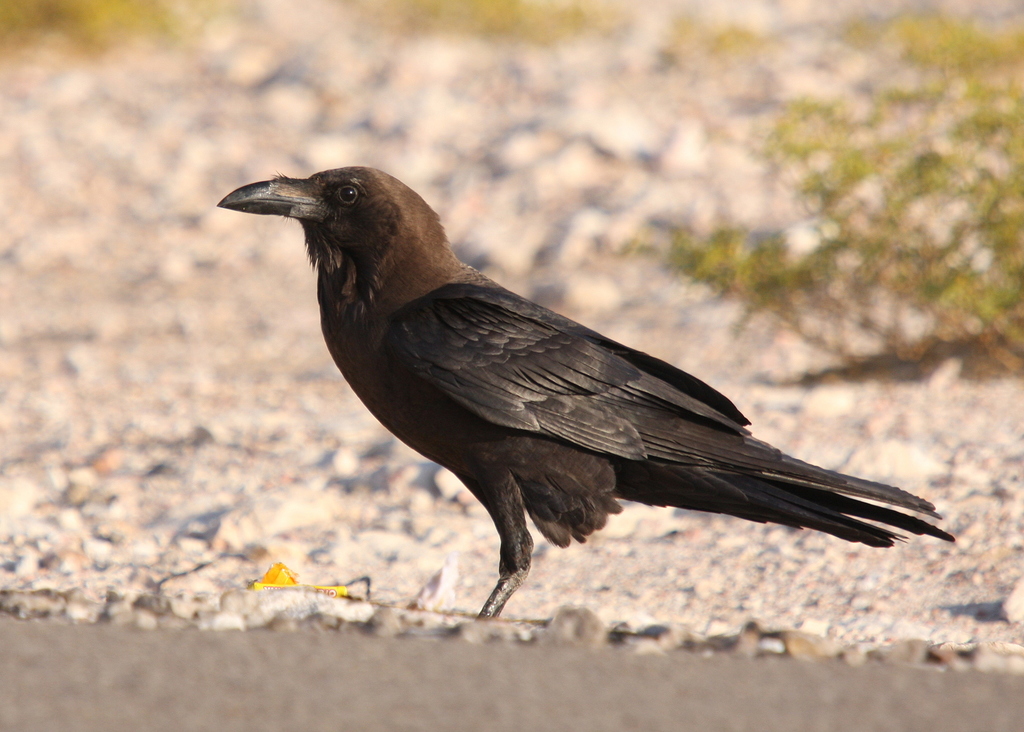
The brown-necked raven (Corvus ruficollis) is a larger bird (52–56 cm in length) than the carrion crow though not as large as the common raven. It has similar proportions to the common raven but the bill is not so large or deep and the wings tend to be a little more pointed in profile. The head and throat are a distinct brownish-black giving the bird its English name, while the rest of the plumage is black glossed with purple, blue or purplish-blue. Like the common raven, thick-billed raven and white-necked raven, it is one of the larger raven species. The feathers of this species often fade quite quickly to a brownish black (even the truly black feathers) and the bird can look distinctly brown by the time it moults. The feet, legs and bill are black. The dwarf raven was formerly considered a subspecies (Corvus ruficollis edithae) but this bird now appears to be closer to the pied crow (C. albus) than this species.
From the article Brown-necked raven on Wikipedia (CC BY-SA), quoted section by section
Range & habitat
This species has a wide range across virtually the whole of North Africa, down as far as Kenya, the Arabian Peninsula and up into the Greater Middle East and southern Iran. It lives in a predominantly desert environment visiting oases and palm groves. Food consists of a wide range of items, including carrion, snakes, locusts and other grasshoppers, stranded fish (in coastal areas), grain stolen from bags, dates and other fruits. It is quite fearless when not persecuted but is quick to become wary and shy if too much attention is paid to it. A 2009 Israeli study showed the species to cooperatively hunt lizards, with birds blocking exits while others hunted.
Wikipedia: “Distribution and habitat”
Listen
Looking for field recordings…
Where it lives
Recorded sightings
—
geo-referenced records in GBIF, from museums, herbaria and field observers.
Drag the globe to turn it. Dots are where records exist, not a range map; darker means more records.
In the stacks
Searching the stacks…
Every page naming Corvus ruficollis in the Biodiversity Heritage Library →
This page is assembled live from iNaturalist, GBIF, Wikipedia, the Source Library and the Internet Archive. It is not yet part of the hand-edited codex. iNaturalist taxon 8034.