On eBird ↗
American Crow
Live sightings near you, the range map, bar charts of when it is seen, and Macaulay Library photos and recordings.
American Crow
Corvus brachyrhynchos
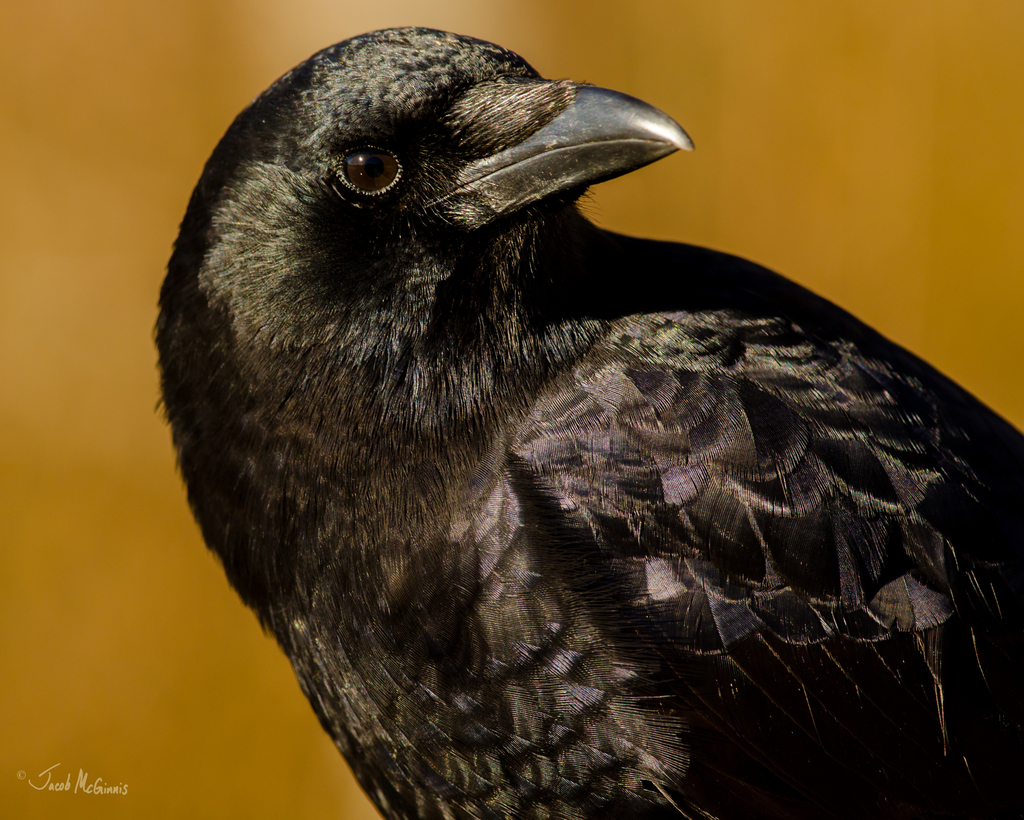
The American crow (Corvus brachyrhynchos) is a large passerine bird species of the family Corvidae. It is a common bird found throughout much of North America, only absent from the tundra biome. The American crow is the New World counterpart to the carrion crow and the hooded crow of Eurasia, occupying similar ecological niches.
The American crow has all-black plumage, with iridescent feathers. It looks similar to other all-black corvids. It is highly intelligent, similar to other Corvidae, and is adaptable to human environments.
From the article American crow on Wikipedia (CC BY-SA), quoted section by section
Description
The American crow is a large, distinctive bird with iridescent black feathers all over. Its legs, feet, and bill are also black. They measure 40–53 cm (16–21 in) in length, of which the tail makes up about 40%. The wing chord is 24.5 to 33 cm (9.6 to 13.0 in), with the wingspan ranging from 85 to 100 cm (33 to 39 in). The bill length can be from 3 to 5.5 cm (1.2 to 2.2 in), varying strongly according to location. The tarsus is 5.5 to 6.5 cm (2.2 to 2.6 in) and the tail is 13.5 to 19 cm (5.3 to 7.5 in). The body mass can vary from 316 to 620 g (11.1 to 21.9 oz). Males tend to be larger than females. The most usual call is a loud, short, and rapid caaw-caaw-caaw. Usually, the birds thrust their heads up and down as they utter this call. American crows can also produce a wide variety of sounds and sometimes mimic noises made by other animals, including other birds, such as barred owls. Visual differentiation from the fish crow (C. ossifragus) is extremely difficult and often inaccurate. Nonetheless, differences apart from size do exist. Fish crows tend to have more slender bills and feet. There may also be a small, sharp hook at the end of the fish crow's upper bill. Fish crows also appear as if they have shorter legs when walking. …
What it does
Studying the behavior of American crows is laborious due to the difficulty in catching them, resulting in much of their behavior, including daily routine, migration, molting, survivorship, age of first breeding, nestling development, and the nature of nesting helpers, being poorly studied.
Diet. The American crow is omnivorous. It will feed on invertebrates of all types, carrion, scraps of human food, fruits, nuts such as walnuts and almonds, seeds, eggs and nestlings, stranded fish on the shore, and various grains. American crows are active hunters and will prey on mice, young rabbits, frogs, and other small animals. In the winter and autumn, the diet of American crows is more dependent on nuts and acorns. Occasionally, they will visit bird feeders. The American crow is one of only a few species of birds that have been observed modifying and using tools to obtain food. Like most crows, they will scavenge at landfills, scattering garbage in the process. Where available, corn, wheat, and other crops are a favorite food. These habits have historically caused the American crow to be considered a nuisance. However, it is suspected that the harm to crops is offset by the service the American crow provides by eating insect pests.
Reproduction. American crows are socially monogamous cooperative breeding birds. …
Wikipedia: “Behavior and ecology”
In human culture
Crows are used as a motif in some human cultures, often associated with death, thieves, graveyards, bad luck, and other negative connotations. American crows are sometimes considered a pest, often due to their loud calls. However, in other cultures, like Native American folklore, crows are considered good luck, noted for their intelligence. Similarly, they are also seen by some neo-pagan and indigenous cultures as signs of good luck or even signs of certain gods, such as Apollo, Odin, and others. Crows are also featured in Aesop's Fables, in stories such as "The Crow and the Pitcher", and "The Fox and the Crow".
Wikipedia: “Role in human cultures”
Listen
Looking for field recordings…
Where it lives
Recorded sightings
—
geo-referenced records in GBIF, from museums, herbaria and field observers.
Drag the globe to turn it. Dots are where records exist, not a range map; darker means more records.
In the stacks
Searching the stacks…
Every page naming Corvus brachyrhynchos in the Biodiversity Heritage Library →
This page is assembled live from iNaturalist, GBIF, Wikipedia, the Source Library and the Internet Archive. It is not yet part of the hand-edited codex. iNaturalist taxon 8021.