- Plants
- ›Vascular Plants
- ›flowering plants
- ›Dicots
- ›Sunflowers, Bellflowers, Fanflowers, and Allies
- ›Sunflowers, Daisies, Asters, and Allies
- ›Asteroideae
- ›asters and allies
- ›Machaerantherinae
- ›Xylorhiza
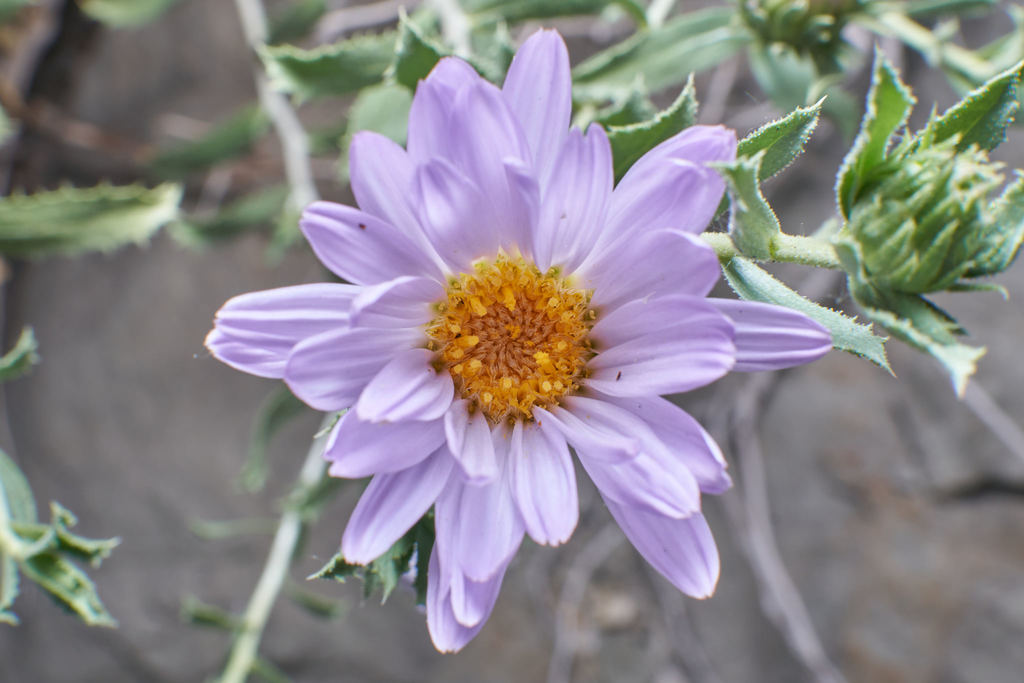
Mecca Woodyaster
Xylorhiza cognata
Xylorhiza cognata is a rare species of flowering plant in the family Asteraceae known by the common names Mecca-aster and Mecca woodyaster.
From the article Xylorhiza cognata on Wikipedia (CC BY-SA), quoted section by section
Description
Xylorhiza cognata is a woody subshrub with branching stems that may approach 1.5 metres (4.9 ft) in height. They are hairy and glandular when new and lose their hairs with age. The leaves are lance-shaped to oval with smooth, toothed, or spiny 'holly-like' edges. The inflorescence is a solitary flower head with up to 30 or more pale lavender to pale violet rays surrounding a yellow central disk. Each petal may measure over 2 centimeters in length. The flowering period is January to June. The fruit is an achene which may be over a centimeter long, including its pappus of bristles.
Conservation. Xylorhiza cognata is a listed Endangered species on the California Native Plant Society Inventory of Rare and Endangered Plants. Threats to this species include recreational off-road and other vehicles, and potential property development projects.
Range & habitat
The shrub is endemic to the Colorado Desert within southern California, in Riverside County and Imperial County. Most known populations are in the Mecca Hills and Indio Hills, located on the southeast side of the Coachella Valley and northeast of the Salton Sea. It grows in arid canyons and bajadas/washes, below 400 metres (1,300 ft) within creosote bush scrub habitats of the Californian and northwestern Colorado Desert sub-region of the Sonoran Desert ecoregion of North America.
Wikipedia: “Distribution”
Where it lives
Recorded sightings
—
geo-referenced records in GBIF, from museums, herbaria and field observers.
Drag the globe to turn it. Dots are where records exist, not a range map; darker means more records.
In the stacks
Searching the stacks…
Every page naming Xylorhiza cognata in the Biodiversity Heritage Library →
This page is assembled live from iNaturalist, GBIF, Wikipedia, the Source Library and the Internet Archive. It is not yet part of the hand-edited codex. iNaturalist taxon 79544.