- Plants
- ›Vascular Plants
- ›flowering plants
- ›Dicots
- ›Mints, Plantains, Olives, and Allies
- ›bladderwort family
- ›Utricularia
- ›Utricularia
- ›Utricularia
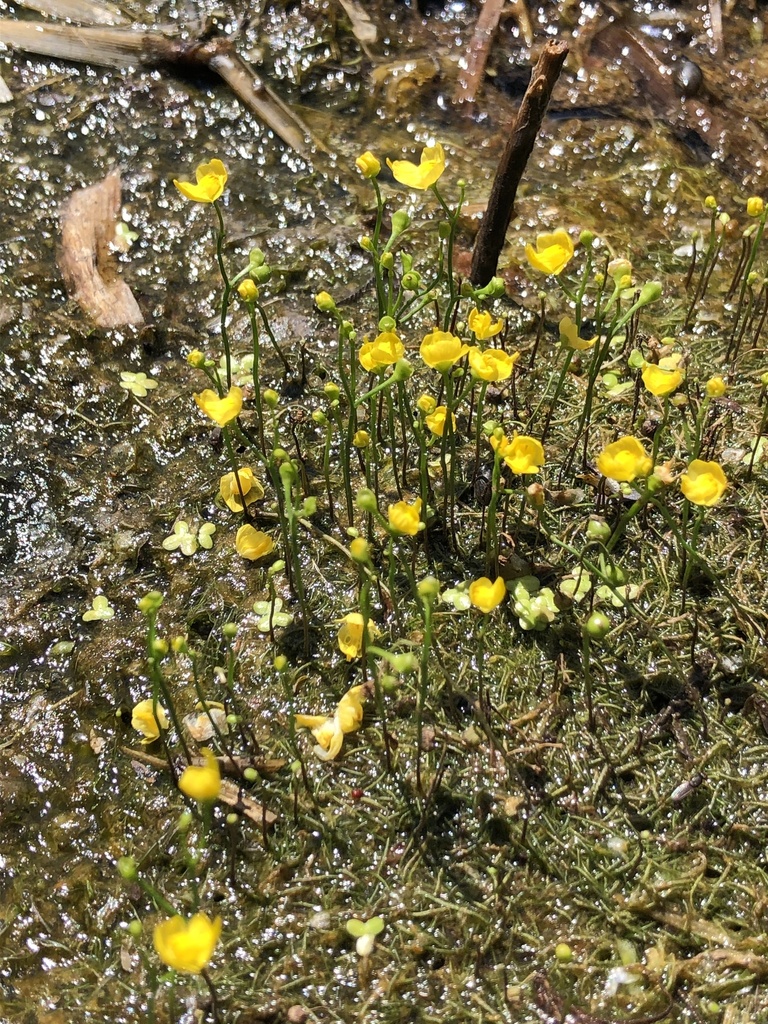
humped bladderwort
Utricularia gibba
Utricularia gibba, commonly known as the humped bladderwort or floating bladderwort, is a small, mat-forming species of carnivorous aquatic bladderwort. It is found on all continents except Antarctica.
U. gibba has an exceptionally small genome for a plant, despite having a typical number of genes. The sequencing of its DNA revealed only 3% repetitive DNA material.
From the article Utricularia gibba on Wikipedia (CC BY-SA), quoted section by section
Description
Utricularia gibba is an aquatic carnivorous plant that belongs to the genus Utricularia, or bladderworts. The specific epithet gibba is Latin for "hump" or "swelling" – a reference to the inflated base of the lower lip of the corolla. It is a small- to medium-sized aquatic plant that can either be affixed to the substrate in shallow water or free-floating in the water column, however it will likely flower more if supported by a substrate beneath shallow water. It forms mats of criss-crossing, branching, thread-like stolons, each growing to approximately 20 cm (8 in) or longer and 0.2–1 mm thick. What are sometime described as leaves or leaf-like organs – the actual distinction is difficult in the reduced morphology – are numerous and scattered along the length of the stolons and are 0.5–1.5 cm (0.2–0.6 in) long with a very short dichotomous branching pattern toward the tip of anywhere from one to eight branches but usually not more than four. The bladder traps take the place of some of these distal branches on the leaf-like structures. The traps are ovoid and are attached to the leaf-like structure by a short stalk; each trap is 1–2.5 mm long and has two primary setiform branched appendages on top and some smaller appendages surrounded the entrance to the trap. …
Range & habitat
Utricularia gibba has a vast geographic range and is native to the eastern United States, southeastern Canada, Central America, the Caribbean, the western Mediterranean, Southern Africa and southern India. It is considered an invasive species in Hawaiʻi, Australia, Japan, Brazil, New Zealand, Singapore, Serbia, Hungary and the United Kingdom. It grows in ponds and lakes or shallow water in ditches, pools, bogs, swamps, and marshes that may be still or slowly flowing. It can sometimes be found growing in deep water but will not flower unless the inflorescences are supported near the surface by living or dead vegetation. The waters in which it grows are typically poor in available phosphorus and nitrogen.
Wikipedia: “Distribution and habitat”
How it is grown
Utricularia gibba has the reputation of being one of the easier aquatic bladderworts to grow, often being described as a weed in cultivation. In his 1998 book The Savage Garden: Cultivating Carnivorous Plants, Peter D'Amato advised that successful cultivation could be achieved with U. gibba floating in a small cup or bowl, within waterlogged peat, or even among the water-filled trays of other plants. It can also easily be grown in aquaria.
Wikipedia: “Cultivation”
Where it lives
Recorded sightings
—
geo-referenced records in GBIF, from museums, herbaria and field observers.
Drag the globe to turn it. Dots are where records exist, not a range map; darker means more records.
In the stacks
Searching the stacks…
Every page naming Utricularia gibba in the Biodiversity Heritage Library →
This page is assembled live from iNaturalist, GBIF, Wikipedia, the Source Library and the Internet Archive. It is not yet part of the hand-edited codex. iNaturalist taxon 79464.