- Plants
- ›Vascular Plants
- ›flowering plants
- ›Dicots
- ›Sunflowers, Bellflowers, Fanflowers, and Allies
- ›Sunflowers, Daisies, Asters, and Allies
- ›Asteroideae
- ›Chamomiles, yarrows, and allies
- ›Anthemidinae
- ›Tripleurospermum
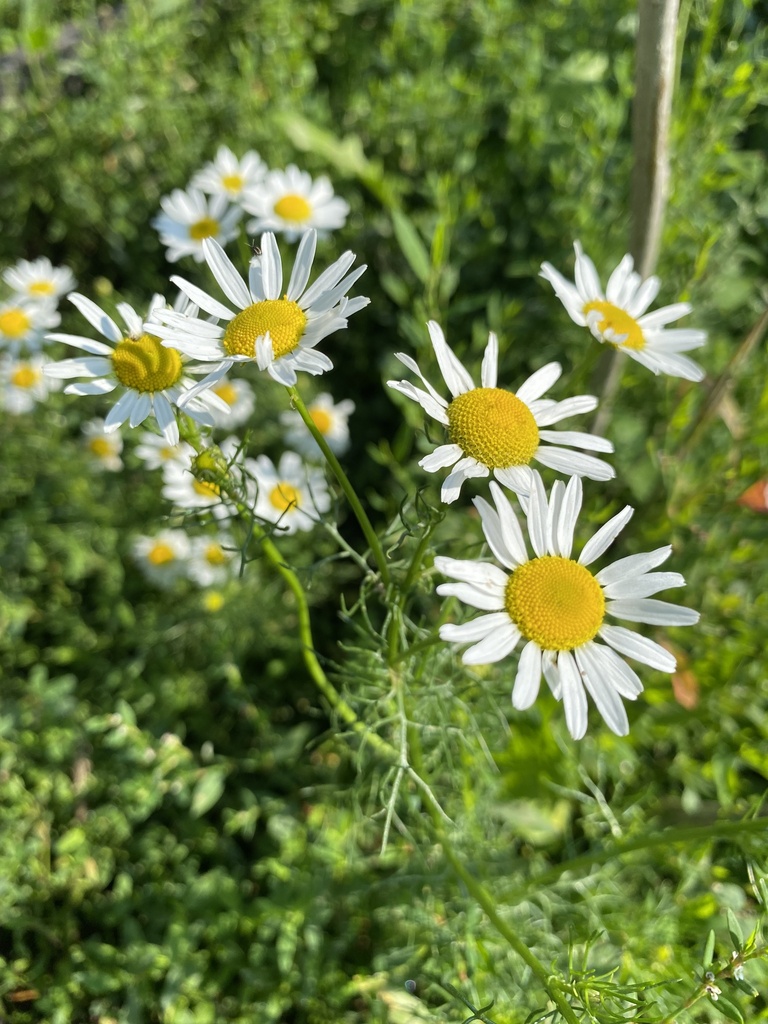
scentless mayweed
Tripleurospermum inodorum
Tripleurospermum inodorum, common names scentless false mayweed, scentless mayweed, scentless chamomile, wild chamomile, mayweed, false chamomile, and Baldr's brow, is the type species of Tripleurospermum. This plant is native to Eurasia and North Africa and is considered an invasive weed in North America.
From the article Tripleurospermum inodorum on Wikipedia (CC BY-SA), quoted section by section
Description
The species may grow to be 20–80 cm (7.9–31.5 in) in height. It is usually 1-stemmed, with the stem erect–ascending, branching, glabrous, green. Stems are single, erect, branched in the upper plant, weakly ridged or lined, hairless though sparsely hairy when young. Leaves are alternate, short-stalked–stalkless. The blade is 2–3 times pinnately lobed (–with leaflets), glabrous, lobes (or leaflets) long, thread-like narrow, sharp-pointed. Leaves are ¾ to 3 inches long, feathery with a few to numerous thread-like branching lobes. The cotyledons are oribicular to oblong, very small, 3 to 5 mm long, and stalkless. Flowers are single flower-like, usually with a 3–5 cm (1.2–2.0 in) capitula, surrounded by involucral bracts. The capitula's ray-florets are white, tongue-like, tip shallowly 3-toothed; disc florets are yellow, tubular, small. Stamens 5. Pistil of 2 fused carpels. Involucral bracts are of different lengths, 1–1.5 mm (0.039–0.059 in) broad, light brown–white margins. Disc is stacked, full. Capitula is 1–20 borne in a corymbose cluster. It flowers from June–October. Pollen is collected by solitary bees. The fruit is a flattish, ridged achene, with 2 round–angular oil spots, tip sometimes with small, membranous ring.
Similar species. Tripleurospermum maritimum (false mayweed) is morphologically similar to T. inodorum. …
What it does
T. inodorum grows in fields, fallow land, lawns, wasteland, roadsides, yards, gardens. It is an annual or short-lived perennial. It is native to Eurasia. Tripleurospermum inodorum has been classified as a noxious weed (class C) in the state of Washington and is considered invasive in other states (it is resistant to some herbicides); it is a weed of cereals in western Canada. According to Canadian regulations, it is classified as Secondary Noxious, Class 3 and Noxious, Class 5 in the Canadian Weed Seeds Order, 2016 under the Seeds Act.
Wikipedia: “Ecology”
In human culture
In Sweden and Norway, it is called Baldr's brow, but in Iceland, it is the close relative sea mayweed (Matricaria maritima) that carries this name. In Gylfaginning, Snorri Sturluson explains that the name Balder's brow comes from the plants' whiteness:
Wikipedia: “Mythology”
Where it lives
Recorded sightings
—
geo-referenced records in GBIF, from museums, herbaria and field observers.
Drag the globe to turn it. Dots are where records exist, not a range map; darker means more records.
In the stacks
Searching the stacks…
Every page naming Tripleurospermum inodorum in the Biodiversity Heritage Library →
This page is assembled live from iNaturalist, GBIF, Wikipedia, the Source Library and the Internet Archive. It is not yet part of the hand-edited codex. iNaturalist taxon 79441.