- Plants
- ›Vascular Plants
- ›flowering plants
- ›Dicots
- ›Sunflowers, Bellflowers, Fanflowers, and Allies
- ›Sunflowers, Daisies, Asters, and Allies
- ›Famatinanthoideae
- ›Famatinantheae
- ›Famatinanthus
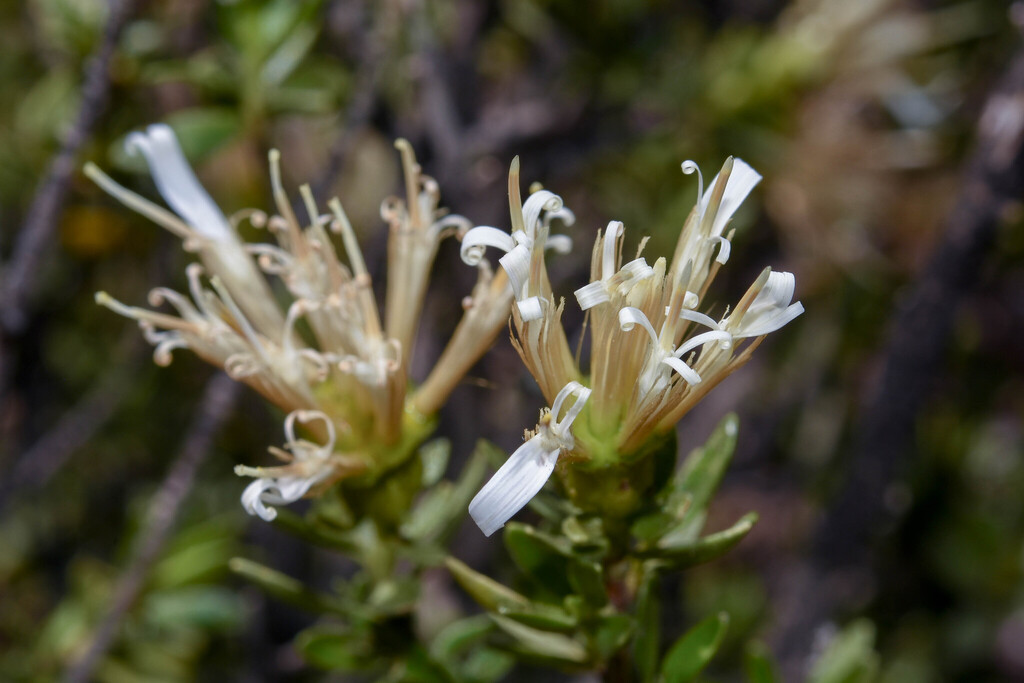
Famatinanthus decussatus
Famatinanthus is a genus in the family Asteraceae that was described in 2014 and has been assigned to its own tribe Famatinantheae and subfamily Famatinanthoideae. It contains only one known species, F. decussatus, a small shrub of 0.5–1.8 m (1 ft 8 in – 5 ft 11 in) high that is an endemic of the Andes of north-western Argentina, with small, entire, oppositely set leaves and flowerheads containing about ten cream-colored, ray and disk florets, with backward coiled lobes. It is locally known as sacansa. For more than 100 years, the species was known to science only from the type collection. It was described in 1885 and originally assigned to the genus Aphyllocladus.
From the article Famatinanthus on Wikipedia (CC BY-SA), quoted section by section
Description
Famatinanthus is a long-lived, xerophitic, thornless shrub of 0.5–1.8 m (1 ft 8 in – 5 ft 11 in) high. Flowers can be found from December to February. It has fifty four chromosomes (2n=54), probably developed through multiplication of a base set of nine (n=9).
Stems and leaves. In the field, the stems are blackish in colour and look powdery. They are circular in cross section, unribbed and without secretory cavities, with side-branches approximately perpendicular to the main branch. Leaves remain attached when fully grown and are oppositely set along the branches. The leaves are leathery, have no petiole, are oval to elongated reversed egg-shaped, with the base narrowing gradually to the main vein but clasping the stem at the foot, with entire margins, a pointy tip, and its veins branching pinnately. The leaves have peculiar stomata that are raised by the surrounding tissue and hide a large chamber underneath. There are also sparse, sunken, reversed egg-shaped glandular hairs of about 50 μm high, on both surfaces of the leaf consisting of about 5 flat cells, arranged like a pile of pancakes, these excrete essential oils, and appear as dots to the naked eye. Both sides of the leaf surface further sprout sparse, erect, multi-storied T-shaped hairs of about 150 μm long. …
Range & habitat
Famatinanthus decussatus is endemic to the Sierra del Famatina, a side chain of the Andes in the La Rioja Province in northwest Argentina.
Wikipedia: “Distribution”
What it does
The plant occurs at altitudes between 1800 and 2700 m. It grows between sparse vegetation, with cacti, and other open shrubs such as Larrea divaricata, Flourensia hirta and Gochnatia glutinosa. The blackish and powdery surface of the branches as can be seen in the field, is the result of the mycelia and spores of a sooty mold belonging to the Dothideomycetidae. Some florets were seen that had filaments but lacked anthers, indicating that insects may eat the anthers.
Wikipedia: “Ecology”
In human culture
The authors derive the generic name Famatinanthus from the Sierra de Famatina, where the type species can be found. Although the authors do not discuss the rest of the name, the Greek word ἄνθος (anthos) meaning "flower", is used as part of many other botanical names. The same in true for the species epithet decussatus, which is Latin, and means "crossed", and has been used in many different taxa to indicate that the leaves are arranged along the stem in opposite pairs, at right angles to those above or below them.
Wikipedia: “Etymology”
Where it lives
Recorded sightings
—
geo-referenced records in GBIF, from museums, herbaria and field observers.
Drag the globe to turn it. Dots are where records exist, not a range map; darker means more records.
In the stacks
Searching the stacks…
Every page naming Famatinanthus decussatus in the Biodiversity Heritage Library →
This page is assembled live from iNaturalist, GBIF, Wikipedia, the Source Library and the Internet Archive. It is not yet part of the hand-edited codex. iNaturalist taxon 793896.