- Plants
- ›Vascular Plants
- ›flowering plants
- ›Dicots
- ›Sunflowers, Bellflowers, Fanflowers, and Allies
- ›bellflower family
- ›bellflower subfamily
- ›Campanula
- ›Campanula rotundifolia
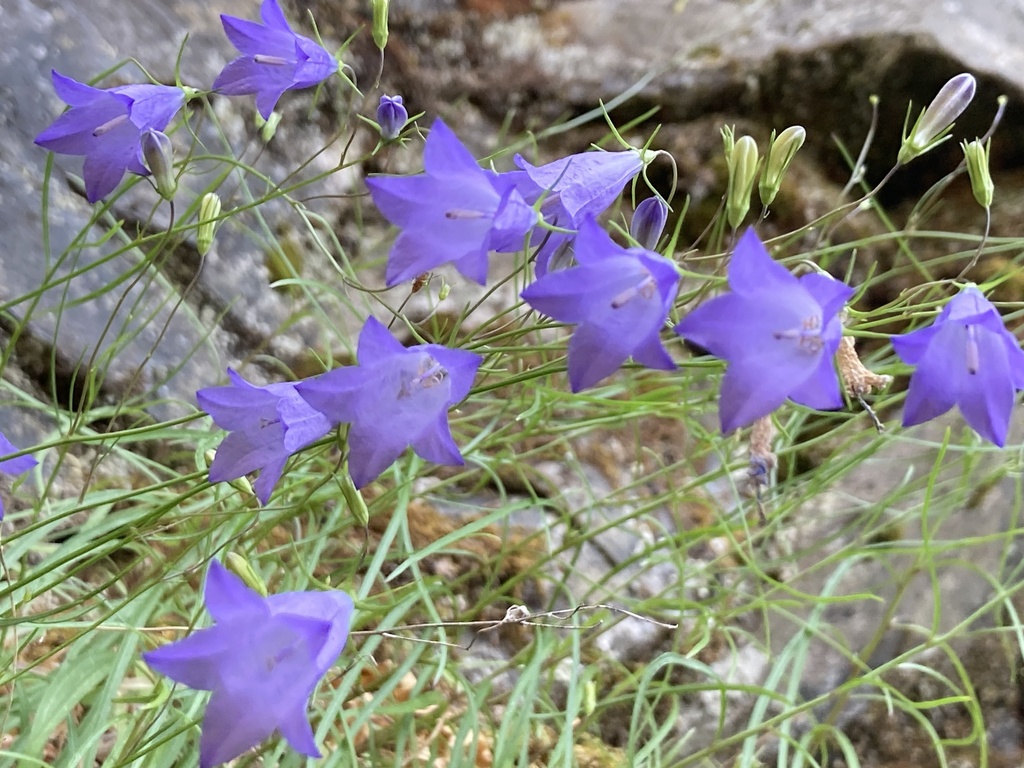
western harebell
Campanula petiolata
Campanula petiolata is a flowering plant that is called western harebell when it is distinguished from Campanula rotundifolia or simply harebell when it is considered the same species. It is in the bellflower family (Campanulaceae). This herbaceous perennial is found in areas of western North America with continental climates. It produces violet-blue, bell-shaped flowers in late summer and autumn. It is closely related to Campanula rotundifolia and is considered either a subspecies or the same species by many botanists.
From the article Campanula petiolata on Wikipedia (CC BY-SA), quoted section by section
Description
Campanula petiolata is a slender, prostrate to erect herbaceous perennial 10–50 centimeters tall when fully developed. The leaves at the base of the plant (basal leaves) are round to egg shaped (ovate) in shape, mostly toothed, and usually disappear before the plants flower. The basal leaves are more often ovate than round. The leaves on the lower stem are slightly widened in the middle to resembling a skinny lance point (lanceolate) with saw toothed edges (serrate). The upper leaves are reduced to being long and thin like a grass blade (linear) or just slightly lanceolate. Due to the drier habitats of North America the foliage is firmer than that of Campanula rotundifolia. The leaf surfaces are usually smooth, but are rarely slightly rough in texture with fine hairs (scabrous-pubescent). The flowering stems are usually smooth, but when hairy the very small hairs cover the stem completely rather than being confined to lines on the stem. The stems tend to be more upright (strict) than Campanula rotundifolia. The inflorescence is a panicle or raceme, with 1 to many flowers borne on very slender pedicels. The flowers are a bell shape with five points from the five sepals fused together (5-cleft calyx). The flower is sometimes broader than it is long. The flowers are usually a pale lavender to dawn blue in color. …
Range & habitat
Plants of the world online records Campanula petiolata as growing in the far north of Canada in Nunavut and the Yukon southwards to the United States west of the Dakotas, Colorado, and Texas. The southern limit of its range extends into north east of Mexico. In the Pacific Northwest they are unevenly distributed from sea level to approximately 1900 meters in elevation. In the Southern Rocky Mountains they are often found on grassy hillsides, in lodgepole pine forests, along road cuts in montane ecosystems from the foothills to the timberline. In northern Mexico it grows in three states, Chihuahua, Coahuila, and Nuevo León. Campanula petiolata will grow in relatively dry areas in the mountains or in medium (mesic) soils, but require well drained gravely or sandy soils if conditions have more moisture.
Wikipedia: “Habitat and range”
What it does
The leaf-cutter bee species Megachile melanophaea has been collected from the flowers of Campanula petiolata at least once. It is one of the few plants that will continue to bloom in the high mountain parks of Colorado into the summer from mid July to August.
Wikipedia: “Ecology”
How it is grown
The western harebell is rhizomatous, forming a clump of plants and tends to have more of this character when growing in sunny conditions.
== References ==
Wikipedia: “Cultivation”
Where it lives
Recorded sightings
—
geo-referenced records in GBIF, from museums, herbaria and field observers.
Drag the globe to turn it. Dots are where records exist, not a range map; darker means more records.
In the stacks
Searching the stacks…
Every page naming Campanula petiolata in the Biodiversity Heritage Library →
This page is assembled live from iNaturalist, GBIF, Wikipedia, the Source Library and the Internet Archive. It is not yet part of the hand-edited codex. iNaturalist taxon 793756.