- Plants
- ›Vascular Plants
- ›flowering plants
- ›Dicots
- ›myrtles, evening primroses, and allies
- ›bushwillow family
- ›Terminalia
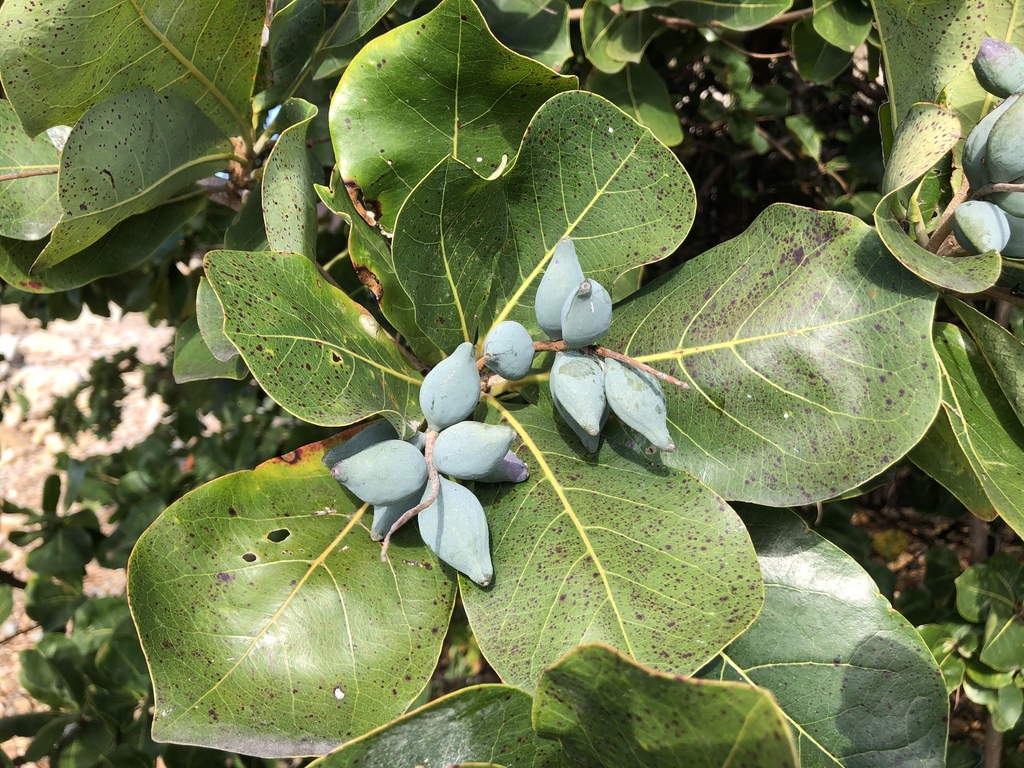
Terminalia arenicola
Terminalia arenicola, commonly known as beach almond or brown damson, is a tree in the family Combretaceae which is endemic to Queensland in Australia.
From the article Terminalia arenicola on Wikipedia (CC BY-SA), quoted section by section
Description
Terminalia arenicola is a small to medium-sized tree growing to around 10 m (33 ft) high, the trunk is grey and tessellated, branches are often sympodial. The leaves are obovate, discolorous, spirally arranged and clustered towards the ends of the branches. They may be up to 22 cm (8.7 in) long and 14 cm (5.5 in) wide. Domatia are usually present, as well as glands on the leaf underside near the junction with the petiole. The inflorescence is an axillary spike or raceme, which carries numerous pentamerous white or cream flowers measuring about 7 mm (0.28 in) diameter. The flowers near the base of the spike are bisexual whilst those near the apex are male. The fruit is a drupe, at maturity measuring up to 40 mm (1.6 in) long, 25 mm (0.98 in) wide and 18 mm (0.71 in) high, with a short "beak" at the distal end. They are initially glaucous blue/green, becoming dark purple or red at maturity. This species is very similar to Terminalia catappa, but is generally smaller in most respects.
Phenology. The brown damson is semi-deciduous and may be bare for a brief period in the spring (Sep-Oct). Flowering occurs from September to May and the fruit may ripen at any time of the year.
Range & habitat
The brown damson is found in coastal forests in close proximity to beaches, often co-occurring with T. catappa and T. muelleri. The longitudinal range is stated in Flora of Australia as being from 16°S (i.e. in the vicinity of the Bloomfield River) to 20°S (near Bowen), while Byrnes' paper defines the range as being from 22°S (near Airlie Beach) northwards, with no northern limit declared.
Wikipedia: “Distribution and habitat”
How it is grown
This species, along with T.catappa, has been widely planted in coastal cities of northeast Queensland, on beaches and in streets and parks, as it provides good shade and beautification of these areas.
Wikipedia: “Cultivation”
In human culture
The species epithet arenicola is from the Latin harēna, 'sand', and -cola, 'inhabitant', which refers to the beach habitat that is favoured by this tree.
Wikipedia: “Etymology”
Where it lives
Recorded sightings
—
geo-referenced records in GBIF, from museums, herbaria and field observers.
Drag the globe to turn it. Dots are where records exist, not a range map; darker means more records.
In the stacks
Searching the stacks…
Every page naming Terminalia arenicola in the Biodiversity Heritage Library →
This page is assembled live from iNaturalist, GBIF, Wikipedia, the Source Library and the Internet Archive. It is not yet part of the hand-edited codex. iNaturalist taxon 793726.