On eBird ↗
Green Iora
Live sightings near you, the range map, bar charts of when it is seen, and Macaulay Library photos and recordings.
Green Iora
Aegithina viridissima
The green iora (Aegithina viridissima) is a species of bird in the family Aegithinidae. It is found in the Thai-Malay Peninsula, Sumatra and Borneo. Its habitats include lowland forests, secondary forest and mangrove forest. It is threatened by habitat loss, and the International Union for Conservation of Nature (IUCN) has assessed it as near-threatened.
From the article Green iora on Wikipedia (CC BY-SA), quoted section by section
Description
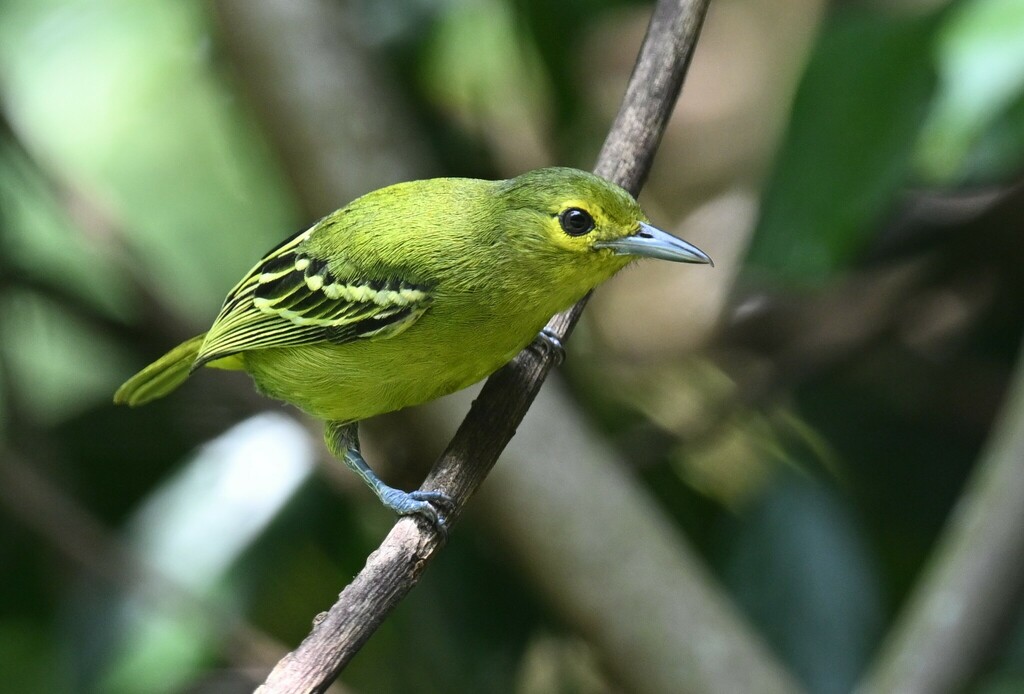
The green iora is 12–14 cm (4.7–5.5 in) long. The male has black lores and bright yellow "eyelids" (a broken eye-ring). The face and upperparts are dark olive. The wings are black, with two white wing-bars on the covert feathers and olive-yellow margins on the flight feathers. The underparts are also dark olive, with lighter flanks and a yellow centre belly. The tail is black. The eyes are dark to red brown, the beak is grey-blue, and the feet are slaty blue. The female has yellow lores and a complete eye-ring. The upperparts and tail are medium olive. The wings are similar to those of the male but are washed olive, and the wing-bars are yellow instead. The underparts are olive green, with a yellow tint on the centre belly. The juvenile bird is similar to the female, but is paler.
Range & habitat
This species is found in Tenasserim, the Thai-Malay Peninsula, Sumatra, Borneo and some small neighbouring islands, and it is locally extinct in Singapore. It lives in the canopy of lowland forests up to 820 m (2,690 ft) in elevation, and is also found in tall secondary forest, peat swamp forest and mangrove forest.
Wikipedia: “Distribution and habitat”
What it does
This iora often occurs in pairs or small groups. It feeds on invertebrates, regularly joining mixed-species foraging flocks. The contact call is a whining, descending ji-sheur or ji-wier, and a ji-jirijiri-jeh mating call has been recorded. The green iora is usually sociable, but intense fighting has also been observed. Breeding has been recorded in April and May. The cup-shaped nest is built on a tree 8–12 m (26–39 ft) above the ground. Both the male and female incubate the eggs, and nestlings are brooded in rainy weather. Moulting has been recorded in July and August.
Wikipedia: “Behaviour”
Listen
Looking for field recordings…
Where it lives
Recorded sightings
—
geo-referenced records in GBIF, from museums, herbaria and field observers.
Drag the globe to turn it. Dots are where records exist, not a range map; darker means more records.
In the stacks
Searching the stacks…
Every page naming Aegithina viridissima in the Biodiversity Heritage Library →
This page is assembled live from iNaturalist, GBIF, Wikipedia, the Source Library and the Internet Archive. It is not yet part of the hand-edited codex. iNaturalist taxon 7937.