- Plants
- ›Vascular Plants
- ›flowering plants
- ›Dicots
- ›Mustards, Capers, and Allies
- ›mustard family
- ›Brassicoideae
- ›Brassicodae
- ›Thlaspideae
- ›Thlaspi
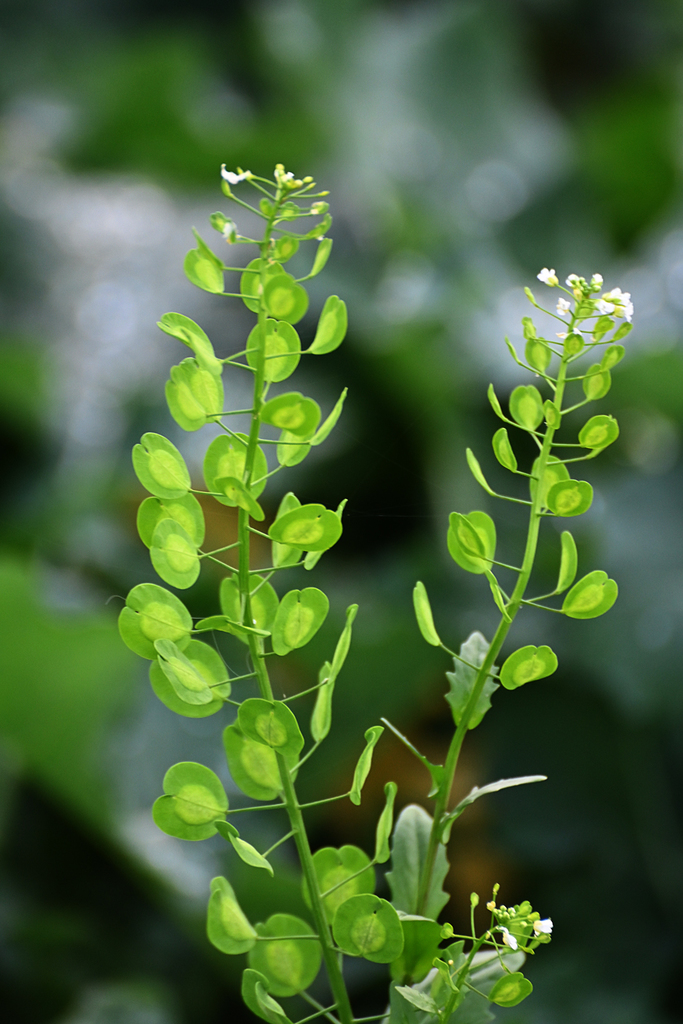
field penny-cress
Thlaspi arvense
Thlaspi arvense, known by the common name field pennycress, is a flowering plant in the cabbage family Brassicaceae. It is native to Eurasia, and is a common weed throughout much of North America and its home.
From the article Thlaspi arvense on Wikipedia (CC BY-SA), quoted section by section
Description
Thlaspi arvense is a foetid, hairless annual plant, growing up to 60 cm (24 in) tall, with upright branches. The stem leaves are arrow-shaped, narrow and toothed. It blooms between May and July, with racemes or spikes of small white flowers that have 4 sepals and 4 longer petals. Later it has round, flat, winged pods with a deep apical notch, measuring 1 cm (0.39 in) across. They contain small brown-black seeds. The common name 'pennycress' is derived from the shape of the seeds looking like an old English penny. Other English common names are: stinkweed, bastard cress, fanweed, field pennycress, frenchweed and mithridate mustard. Pennycress is an annual, overwintering herb with an unpleasant odor when its leaves are squeezed. It grows up to 40 to 80 cm depending on environmental conditions. White, lavender or pink flowers with four petals develop between five and eight seeds. Numbers of chromosomes is 2x. Pennycress, has flat and circular notched pods. Its seeds have a high oil content and the species has gained interest as a potential feedstock for biofuel production.
Range & habitat
The field pennycress is native to the temperate regions of Eurasia, in many of which it is an archaeophyte (an ancient introduction). It has been naturalised to North America, and so can be regarded as having a circumpolar distribution. It is found throughout Europe (it is missing from Iceland, the Faroese and Svalbard, relatively rarer in the Arctic and the Mediterranean mainlands, and absent from Portugal and the Mediterranean islands). Its area then extends through the Greater Caucasus, the Armenian Highlands, northwestern Iran, Kazakhstan, southern Siberia and up to the Pacific coast of Khabarovsk and Primorsky Krai, the Altai, Tian Shan and Pamir mountains, Korea and the Japanese Archipelago, all but the southeasternmost provinces of China, the mountains in the north of South Asia (in parts of Nepal at 2000–4600 m, in Indian Jammu and Kashmir and Ladakh, in Pakistan's Chitral, Hazara, Kurram Valley, and as far south as Rawalpindi District), and Ethiopia. It has also been introduced to Australia and the Americas. In the northern parts of the United States, its habitats include cropland, fallow fields, areas along roadsides and railroads, gardens plots, weedy meadows, and waste areas. This plant prefers disturbed areas, and its capacity to invade higher quality natural habitats is low.
Wikipedia: “Distribution”
What it does
Field pennycress is a weed of cultivated land and wasteland. A study in Germany indicates that a pennycress-corn double-cropping system improves spider diversity to a larger degree than mustard-corn, green fallow-corn and bare fallow-corn double cropping systems. The addition of pennycress to a corn rotation also increased and stabilized ground beetle diversity more effectively than a mustard (Sinapis alba)–corn rotation, a green fallow–corn rotation, or a bare fallow–corn rotation. This was mainly due to the evenness of plant cover throughout the growing season. Therefore, Bioenergy from double-cropped pennycress may support ground beetle diversity. Pennycress can be utilized as part of a comprehensive integrated weed management strategy. Fall establishment can provide early spring ground cover and suppress aggressive spring germinating weeds such as common lambsquarters (Chenopodium album), giant ragweed (Ambrosia trifida), and tall waterhemp (Amaranthus tuberculatus). Johnson et al. (2015) speculated that weed suppression may have been caused by allelopathic compounds rather than ground cover when pennycress seeding rates and companion crops were taken into account.
Wikipedia: “Ecology”
At the table
The field pennycress has a bitter taste; it is usually parboiled to remove the bitter taste. This is mostly used in salads, sometimes in sandwich spreads. It is said to have a distinctive flavour.
Wikipedia: “Food”
Where it lives
Recorded sightings
—
geo-referenced records in GBIF, from museums, herbaria and field observers.
Drag the globe to turn it. Dots are where records exist, not a range map; darker means more records.
In the old herbals & bestiaries

In the stacks
Searching the stacks…
Every page naming Thlaspi arvense in the Biodiversity Heritage Library →
This page is assembled live from iNaturalist, GBIF, Wikipedia, the Source Library and the Internet Archive. It is not yet part of the hand-edited codex. iNaturalist taxon 79358.