- Animals
- ›Chordates
- ›Vertebrates
- ›Birds
- ›Perching Birds
- ›Ovenbirds and Woodcreepers
- ›Typical Ovenbirds
- ›Cranioleuca
On eBird ↗
Line-cheeked Spinetail
Live sightings near you, the range map, bar charts of when it is seen, and Macaulay Library photos and recordings.
Line-cheeked Spinetail
Cranioleuca antisiensis
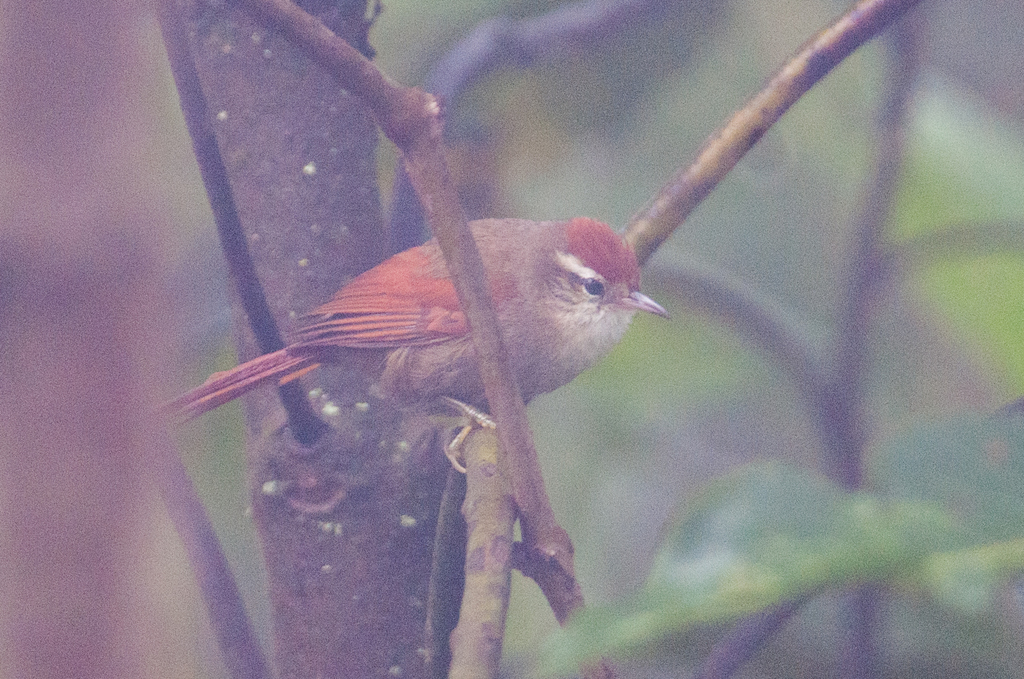
The line-cheeked spinetail (Cranioleuca antisiensis) is an arboreal species of bird in the ovenbird family Furnariidae. It is a common species in the Andes in Ecuador and Peru. Its natural habitat is subtropical or tropical moist montane forests, woodland and scrub. It is distinguished from other species by its distribution, behaviour and white supercilium. There are two recognized subspecies, which are in reality a gradient in morphology and plumage from one extreme to the other.
The IUCN Red List conservation status is rated as Least Concern, as the line-cheeked spinetail is common along its range and is presumably stable. However, since it is arboreal, the line-cheeked spinetail is vulnerable to deforestation. Yet, it is relatively tolerant to human disturbance and does well in successional vegetation.
From the article Line-cheeked spinetail on Wikipedia (CC BY-SA), quoted section by section
Description
The line-cheeked spinetail is a mid-sized spinetail, weighing 15–18 g and reaching 14.5 cm long. Like other spinetails in the genus Cranioleuca, it has a long graduated tail and a relatively long bill that curves downward slightly. It has a rufous crown; with a well-defined white supercilium; a pale throat; and some streaking on its ear coverts. It is brown to olive-grey above; with a greyish brown breast and belly; and rufous tail and wings. The line-cheeked spinetail is a diurnal species and vocalizes most actively at dawn and dusk to maintain their breeding territory boundaries. It is often seen singing alone in branches near the top of trees. Its calls are a variation of chippering and scolding, including a "tsi-chik". The song is a series of loud shrills, usually ending in a trill before fading. Both adults and juveniles respond strongly to playback of songs, suggesting aggression between individuals within the species. Although the distribution of the line-cheeked spinetail does not overlap with other Cranioleuca, it may be found in the same areas as the ash-browed spinetail (C. curtata) in montane valleys. However, the ash-browed spinetail has a less visible grey supercilium and tends to forage higher up in the canopy. The line-cheeked spinetail may also be confused with the red-faced spinetail (C. erythrops), especially the juveniles, which have a buff supercilium. …
Range & habitat
The line-cheeked spinetail occupies a clinal distribution along the western slope of the Andes in south-west Ecuador and western Peru. A published observation of a breeding pair in Mashpi Protected Forest suggests that their distribution may extend further north in Ecuador than previously thought. However, more observations would be needed to confirm this. The tree-line along the western slope of the Andes occurs around 3000m, which is also the highest elevation that line-cheeked spinetails occur. In Ecuador, line-cheeked spinetails can occupy elevations as low as 800m, whereas it is limited to 2000m is the more arid regions of its Peru range. Its habitat ranges from semi-humid to humid montane scrub forest and forest edges. However, it prefers habitat less humid than "cloud forests". Line-cheeked spinetails occur primarily where there is dense evergreen vegetation, and are not found in deciduous and arid habitats.
Wikipedia: “Distribution and habitat”
What it does
Line-cheeked spinetails defend relatively small territories as a family group. These groups often consist of 2–4 adults and 1–2 juveniles. They are also sometimes seen in mixed flocks.
Breeding. Little is known about the courtship of line-cheeked spinetails; however, they are assumed to be socially monogamous. Nests are formed around February and March, and two eggs are laid. Nests are usually large and oval shaped, built at the ends of branches. A nest in north-west Ecuador was described as a domed structure built on the underside of a palm leaf. The exterior was constructed out of moss, cucurbitaceous vine and covered in the hairy seeds of a Bombacaceae, while the interior was built with palm fibres, Lauraceae leaves and lines with epiphyte rootlets. Incubation and parental care have not been described, although fledglings are observed by August.
Diet. As with other species within the family Furnariidae, line-cheeked spinetails are insectivores, although their exact diet has not yet been studied. They glean primarily near the ground and within shrubs. However, their status as an understory bird is questioned, as they will often move up in the canopy to forage.
== References ==
Wikipedia: “Behaviour”
Listen
Looking for field recordings…
Where it lives
Recorded sightings
—
geo-referenced records in GBIF, from museums, herbaria and field observers.
Drag the globe to turn it. Dots are where records exist, not a range map; darker means more records.
In the stacks
Searching the stacks…
Every page naming Cranioleuca antisiensis in the Biodiversity Heritage Library →
This page is assembled live from iNaturalist, GBIF, Wikipedia, the Source Library and the Internet Archive. It is not yet part of the hand-edited codex. iNaturalist taxon 793464.