- Plants
- ›Vascular Plants
- ›flowering plants
- ›monocots
- ›Agaves, Orchids, Irises, and Allies
- ›Orchids
- ›Orchidoid Orchids
- ›Diurideae
- ›Diuridinae
- ›Diuris
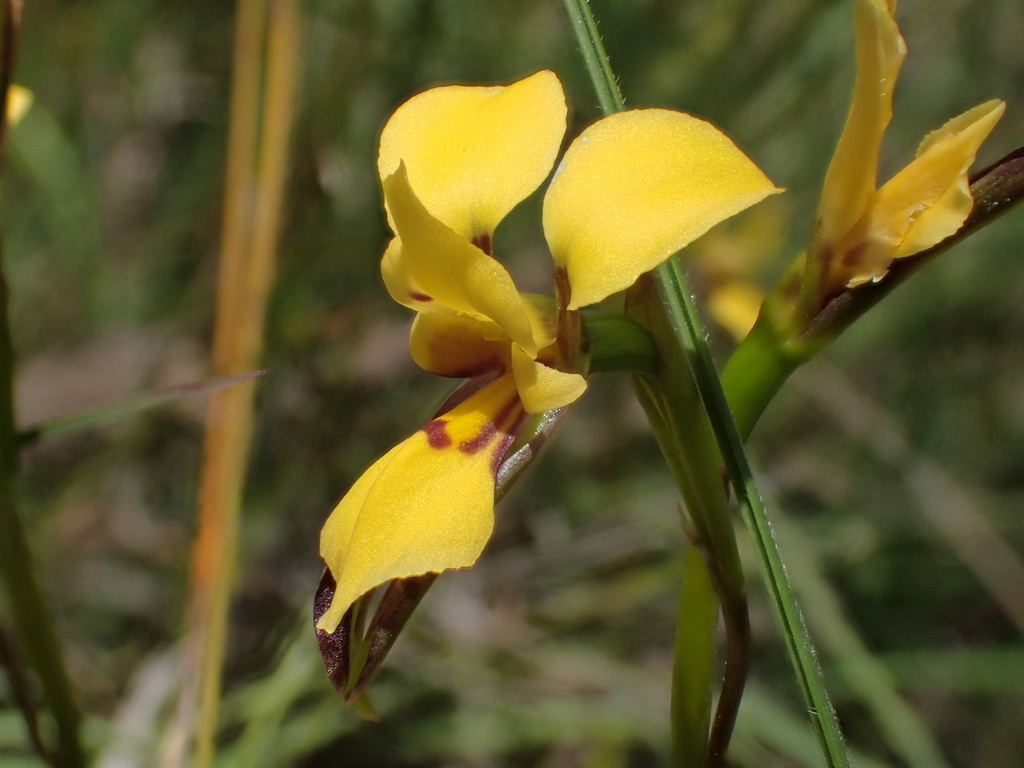
short-leaved donkey orchid
Diuris brevifolia
Diuris brevifolia, commonly known as the short-leaved donkey orchid, is a species of orchid which is endemic to South Australia. It has a few narrow, twisted leaves and a flowering stem with up to five bright yellow flowers with brown markings and relatively large, spreading lobes on the labellum. This is a relatively late-flowering species of donkey orchid.
From the article Diuris brevifolia on Wikipedia (CC BY-SA), quoted section by section
Description
Diuris brevifolia is a tuberous, perennial herb with between four and eight, often twisted leaves which are 70–120 mm (3–5 in) long and 3–4 mm (0.1–0.2 in) wide. Up to five bright yellow flowers 15–20 mm (0.6–0.8 in) wide are borne on a flowering stem 150–400 mm (6–20 in) tall. There are two brown spots on the base of the dorsal sepal and the labellum callus is outlined in brown. The dorsal sepal is erect or bent upwards, 12–15 mm (0.5–0.6 in) long, 6–7 mm (0.2–0.3 in) wide. The lateral sepals are greenish, linear to lance-shaped, 13–16 mm (0.5–0.6 in) long, 3–4 mm (0.1–0.2 in) wide and turn downwards, more or less parallel to each other. The petals are erect or curved backwards, have a dark brown stalk 4–6 mm (0.16–0.24 in) long with a blade 9–11 mm (0.35–0.43 in) long and 6–7 mm (0.2–0.3 in) wide. The labellum is egg-shaped, 12–15 mm (0.5–0.6 in) long and 7–8 mm (0.28–0.31 in) wide with side lobes 5–6 mm (0.20–0.24 in) long and about 3 mm (0.1 in) wide. There are two parallel ridge-like calli about 6–7 mm (0.2–0.3 in) long near the mid-line of the labellum. Flowering occurs from October to December.
Range & habitat
The short-leaved donkey orchid grows in a variety of habitats including heath, forest and woodland but is most common around the edges of swamps and river flats. It only occurs to the south of Adelaide and on Kangaroo Island.
Wikipedia: “Distribution and habitat”
Where it lives
Recorded sightings
—
geo-referenced records in GBIF, from museums, herbaria and field observers.
Drag the globe to turn it. Dots are where records exist, not a range map; darker means more records.
In the stacks
Searching the stacks…
Every page naming Diuris brevifolia in the Biodiversity Heritage Library →
This page is assembled live from iNaturalist, GBIF, Wikipedia, the Source Library and the Internet Archive. It is not yet part of the hand-edited codex. iNaturalist taxon 792282.