On eBird ↗
Rufous Whistler
Live sightings near you, the range map, bar charts of when it is seen, and Macaulay Library photos and recordings.
Rufous Whistler
Pachycephala rufiventris
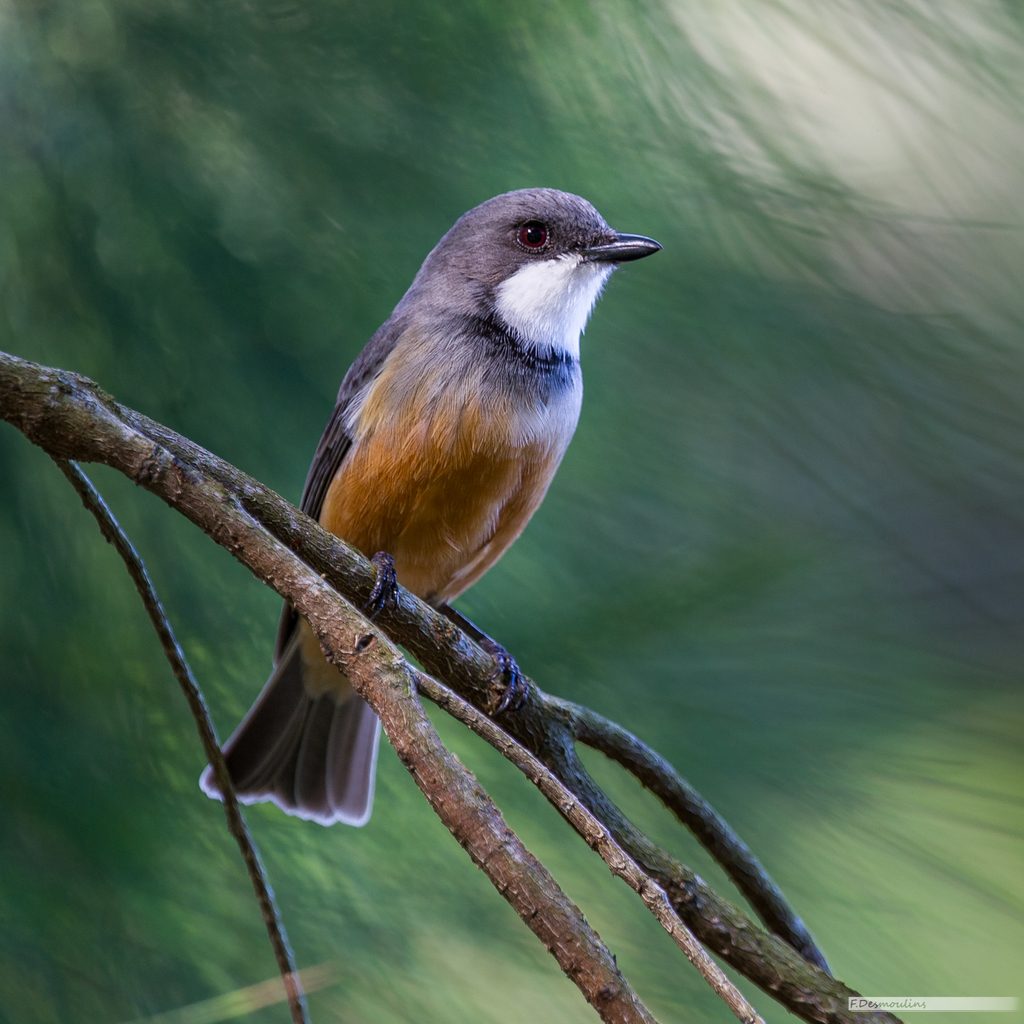
The rufous whistler (Pachycephala rufiventris) is a species of whistler found in New Caledonia and Australia. Predominantly a reddish-brown and grey bird, it makes up for its subdued plumage with its song-making ability. Like many other members of the Pachycephalidae, it has a variety of musical calls.
From the article Rufous whistler on Wikipedia (CC BY-SA), quoted section by section
Description
Rufous whistlers are large-headed and stocky. They have short beaks and long tails (almost as long as the rest of the bird) which are very narrow and have sharp, forked tips. The species is sexually dimorphic. While females are typically dull brown or grey with streaked underbodies, males have rufous underparts and predominantly dark-grey back and tail with white throats and (in most cases) a black mask that covers most of their head and some of their neck. These birds are between 16 and 18 centimetres (6.3 and 7.1 inches) in size, on average, and their normal weight is approximately 25 grams (0.88 ounces). The rufous whistler has a variety of musical calls which consist of a lengthy series of ringing notes.
Range & habitat
The rufous whistler can be found in forested areas, woodland, and shrubland, but also in gardens and farmland. It migrates seasonally, moving south in the spring and north in the autumn. In New Caledonia the species does not undertake migrations but is instead resident in areas of open forest and savannah.
Wikipedia: “Distribution and habitat”
What it does
While rufous whistlers primarily feed on insects, they also eat seeds, fruit and occasionally, leaves and grasses. They never forage for food on the ground which is unusual for whistlers which typically do not forage at particularly high levels.
Wikipedia: “Feeding”
Listen
Looking for field recordings…
Where it lives
Recorded sightings
—
geo-referenced records in GBIF, from museums, herbaria and field observers.
Drag the globe to turn it. Dots are where records exist, not a range map; darker means more records.
In the stacks
Searching the stacks…
Every page naming Pachycephala rufiventris in the Biodiversity Heritage Library →
This page is assembled live from iNaturalist, GBIF, Wikipedia, the Source Library and the Internet Archive. It is not yet part of the hand-edited codex. iNaturalist taxon 7920.