- Plants
- ›Vascular Plants
- ›flowering plants
- ›Dicots
- ›Roses, Elms, Figs, and Allies
- ›rose family
- ›Amygdaloideae
- ›Maleae
- ›Cotoneaster
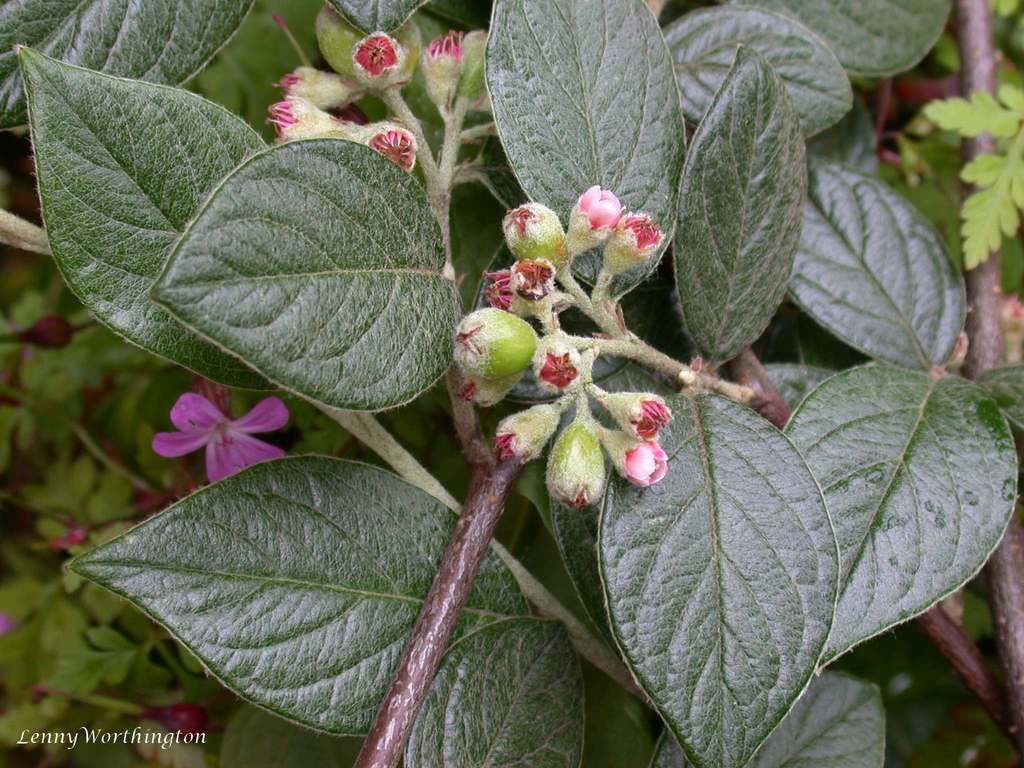
Stern's Cotoneaster
Cotoneaster sternianus
Cotoneaster franchetii (Franchet's cotoneaster or orange cotoneaster) is a species of Cotoneaster native to southwestern China, in the provinces of Guizhou, Sichuan, Tibet, and Yunnan, and also in adjacent northern Myanmar and northern Thailand.
It is an evergreen or semi-evergreen shrub growing to 3 metres (9.8 ft) tall. The leaves are oval-acute, 2–3.5 centimetres (0.79–1.38 in) long and 1–1.5 centimetres (0.39–0.59 in) broad, shiny green above, pubescent below with dense whitish to yellowish hairs. The flowers are produced in corymbs of 5–15 together, each flower 6–7 millimetres (0.24–0.28 in) diameter, with the five petals pink on the outer side, white on the inner side. The fruit is a red pome 6–9 millimetres (0.24–0.35 in) diameter; they are eaten by fruit-eating birds who disperse the seeds in their droppings.
From the article Cotoneaster franchetii on Wikipedia (CC BY-SA), quoted section by section
At the table
Cotoneaster franchetii is a popular ornamental plant. It has escaped from cultivation and become locally naturalised in parts of the British Isles and the Pacific Northwest of North America, as well as Northern California. Scientists at the Royal Horticultural Society (RHS) in the UK carried out a study on the effectiveness of hedges for soaking up air pollution, comparing different types of shrubs including cotoneaster, hawthorn, and western red cedar. They found that bushy, hairy-leafed varieties of cotoneaster, such as this, are “super plants” that can help soak up air pollution. On roads with heavy traffic, the dense, hairy-leaved Cotoneaster franchetii was at least 20% more effective at soaking up air pollution than other shrubs often planted along roadsides.
== References ==
Wikipedia: “Cultivation and uses”
Where it lives
Recorded sightings
—
geo-referenced records in GBIF, from museums, herbaria and field observers.
Drag the globe to turn it. Dots are where records exist, not a range map; darker means more records.
In the stacks
Searching the stacks…
Every page naming Cotoneaster sternianus in the Biodiversity Heritage Library →
This page is assembled live from iNaturalist, GBIF, Wikipedia, the Source Library and the Internet Archive. It is not yet part of the hand-edited codex. iNaturalist taxon 791250.