- Plants
- ›Vascular Plants
- ›flowering plants
- ›Dicots
- ›Mints, Plantains, Olives, and Allies
- ›Mint Family
- ›Scutellarioideae
- ›Scutellaria
- ›Scutellaria
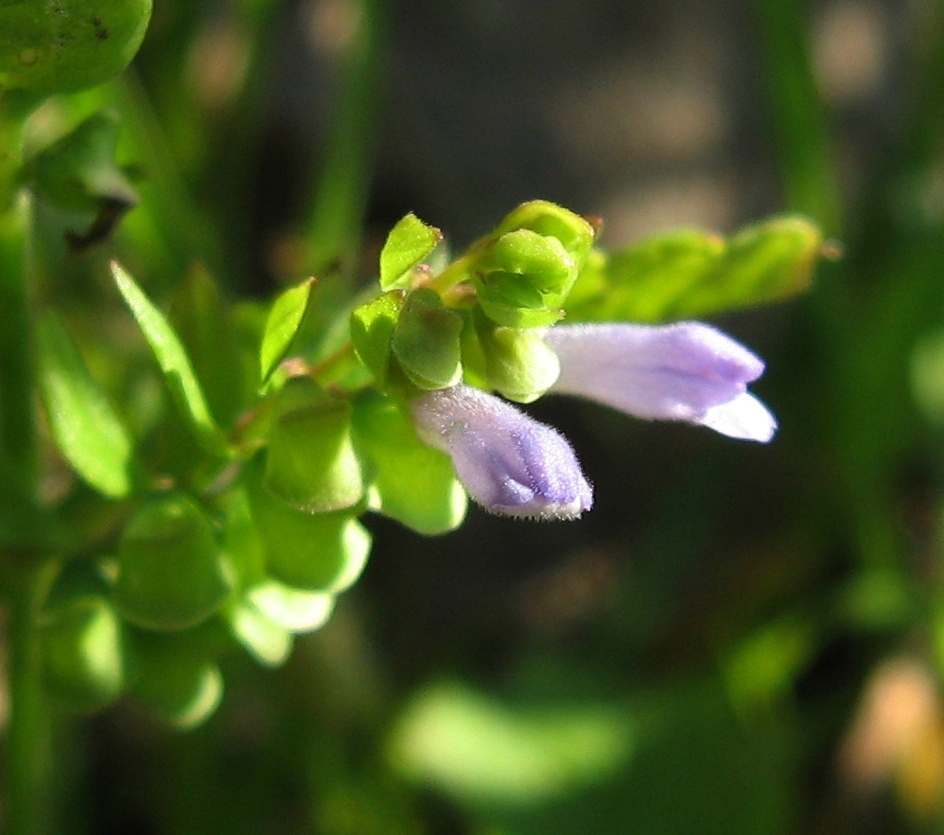
side-flowering skullcap
Scutellaria lateriflora
Scutellaria lateriflora, (commonly "blue skullcap", "mad dog skullcap", "American skullcap", "side-flowering skullcap", etc.) is a hardy perennial herb of the mint family, Lamiaceae, native to North America.
It has an upright habit, growing 60–80 cm (24–31 inches) in maximum height. It is a wetland-loving species and grows near marshes, meadows, and other wet habitats. The blue flowers are just under 1 cm (0.4 inches) long. Most of the flowers do not appear at the top of the main stem but are produced along the length of side branches that grow from the leaf axils.
From the article Scutellaria lateriflora on Wikipedia (CC BY-SA), quoted section by section
At the table
Its extracts are used in herbal medicine intended as a mild sedative and sleep promoter. Cherokee women have used it as an emmenagogue. In 1773, Scutellaria lateriflora became a common treatment in North America for the hysteria and hydrophobia caused by rabies. Skullcap products have been analyzed, with some adulterated by Teucrium canadense or T. chamaedrys, also known as germander, which contains potentially hepatotoxic diterpenes.
Wikipedia: “Traditional uses and research”
In medicine
The principal phytochemicals are polyphenols in the leaves, stems, and roots of some Scutellaria species, including baicalin, baicalein, wogonin, and oroxylin A. Other constituents include lateriflorin, melatonin, serotonin, viscidulin III-2'-O-glucoside, Chyrin-6-C-ara-glc, trans-verbascoside, viscidulin, trans-martynoside, oroxylin A-7-O-glc, wogonoside, chitin, and scutellarin. Scutellaria lateriflora contains flavonoids. One study identified 5,6,7-trihydroxy-2'- methoxyflavone and its 7-O-glucuronide. Scutellarin is a flavone found in S. lateriflora and S. barbata. It is transformed by hydrolysis into scutellarein. Genkwanin, hesperetin, quercetin, rutin, naringenin, chrysin, and daidzein are the flavonoids found in S. lateriflora. The flavonoids are readily extracted using hot water. The oil from S. lateriflora contains τ-cadinene, calamenene, β-elemene, α-cubebene, and α-humulene.
Wikipedia: “Phytochemicals”
Where it lives
Recorded sightings
—
geo-referenced records in GBIF, from museums, herbaria and field observers.
Drag the globe to turn it. Dots are where records exist, not a range map; darker means more records.
In the stacks
Searching the stacks…
Every page naming Scutellaria lateriflora in the Biodiversity Heritage Library →
This page is assembled live from iNaturalist, GBIF, Wikipedia, the Source Library and the Internet Archive. It is not yet part of the hand-edited codex. iNaturalist taxon 79017.