- Plants
- ›Vascular Plants
- ›flowering plants
- ›Dicots
- ›Mints, Plantains, Olives, and Allies
- ›Mint Family
- ›Nepetoideae
- ›Mentheae
- ›Melissas and sages
- ›Salvia
- ›Audibertia
- ›Audibertia
- ›Salvia dorrii
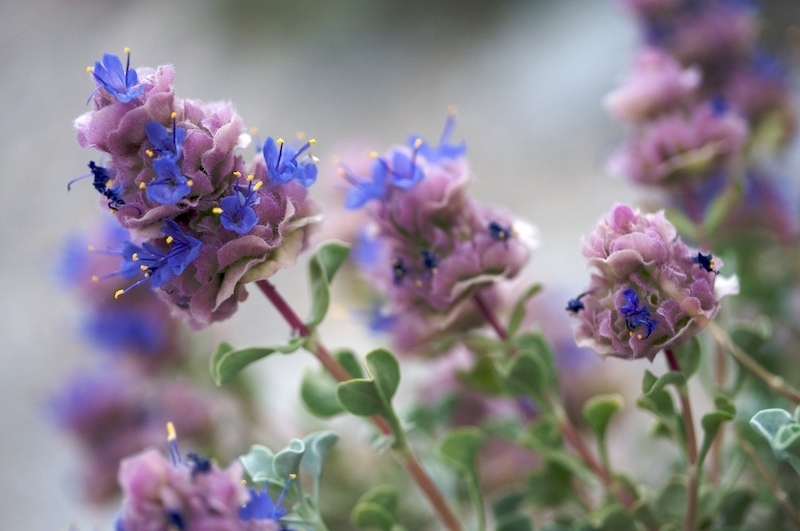
Dorr's Sage
Salvia dorrii
Salvia dorrii, the purple sage, Dorr's sage, fleshy sage, mint sage, or tobacco sage, is a herbaceous perennial in the family Lamiaceae. It is native to mountain areas in the western United States and northwestern Arizona, found mainly in the Great Basin Range habitat and southward to the Mojave Desert, growing in dry, well draining soils. Some large native populations of this species also are found in the Aquarius Plateau region of Southern Utah.
From the article Salvia dorrii on Wikipedia (CC BY-SA), quoted section by section
Description
Salvia dorrii is a woody subshrub reaching 10–70 cm (4–28 in) in height and width. The grey-green leaves are narrow and lanceolate, are tapered at the base and rounded at the tip generally without teeth or lobes. They are generally basal, and 1–3 cm (3⁄8–1+1⁄8 in) long. They have an intense but pleasant, mildly intoxicating minty aroma, with the scent released when the foliage is handled or crushed. The inflorescence is made up of spike-like clusters of numerous purple flowers that are bilaterally symmetric. Each cluster is 12–30 mm (1⁄2–1+1⁄8 in) across. Bracts are generally round 5–12 mm (1⁄4–1⁄2 in) long. Each calyx is usually 6–11 mm (1⁄4–3⁄8 in). The upper lip is most often round without teeth or lobes. The lower lip lobes are pointed without spines. The color is variable, blue to purple to rose. The corolla tube is 6–13 mm (1⁄4–1⁄2 in) or so, often blue but sometimes purple to pink to white. The stamens and style protrude from the flower. The latter is forked at the tip. The flowers remain on the plants after being pollinated, with the desiccated flowers remaining for some weeks or months after flowering. This species features prominently in native American traditional medicine practices.
Where it lives
Recorded sightings
—
geo-referenced records in GBIF, from museums, herbaria and field observers.
Drag the globe to turn it. Dots are where records exist, not a range map; darker means more records.
In the stacks
Searching the stacks…
Every page naming Salvia dorrii in the Biodiversity Heritage Library →
This page is assembled live from iNaturalist, GBIF, Wikipedia, the Source Library and the Internet Archive. It is not yet part of the hand-edited codex. iNaturalist taxon 78967.