- Plants
- ›Vascular Plants
- ›flowering plants
- ›Dicots
- ›Mints, Plantains, Olives, and Allies
- ›Mint Family
- ›Nepetoideae
- ›Mentheae
- ›Melissas and sages
- ›Salvia
- ›Audibertia
- ›Audibertia
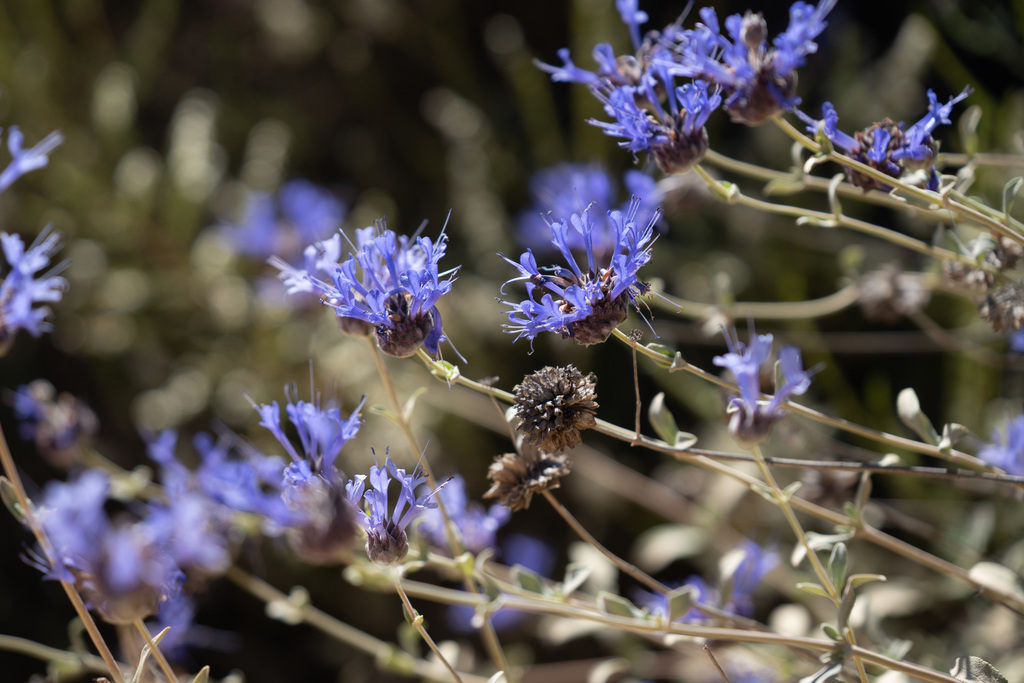
Cleveland Sage
Salvia clevelandii
Salvia clevelandii, the fragrant sage, blue sage, Jim sage, Cleveland sage, and Cleveland's blue sage is a perennial plant of family Lamiaceae native to Southern California and northern Baja California, growing below 900 m (3,000 ft) elevation in California coastal sage and chaparral habitat. The plant was named in 1874 by Asa Gray, honoring plant collector Daniel Cleveland.
From the article Salvia clevelandii on Wikipedia (CC BY-SA), quoted section by section
Description
Salvia clevelandii is an evergreen shrub that reaches 1 to 1.5 m (3.3 to 4.9 ft) in height and width. The fragrant, ashy green leaves are obovate and rugose, growing less than 2.5 cm (0.98 in) long. Flowers are on 30 cm (12 in) spikes, with numerous whorls of upright amethyst blooms opening in June–July.
Phytochemistry. The rose potpourri scented foliage of hybrids is composed of camphor and 1,8-cineole. Named cultivars with a eucalyptus scent also contain around 20% 1,8-cineole.
Range & habitat
Salvia clevelandii is found throughout portions of Southern California and northwestern Baja California, in chaparral and coastal sage scrub. It is distributed along the coast of San Diego County, the Peninsular Ranges of San Diego and Orange counties, and in northwestern Baja California, from the border to the northern portion of the central desert in the southern Sierra de San Pedro Martir.
Wikipedia: “Distribution and habitat”
How it is grown
Salvia clevelandii is a popular Southwest US landscape plant, cultivated since the 1940s. Plants prefer dry summers, good drainage, and tolerate full sun in cooler areas. As a landscape plant they have a relatively short life span of five to ten years. They are hardy to −7 °C (19 °F). Cultivars and hybrids include:
'Winnifred Gilman', a popular cultivar with intense violet-blue flowers. 'Betsy Clebsch', a shorter cultivar with wide variation in flower color. 'Allen Chickering', 'Aromas', 'Pozo Blue', 'Santa Cruz Dark', and 'Whirly Blue' are hybrids with similar appearance. Salvia clevelandii is one of the parents of the hybrid Salvia 'Celestial Blue'.
Wikipedia: “Cultivation”
Where it lives
Recorded sightings
—
geo-referenced records in GBIF, from museums, herbaria and field observers.
Drag the globe to turn it. Dots are where records exist, not a range map; darker means more records.
In the stacks
Searching the stacks…
Every page naming Salvia clevelandii in the Biodiversity Heritage Library →
This page is assembled live from iNaturalist, GBIF, Wikipedia, the Source Library and the Internet Archive. It is not yet part of the hand-edited codex. iNaturalist taxon 78966.