- Plants
- ›Vascular Plants
- ›flowering plants
- ›Dicots
- ›Nances, Willows, and Allies
- ›willow family
- ›Salix
- ›Vetrix
- ›Geyerianae
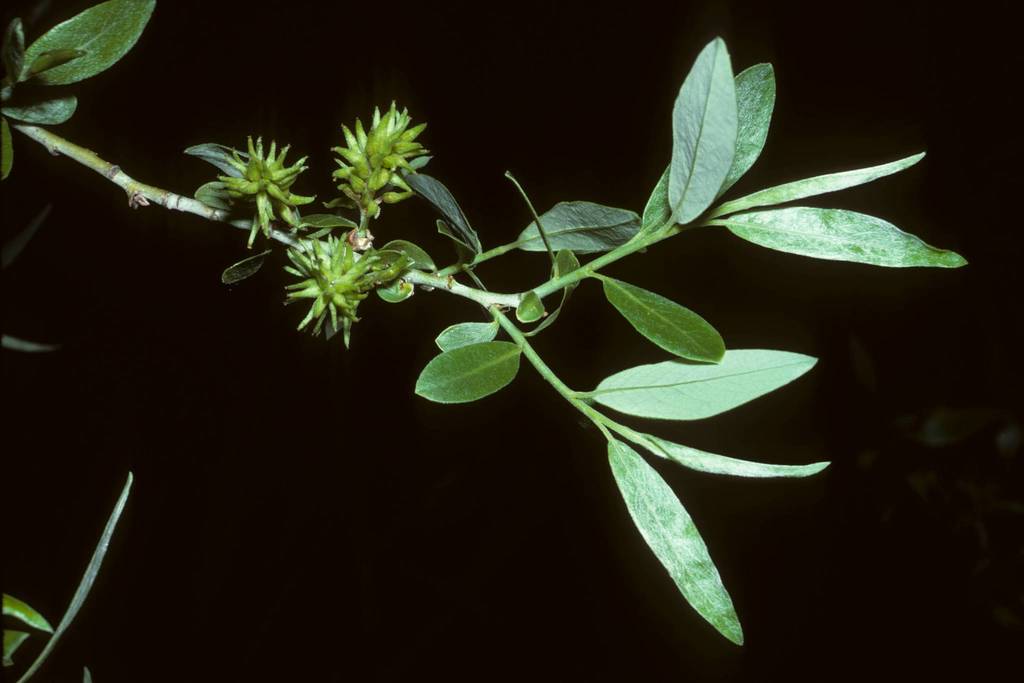
Geyer's willow
Salix geyeriana
Salix geyeriana is a species of willow known by the common names Geyer's willow, Geyer willow and silver willow. The type specimen was collected by the botanist Karl Andreas Geyer, for whom it was named. Its conspicuous, yellow flowers begin to bloom as early as March, to as late as the end of June.
From the article Salix geyeriana on Wikipedia (CC BY-SA), quoted section by section
Description
Salix geyeriana is a shrub growing up to 5 m (16 ft) tall, sometimes forming dense colonial thickets. The leaves are narrowly or widely lance-shaped and may grow over 7 cm long. Young leaves are coated in white or pale silky hairs, and some adult leaves retain their hairy textures. The leaves generally lack stipules or have only vestigial ones. The inflorescence is a spherical or slightly elongated catkin usually not more than about 2 cm long. This species reproduces sexually by seed, as well as vegetatively, by sprouting from the stem or sections of the stem, which contain early root structures that readily sprout when buried in moist substrate.
Range & habitat
S. geyeriana grows in moist and wet habitat types, such as lakesides, riverbanks, and bogs.
Wikipedia: “Habitat”
Where it lives
Recorded sightings
—
geo-referenced records in GBIF, from museums, herbaria and field observers.
Drag the globe to turn it. Dots are where records exist, not a range map; darker means more records.
In the stacks
Searching the stacks…
Every page naming Salix geyeriana in the Biodiversity Heritage Library →
This page is assembled live from iNaturalist, GBIF, Wikipedia, the Source Library and the Internet Archive. It is not yet part of the hand-edited codex. iNaturalist taxon 78940.