- Plants
- ›Vascular Plants
- ›flowering plants
- ›Dicots
- ›saxifrages, stonecrops, and allies
- ›Gooseberry Family
- ›Ribes
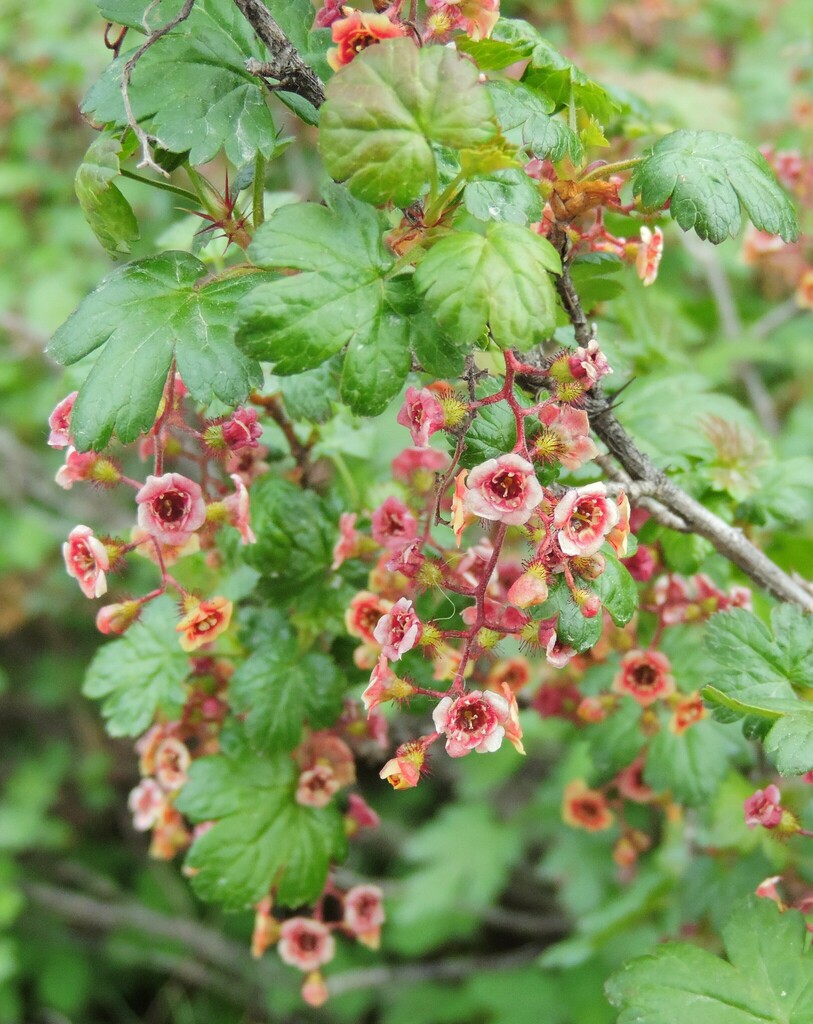
swamp currant
Ribes lacustre
The shrub Ribes lacustre is known by the common names prickly currant, black swamp gooseberry, and black gooseberry. It is widely distributed, from California to Alaska and across North America east to Pennsylvania and Newfoundland, and south as far as New Mexico.
From the article Ribes lacustre on Wikipedia (CC BY-SA), quoted section by section
Description
The shrub grows erect to spreading, .5–2 metres (1+1⁄2–6+1⁄2 feet). The deciduous leaves are palmate, alternately arranged, and 2.5–5 centimetres (1–2 in) wide, usually with 5 deeply indented lobes and a heart-shaped base. Leaf margins are toothed, and the upper side is dark and glossy green. Clusters of reddish to maroon flowers bloom from April through August. Racemes of 5 to 15 pink disk-shaped flowers hang from stems covered with short hairs, bristles and, at leaf nodes, larger thick spines. Bark on older stems is cinnamon-colored. The fruit consists of dark purple berries 6–8 millimetres (1⁄4–5⁄16 inch) long.
Range & habitat
It is widely distributed, from California to Alaska and across North America east to Pennsylvania and Newfoundland, and south as far as New Mexico. It may be found in low-elevation forests and swamps all the way up to the subalpine.
Preferred Sites. It is considered to be an extremely hardy species, capable of tolerating a wide range of soil types and conditions, as evidenced by its wide distribution. It occurs in moist woods and forests, meadow margins, streambanks, and on rough terrain such as avalanche chutes and rock crevices. It does not commonly form dense thickets.
Dispersal. Ribes lacustre regenerates primarily from seed, but can also regenerate vegetatively with adventitious roots which grow when the stems remain in prolonged contact with soil. Plants begin producing seeds when three to five years old, and each mature bush produces around 50-75 berries. Seeds are dispersed by animals or by falling from the parent plant. Seeds remain viable in the soil for long periods. In a mature forest in west-central Idaho, 51 viable prickly currant and sticky currant seeds were found per square foot of soil.
Wikipedia: “Distribution and habitat”
Where it lives
Recorded sightings
—
geo-referenced records in GBIF, from museums, herbaria and field observers.
Drag the globe to turn it. Dots are where records exist, not a range map; darker means more records.
In the stacks
Searching the stacks…
Every page naming Ribes lacustre in the Biodiversity Heritage Library →
This page is assembled live from iNaturalist, GBIF, Wikipedia, the Source Library and the Internet Archive. It is not yet part of the hand-edited codex. iNaturalist taxon 78858.