- Plants
- ›Vascular Plants
- ›flowering plants
- ›Dicots
- ›beeches, oaks, walnuts, and allies
- ›beech family
- ›Quercus
- ›Cerris
- ›Ilex
- ›Quercus ilex
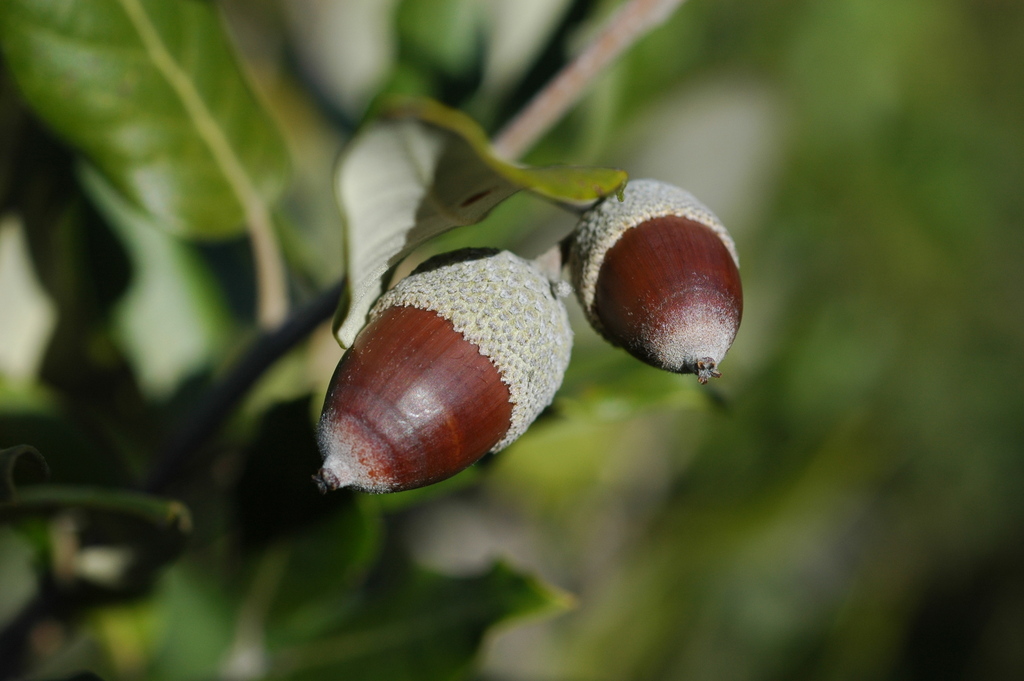
Holm oak
Quercus ilex
Quercus ilex, the evergreen oak, holly oak or holm oak, is a large evergreen oak native to the Mediterranean region. It takes its name from holm, an ancient name for holly. It is a member of the Cerris section of the genus, with acorns that mature in a single summer.
From the article Quercus ilex on Wikipedia (CC BY-SA), quoted section by section
Description
It is a large evergreen tree, attaining in favourable places a height of 21–28 metres (69–92 feet), and developing in open situations a huge head of densely leafy branches as much across, the terminal portions of the branches often pendulous in old trees. The tallest recorded, a tree planted at Windsor Great Park, is 30.4 m tall. The trunk is sometimes over 6 m (20 ft) in girth. The young shoots are clothed with a close grey felt. The leaves are very variable in shape, most frequently narrowly oval or ovate-lanceolate, 4–8 centimetres (1+1⁄2–3 inches) long (rarely to 10 cm long), 2–5 cm wide (rarely to 8 cm wide), rounded or broadly tapered at the base, pointed, the margins usually entire on mature trees, or (especially on young trees) more or less spiny-toothed. When quite young, both surfaces are clothed with whitish down, which soon falls away entirely from the upper surface, leaving it a dark glossy green; on the lower surface it turns grey or tawny, and persists until the fall of the leaf; the petiole is 3–16 millimetres (1⁄8–5⁄8 in) long. The acorns are produced one to three together on a short downy stalk, ripening the first season; they are usually 12–20 mm long in the UK, the cups with adpressed, downy scales, and an often wavy margin.
Range & habitat
Holm oak grows in pure stands or mixed forest in the Mediterranean and often at low or moderate elevations, but also at higher altitudes in the Atlas Mountains. It is native from westernmost Turkey and through Greece west to parts of the Iberian Peninsula, where it mixes with Q. rotundifolia, along the northern Mediterranean coastal belt, and in the Atlas Mountains in Tunisia and Algeria.
Wikipedia: “Distribution and habitat”
At the table
The wood is hard and tough, and has been used since ancient times for general construction purposes as pillars, tools, wagons (as mentioned in Hesiod, Works and Days on page 429), vessels and wine casks. It is also used as firewood and in charcoal manufacture. The holm oak is one of the top three trees used in the establishment of truffle orchards, or truffières. Truffles grow in an ectomycorrhizal association with the tree's roots.
The first trees to be grown from acorns in England are still to be found within the stately grounds of Mamhead Park, Devon. From Britton & Brayley in The Beauties of England and Wales (1803):The woods and plantations of Mamhead are numerous and extensive. Many of them were introduced by Mr Thomas Balle (sic), the last of that family who, on returning from the continent, brought with him a quantity of cork, ilex, wainscot, oak; Spanish chestnut, acacia, and other species of exotic trees. Holm oak is not officially listed as an invasive species in the United Kingdom but is naturalised, able to naturally regenerate. Normally the tree is unable to withstand severe frost, which would prevent it from spreading north, but with climate change, it has successfully penetrated and established itself in areas north of its native range. The largest population of holm oak in Northern Europe is present on and around St. …
Wikipedia: “Cultivation and uses”
In human culture
The resemblance of the foliage to that of the common European holly, Ilex aquifolium, has led to its common and botanic names. The species name ilex was originally the classical Latin name for the holm oak, but later adopted as a botanical genus name for the hollies. The common name 'holm oak' takes its name from holm, an ancient name for holly.
Wikipedia: “Etymology”
Where it lives
Recorded sightings
—
geo-referenced records in GBIF, from museums, herbaria and field observers.
Drag the globe to turn it. Dots are where records exist, not a range map; darker means more records.
In the old herbals & bestiaries

Commentaries on the Six Books of Dioscorides
Pietro Andrea Mattioli · 1560 · p.239

Elements of Botany
Joseph Pitton de Tournefort · 1719 · p.101

Herbarium Portatile, Oder Behendes Kräuter- und Gewächs-Buch: Darinn nicht allein 1363. so wol Einheimische als Außländndische Kräuter mit Lateinisch und Deutscher Benennung abgebildet, sondern auch die meisten, so in der Medicin gebräuchlich, kürtzlich erkläret werden
Panckow, Thomas · 1656 · p.362
In the stacks
Searching the stacks…
Every page naming Quercus ilex in the Biodiversity Heritage Library →
This page is assembled live from iNaturalist, GBIF, Wikipedia, the Source Library and the Internet Archive. It is not yet part of the hand-edited codex. iNaturalist taxon 78805.