- Plants
- ›Vascular Plants
- ›flowering plants
- ›Dicots
- ›Sunflowers, Bellflowers, Fanflowers, and Allies
- ›Sunflowers, Daisies, Asters, and Allies
- ›Asteroideae
- ›paper daisies
- ›cudweeds, everlastings, and pussytoes
- ›Coronidium
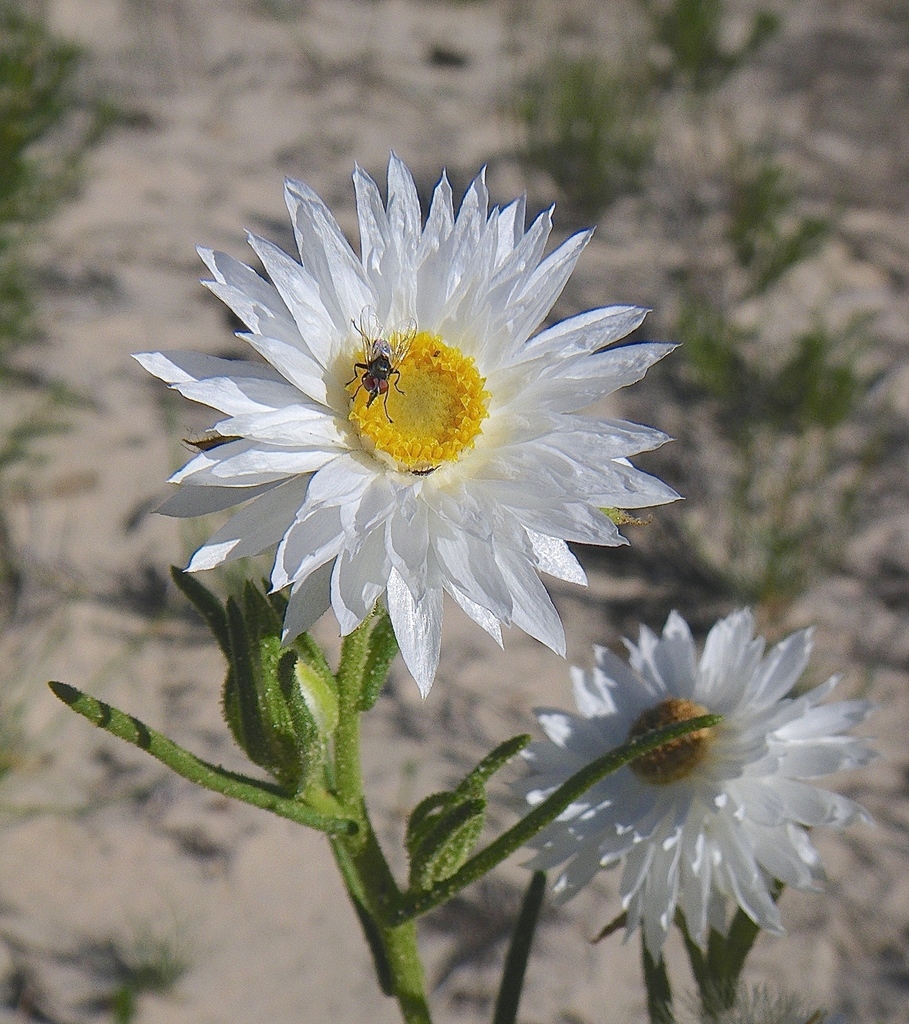
Branched Everlasting
Coronidium adenophorum
Coronidium adenophorum, commonly known as branched everlasting, is a flowering plant in the family Asteraceae. It is an erect, single-stemmed, annual or biennial herb with sessile linear leaves, solitary heads of white flowers and is endemic to the south-east of mainland Australia.
From the article Coronidium adenophorum on Wikipedia (CC BY-SA), quoted section by section
Description
Coronidium adenophorum is an erect, single-stemmed annual or biennial herb that typically grows to a height of 50 cm (20 in) and has stems covered with glandular hairs. Its leaves are sessile, linear, 60 mm (2.4 in) long and covered with glandular hairs. The flowers are borne in a hemispherical head 45 mm (1.8 in) in diameter with white involucral bracts at the base, the outer bracts are sessile, the intermediate bracts narrowly oblong and the innermost bracts are shorter and prominently covered with soft hairs. Flowering occurs between October and March, and the cypselas are about 1.5 mm (0.059 in) long with thread-like pappus bristles.
Range & habitat
Branched everlasting is found on Kangaroo Island, in the Murray–Darling basin and the south-east of South Australia, in dune mallee in the Big Desert south of Murrayville and in heathy woodland on Mt Abrupt in the Grampians.
Wikipedia: “Distribution and habitat”
Where it lives
Recorded sightings
—
geo-referenced records in GBIF, from museums, herbaria and field observers.
Drag the globe to turn it. Dots are where records exist, not a range map; darker means more records.
In the stacks
Searching the stacks…
Every page naming Coronidium adenophorum in the Biodiversity Heritage Library →
This page is assembled live from iNaturalist, GBIF, Wikipedia, the Source Library and the Internet Archive. It is not yet part of the hand-edited codex. iNaturalist taxon 787666.