- Plants
- ›Vascular Plants
- ›flowering plants
- ›monocots
- ›Aroids, Water Plantains, Seagrass, and allies
- ›pondweed family
- ›Potamogeton
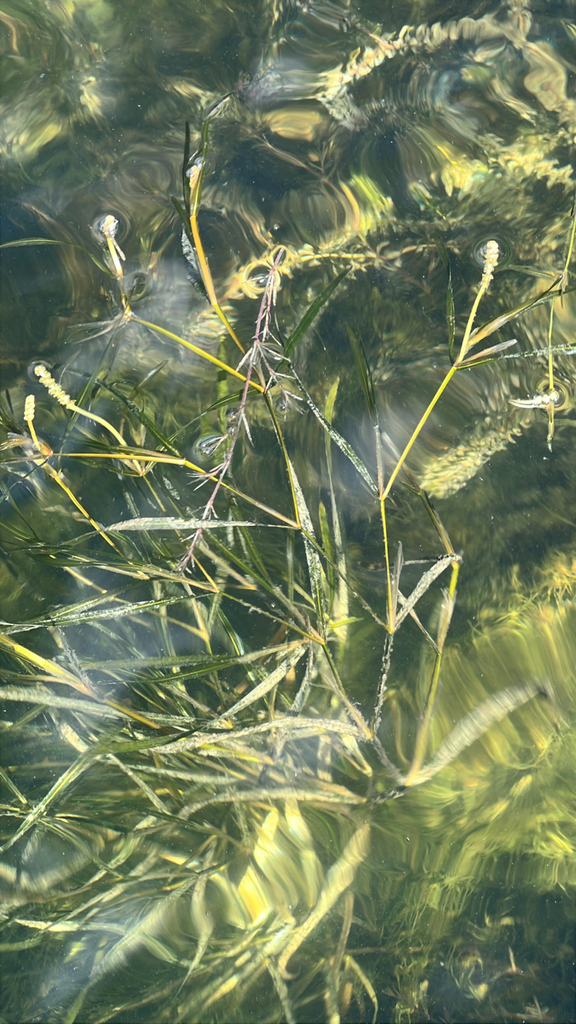
eel-grass pondweed
Potamogeton zosteriformis
Potamogeton compressus is a species of aquatic plant known by the common names grass-wrack pondweed, flatstem pondweed and eel-grass pondweed.
From the article Potamogeton compressus on Wikipedia (CC BY-SA), quoted section by section
Description
Potamogeton compressus produces a strongly flattened, robust, branching stem up to 90 cm in maximum length. It grows annually from turions and seed, producing bushy plants branching near the surface with long, rather grass-like leaves that are 85–240 mm long and 3–6 mm wide and olive-green or dark green, sometimes with a reddish tinge near the surface. Each leaf has two veins either side of the midrib and is bluntly pointed. The leaves have a rather opaque appearance compared to the transparent leaves of most pondweeds due to the presence of fibres called sclerenchymatous strands. There are no rhizomes or floating leaves. The inflorescences are up to 6 mm long with 4–6 flowers with a short peduncle (5–20 mm long, occasionally more). The fruits are 3.1–4 x 2.1–3 mm. Grass-wrack pondweed is relatively easily distinguished from most other pondweeds by its combination of strongly flattened stems and sclerenchymatous strands in the leaf . P. acutifolius is similar in Europe but can be distinguished by its sharply pointed leaves, less branched habit and flower spikes with only 2–6 flowers on peduncles up to 20 mm long. In the Far East, P. mandschuriensis is an altogether smaller plant, with leaves 1.5–2.3 mm wide and 8–14 sclerenchymatous strands, stem 0.8–1.5 mm wide, and fruit 2.8–3.8 mm diameter. This is a diploid species, with 2n=28.
Hybrids with P. acutifolius (P. …
Range & habitat
Potamogeton compressus is native to Europe (Austria, Britain, Denmark, Finland, France, Germany, Ireland, Netherlands, Poland, Russia, Spain, Sweden, Switzerland, Ukraine), Asia (China (Yunnan), Japan, Kazakhstan, Mongolia, Russia). In North America P. compressus / zosteriformis occurs in northern USA and Canada. There are isolated populations in the Balkans, Oregon and the Rockies. There is considerable uncertainty regarding the exact distribution of this species in Siberia and Canada.
Wikipedia: “Distribution”
What it does
Grass-wrack pondweed grows in still or slow-flowing, lowland, calcareous and often rather nutrient-rich water bodies such as backwaters in rivers, ponds and slow-moving streams, usually on fine substrates such as sand, silt, clay or peat, usually in less than 1.5 m water depth. However, Japanese populations have been reported growing in 5 m of water. It is also capable of colonising artificial habitats such as canals and drainage ditches, so long as these are not heavily boated. Grass-wrack pondweed is intolerant of turbid water and prefers some shade. Like its close relative Potamogeton acutifolius, it rarely grows in lakes; the shallow root system is intolerant of disturbance and is therefore vulnerable to wind action, boat disturbance and uprooting by fish. Potamogeton compressus is a rather early succession species and tends to be outcompeted unless the habitat it grows in is regularly disturbed. As a result, populations are often transient. Most reproduction in the wild appears to be asexual via turions, which is likely to mean that populations have limited ability to recolonise if lost. However, turion production is not prolific, with wild plants typically producing only 4-5 turions. …
Wikipedia: “Ecology and Conservation”
How it is grown
Potamogeton compressus is not in cultivation. It could probably be cultivated in rather silty ponds, so long as they are regularly cleaned out in order to prevent other more competitive plants from excluding it. Cultivation experiments for conservation purposes have successfully grown plants to maturity from turions planted in late winter, but adult plants are more difficult to establish due to their limited root system and fragile nature. High mortality was also observed due to snail predation in culture.
Wikipedia: “Cultivation”
Where it lives
Recorded sightings
—
geo-referenced records in GBIF, from museums, herbaria and field observers.
Drag the globe to turn it. Dots are where records exist, not a range map; darker means more records.
In the stacks
Searching the stacks…
Every page naming Potamogeton zosteriformis in the Biodiversity Heritage Library →
This page is assembled live from iNaturalist, GBIF, Wikipedia, the Source Library and the Internet Archive. It is not yet part of the hand-edited codex. iNaturalist taxon 78717.