- Plants
- ›Vascular Plants
- ›flowering plants
- ›Dicots
- ›Gentians, Dogbanes, Madders, and Allies
- ›Dogbane Family
- ›milkweeds
- ›Ceropegieae
- ›Stapeliads
- ›Boucerosia
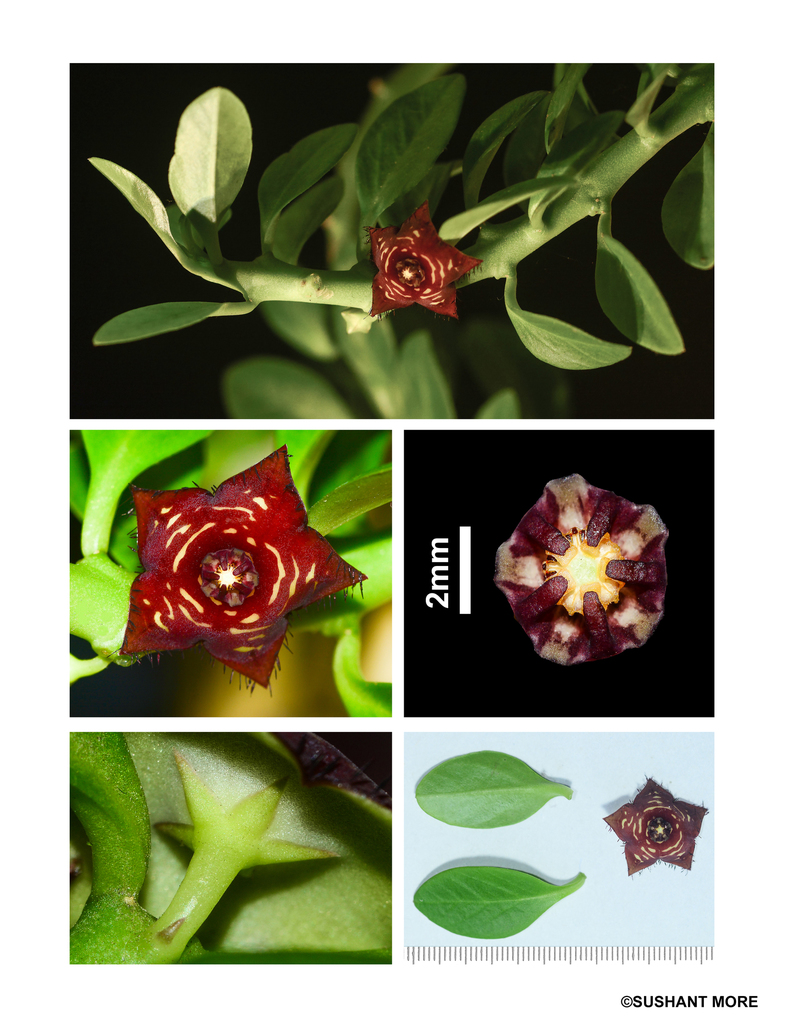
Boucerosia frerei
Boucerosia frerei is a plant in the genus Boucerosia which contains several species many of which are native to the Indian subcontinent and one species, Boucerosia crenulata, native to Myanmar. B. frerei has many local names, including shindel makudi, shindal makadi, makadshingi and sindhad makad - names also given to Caralluma adscendens. In Purandhar it is called potdukhi. In 2019, a new name Shiv Suman was coined by a group of botanical organisations to honour Shivaji. B. frerei is a small succulent endemic to the forest area in the Western Ghats and Deccan Plateau in Maharashtra state in India. It is also grown as a greenhouse plant by succulent plant enthusiasts. At one time, it was on the IUCN list of the twelve most endangered species on earth, but conservation efforts have brought it back from the brink of extinction.
From the article Boucerosia frerei on Wikipedia (CC BY-SA), quoted section by section
Description
Boucerosia frerei is a fleshy perennial succulent with 50 cm (20 in) long branches that have elliptic-oblong leaves that are 7 cm (2.8 in) long. The leaves grow during the monsoon season—in a habit that is unusual compared to its close relatives, it drops the leaves during dry seasons to conserve moisture. The crimson to cherry-red flowers are star shaped with yellow markings and have a 2 to 3 cm (0.79 to 1.18 in) corolla, with patterns of markings that vary from one population to another. Flowers smell of rotten meat and are lined with fine cilia. The deciduous leaves of this plant use regular C3 photosynthesis, while the stem utilizes C4 like most succulents. During dry seasons or dry spells leaves will fall off and the plant will rely on its stem for photosynthesis. The stem may take on a sliver velamin like texture It blooms from August to September.
Range & habitat
Boucerosia frerei is known only in six areas in Maharashtra state in west India, growing at elevations between 750 and 1,347 m (2,461 and 4,419 ft), preferring crevices on cliffs. There are only a few plants in each of the six populations.
Wikipedia: “Distribution and habitat”
At the table
Boucerosia frerei is a distinctive greenhouse plant in temperate climates, and is grown by succulent plant collectors. There are several hybrids between B. frerei and other stapeliad species. The stems and fresh shoots of B. frerei are eaten by locals. The leaves have been applied to wounds and the plant used to promote hair growth.
Wikipedia: “Uses”
Where it lives
Recorded sightings
—
geo-referenced records in GBIF, from museums, herbaria and field observers.
Drag the globe to turn it. Dots are where records exist, not a range map; darker means more records.
In the stacks
Searching the stacks…
Every page naming Boucerosia frerei in the Biodiversity Heritage Library →
This page is assembled live from iNaturalist, GBIF, Wikipedia, the Source Library and the Internet Archive. It is not yet part of the hand-edited codex. iNaturalist taxon 787130.