- Plants
- ›Vascular Plants
- ›flowering plants
- ›monocots
- ›Aroids, Water Plantains, Seagrass, and allies
- ›pondweed family
- ›Potamogeton
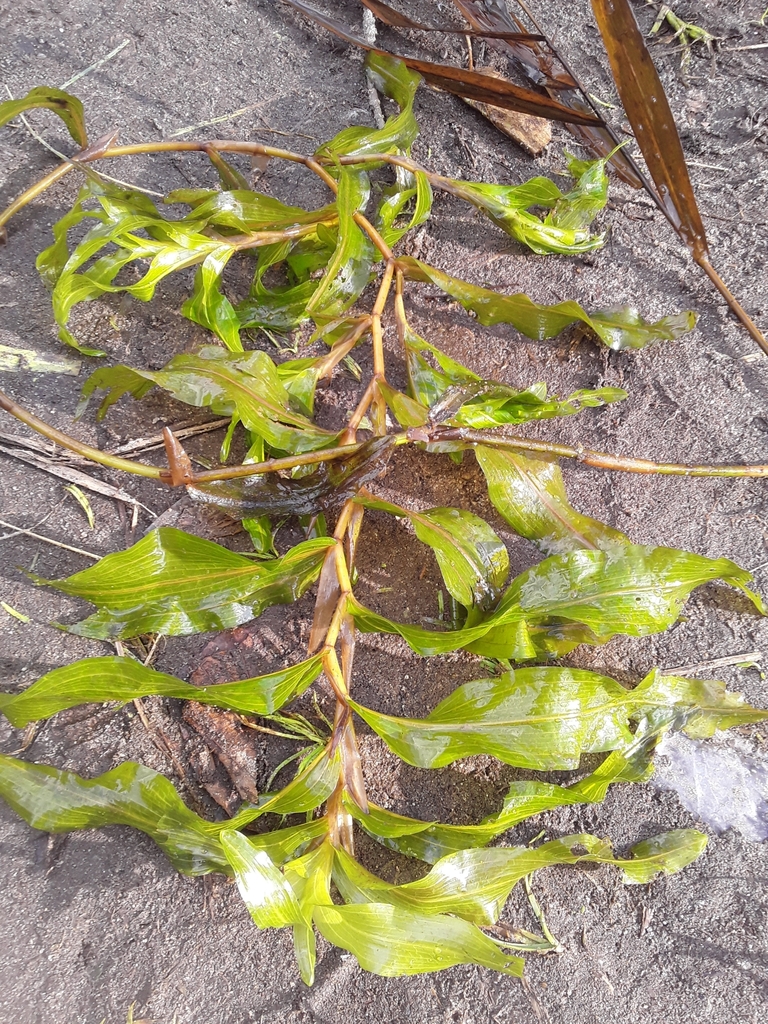
white-stemmed pondweed
Potamogeton praelongus
Potamogeton praelongus, commonly known as whitestem pondweed in North America and long-stalked pondweed in Britain, is a large, perennial aquatic plant in the family Potamogetonaceae. It is widely distributed in lakes and rivers in the northern hemisphere, but is sensitive to poor water quality.
From the article Potamogeton praelongus on Wikipedia (CC BY-SA), quoted section by section
Description
Long-stalked pondweed has tall stems to 3 m growing from stout, rusty-spotted perennial rhizomes. The stems often change direction between each node, giving a characteristic zig-zagging pattern. The transparent pale to deep green leaves are typically between 60 and 150 mm long but occasionally reach 250 mm and are 14–40 mm wide. The stipules are persistent, open, whitish and translucent, with prominent veins when dry. Floating leaves and turions are absent. The inflorescences are produced quite early for a pondweed, in May–June, and have 15–20 inconspicuous greenish flowers and held on robust peduncles 80–200 mm long. The fruits are large for a pondweed, 4.5–5.5 x 2.5–3.6 mm.
Hybrids with several other species, P. alpinus (P. × griffithii A. Benn.), P. crispus (P. × undulatus Wolgf.), P. lucens (P. × jutlandicus Zalewska-Gał.), P. natans (P. × vepsicus A.A. Bobrov & Chemeris) and P. perfoliatus (P. × cognatus Asch. & Graebn.) have been described, but all are rare. Chromosome counts show that, like most other broad-leaved pondweeds, P. praelongus is tetraploid, with 2n=52 chromosomes. Long-stalked pondweed is relatively easy to identify. It could be confused with narrow-leaved forms of Potamogeton perfoliatus, but the persistent stipules, leaves only partially clasping the stem, larger fruits and (usually) zigzag pattern of the stem are distinctive. …
Range & habitat
Potamogeton praelongus has a Holarctic distribution, occurring in northern Europe (Britain, Ireland, Iceland, Scandinavia, Germany, Switzerland, France, Poland, Russia, the Baltic States), Greenland, Asia (Siberia, China, Korea, Japan), and North America (northern US, Canada). There are outlying populations in the Caucasus, Pyrenees and western USA.
Wikipedia: “Distribution”
How it is grown
P. praelongus is not in general cultivation, though it is an attractive plant. Unlike many other pondweeds it remains wintergreen. In common with other pondweeds of this group it roots poorly from stem cuttings and is best propagated by division of the rhizomes. Its preference for relatively deep water and intolerance of turbid conditions may make it unsuitable for many garden ponds. If possible it should be grown in water at least 70 cm deep on a sandy, peaty or silty substrate. Good water quality is needed to reduce the risk of turbid water or growth of blanket weed. Seed can be encouraged to germinate by immersing dried seed in water for at least a month, exposing them to a cold period, or by scarifying them.
Wikipedia: “Cultivation”
Where it lives
Recorded sightings
—
geo-referenced records in GBIF, from museums, herbaria and field observers.
Drag the globe to turn it. Dots are where records exist, not a range map; darker means more records.
In the stacks
Searching the stacks…
Every page naming Potamogeton praelongus in the Biodiversity Heritage Library →
This page is assembled live from iNaturalist, GBIF, Wikipedia, the Source Library and the Internet Archive. It is not yet part of the hand-edited codex. iNaturalist taxon 78713.