- Plants
- ›Vascular Plants
- ›flowering plants
- ›monocots
- ›Aroids, Water Plantains, Seagrass, and allies
- ›pondweed family
- ›Potamogeton
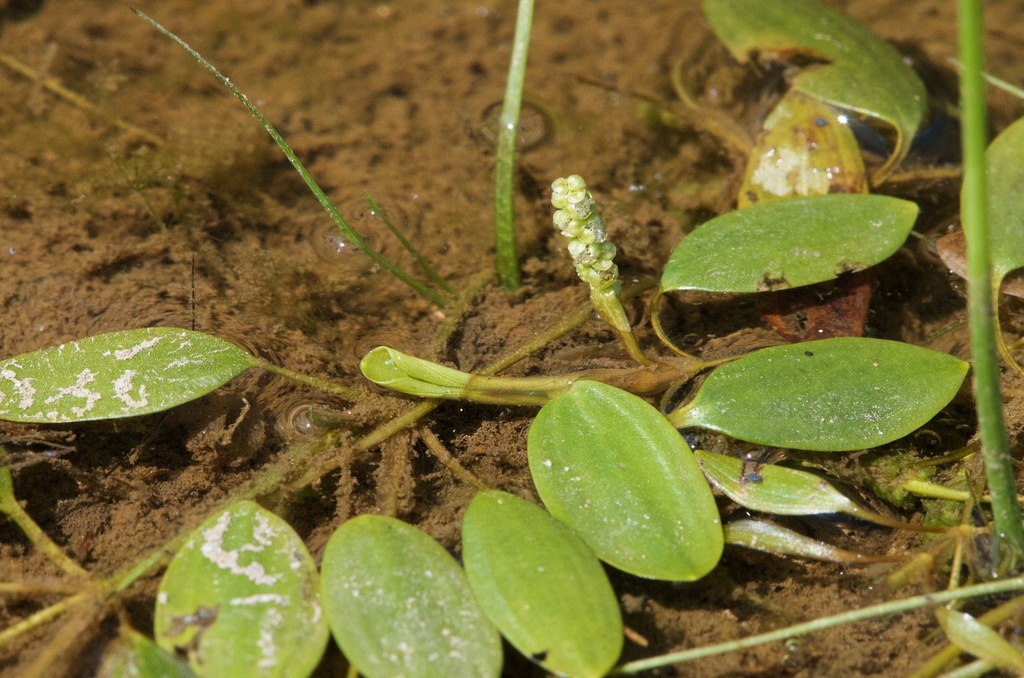
diverse-leaved pondweed
Potamogeton diversifolius
Potamogeton diversifolius is a species of aquatic plant known by the common names waterthread pondweed and diverse-leaved pondweed. It is native to most of the United States, as well as sections of southwestern Canada, and northern Mexico, where it grows in water bodies such as ponds, lakes, ditches, and slow-moving streams. This is a perennial herb producing a very narrow, compressed stem branching to a maximum length around 35 centimeters. It has thin, pointed linear leaves a few centimeters long spirally arranged about the thin stem. The inflorescence is a small spike of flowers emerging from the water surface. Inflorescences also grow on submersed sections of the stem; these are smaller and spherical. It can be difficult to distinguish from similar species of pondweed.
From the article Potamogeton diversifolius on Wikipedia (CC BY-SA), quoted section by section
Description
Potamogeton diversifolius is a vascular aquatic plant that is sometimes known as waterthread pondweed or diverse-leaved pondweed. Some synonyms are Potamogeton capillaceus var. atripes, Potamogeton capillaceus and Potamogeton diversifolius var. multidenticulatus. The plant has dimorphic leaves and is thread like. The leaves are both floating and submerged in water. The floating leaves tend to usually have 7-11 distinct veins, are elliptic and oval in outline. They submerged leaves are alternating, smaller and only usually have 3 veins. Submersed leaves have stipules at the base of the leaf petiole that forms a sheath around the stem. The plant is pale green is in total 0.78-2.5 inches long and 0.02-0.06 inches wide. The plant is a perennial with multi-branched stems extending between 40 and 80 cm long. Stipules of the submersed leaves are fused at the base of the leaf blade and 4–10 mm long The fruits are almost disk-shaped and tend to curve inward towards each other. They also usually have lateral keels and are 0.9 to 2.0 mm in diameter. Flowers range between 1-15 with spikes that are dimorphic. Seeds are formed in clusters. The clusters range from 1-15 and on the stalks of submersed leaves. The floating leaves have lindrical spikes that contain seeds ranging from 5-120 in the axils. The plant blooms red with flowers and fruits throughout June to December. …
Range & habitat
Potamogeton diversifolius can be found in shallow bodies of water including streams, ponds and shallow sections of the lakes. This species is one of the most numerous and widely distributed pondweeds throughout the North America and can be found in 43 US States. This pondweed is in different types of still waters such as pools, ponds, lakes, and even some streams. The plant is currently listed as invasive in Cuba. Water thread pondweed can be found in fresh water. In an experiment involving fish predation scientists discovered that Potamogeton diversifolius was only found within fish free enclosures. P. diversifolius occurs scattered throughout the United States except for the New England states. In recent years the species has been found in newly excavated ditches that contain clay like soil. The species has been found at elevations as high as 2744 m Potamogeton diversifolius has been found in both full sunlight and partial shade. Potamogeton diversifolius occurs in northern Mexico and in Cuba.
Wikipedia: “Distribution”
At the table
Potamogeton diversifolius is known to be used as food for at least approximately 124 animals. The plant provides a habitat for many micro- and macroinvertebrates. After the plant dies decomposition by bacteria and fungi provides food invertebrates. The seeds are eaten by waterfowl. Leaves are eaten by fish and invertebrates. Potamogeton diversifolius is known to be a host of aquatic fungi. In a study on the food of game ducks it was recorded that 11.04% of their food was Potamogeton diversifolius within 247 locations in the United States and Canada. The proportion of P. diversifolius in the diet of game ducks along the Atlantic coast was 11.73%, 13.29% in eastern region, 6.06% in Mississippi region, 3.99% at the gulf coast, 16.29% in western region, 12.14% in Pacific coast, 12.73% in western Canada and 12.47% in eastern Canada.
Wikipedia: “Uses”
Where it lives
Recorded sightings
—
geo-referenced records in GBIF, from museums, herbaria and field observers.
Drag the globe to turn it. Dots are where records exist, not a range map; darker means more records.
In the stacks
Searching the stacks…
Every page naming Potamogeton diversifolius in the Biodiversity Heritage Library →
This page is assembled live from iNaturalist, GBIF, Wikipedia, the Source Library and the Internet Archive. It is not yet part of the hand-edited codex. iNaturalist taxon 78708.