- Plants
- ›Vascular Plants
- ›flowering plants
- ›monocots
- ›Aroids, Water Plantains, Seagrass, and allies
- ›pondweed family
- ›Potamogeton
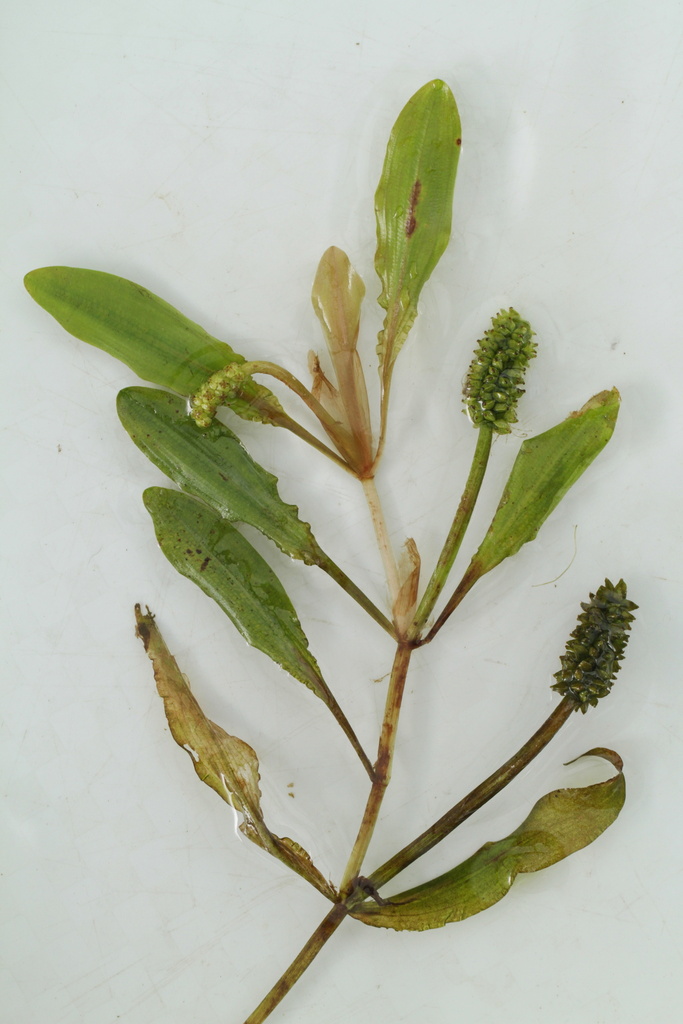
Northern Pondweed
Potamogeton alpinus
Potamogeton alpinus is a species of perennial aquatic plant known by the common names alpine pondweed and red pondweed. It is widespread in the northern hemisphere in both rivers and lakes with good water quality.
From the article Potamogeton alpinus on Wikipedia (CC BY-SA), quoted section by section
Description
Red pondweed is a perennial herb anchoring in the mud substrate via a creeping rhizome. It produces a cylindrical unbranched stem, up to 2.8 m in length. It has sessile lance-shaped submerged leaves that are typically 70–180 mm long and 10–25 mm wide with 4–7 lateral veins on either side and a slightly hooded apex, with an untoothed margin. Floating leaves may also be produced. The inflorescence is a spike of flowers a few centimeters long rising above the water surface. Turions are absent, but in winter each stem dies back to a resting bud with a short length of root, which acts as a functional turion.
Red pondweed is a reasonably distinctive plant and is not likely to be confused with any other pondweed. Early in the growing season it could be confused with P. polygonifolius, but the submerged leaves of the latter have petioles and are relatively longer. P. praelongus is generally greener with noticeably white, zig-zagged stems that generally branch, never produces floating leaves, and its submerged leaves clasp the stem. Fresh specimens often, but not always, show a reddish tint, but this becomes much more obvious in dried material. Despite its name it is neither restricted to alpine regions or unique among pondweeds in having a reddish colouration. Chromosome counts show that, like most other broad-leaved pondweeds, P. …
Range & habitat
Red pondweed is native to much of the Northern Hemisphere, including Asia (Afghanistan, China (Heilongjiang), India (Assam), Japan, Kazakhstan, Korea, Myanmar, Pakistan, Russia, Uzbekistan), Europe (Austria, Belgium, Britain, Denmark, Estonia, France including Corsica, Germany, Ireland, Iceland, Latvia, Lithuania, Netherlands, Norway, Poland, Spain (Pyrenees), Sweden, Switzerland), Greenland, Canada, and the northern United States, especially the Rockies.
Wikipedia: “Distribution”
What it does
Potamogeton alpinus generally grows in neutral to mildly acid (but not very base-poor) water bodies such as lakes, slow-moving rivers and streams, and ponds. P. alpinus needs a deep fine substrate such as sand, silt or peat to root in and appears to avoid exposed situations. It is mainly restricted to fairly nutrient-poor waters. In European rivers, it is associated with high quality environments. In a large-scale study of the plant communities of 3447 British lakes, red pondweed was found in 169, with a preference for circumneutral, moderate alkalinity lakes. Unlike other broad-leaved pondweeds, the stolons of red pondweed die back in winter, leaving constellations of resting buds rooted in the substrate, which regrow in spring. In rivers, red pondweed can persist entirely by asexual means (rooting of stem fragments and turion-like resting bodies, and growth in summer) though this may reflect weed cutting suppressing flowering and seed set. In Britain P. alpinus has declined markedly, especially in the south, though it still occurs throughout Britain. In Wales red pondweed was recently assessed as Critically Endangered, and in England it is categorised as Vulnerable. …
Wikipedia: “Ecology and conservation”
How it is grown
Potamogeton alpinus is not in widespread cultivation, and seems to be rather difficult to maintain, competing poorly with other pond plants. It is possible that this is related to its preference for a deep fine substrate. In common with other pondweeds of this group it roots poorly from stem cuttings and is best propagated by division of the rhizomes.
Wikipedia: “Cultivation”
Where it lives
Recorded sightings
—
geo-referenced records in GBIF, from museums, herbaria and field observers.
Drag the globe to turn it. Dots are where records exist, not a range map; darker means more records.
In the stacks
Searching the stacks…
Every page naming Potamogeton alpinus in the Biodiversity Heritage Library →
This page is assembled live from iNaturalist, GBIF, Wikipedia, the Source Library and the Internet Archive. It is not yet part of the hand-edited codex. iNaturalist taxon 78704.