On eBird ↗
Ashy Minivet
Live sightings near you, the range map, bar charts of when it is seen, and Macaulay Library photos and recordings.
Ashy Minivet
Pericrocotus divaricatus
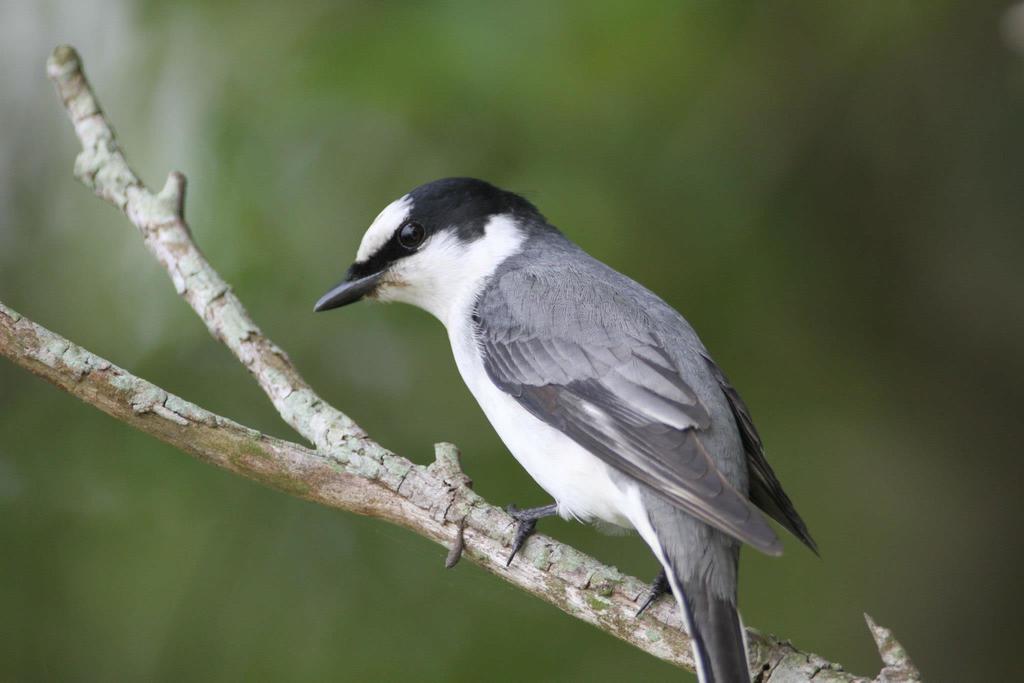
The ashy minivet (Pericrocotus divaricatus) is a passerine bird of eastern Asia belonging to the minivet genus Pericrocotus in the cuckooshrike family Campephagidae. While most of the minivets have shades of yellow, orange and red in their plumage, this species has only greys, whites and blacks. The male is distinctive with a white face and black nape although females can be confused with the female of the brown-rumped minivet. They forage in the canopy, often along with other minivets and join mixed-species foraging flocks.
From the article Ashy minivet on Wikipedia (CC BY-SA), quoted section by section
Description
It is 18.5–20 cm long. The male is grey above and whitish below. It has a black cap with a white forehead and there is a white band across the flight-feathers. The outer tail feathers are white. The bill and feet are black. The female's cap is grey apart from a black band between the bill and eye and a narrow white band above it. The call is a high-pitched, metallic trill. It is considered as closely related to Pericrocotus roseus and Pericrocotus cantonensis but differs in moult pattern. It is one of the few passerine birds that moult their primaries twice in a year and is the longest distance migrant among the minivets. It breeds in south-east Siberia, north-east China, Korea and Japan. Birds in the Ryūkyū Islands of southern Japan are commonly considered to be a separate species—Ryukyu minivet (P. tegimae). The ashy minivet is a long distance migrant, wintering in South and South-east Asia as far south as Sumatra, Borneo and the Philippines as well as from Sri Lanka, first recorded in Northern parts in January 2026. It is found in forest as well as in more open areas with scattered trees. It forages in the tree canopy for insects sometimes joining mixed-species foraging flocks. Migrant birds can often be seen in large flocks. The status of the species is considered to be secure and is considered as a "least concern" species by the IUCN. …
Listen
Looking for field recordings…
Where it lives
Recorded sightings
—
geo-referenced records in GBIF, from museums, herbaria and field observers.
Drag the globe to turn it. Dots are where records exist, not a range map; darker means more records.
In the stacks
Searching the stacks…
Every page naming Pericrocotus divaricatus in the Biodiversity Heritage Library →
This page is assembled live from iNaturalist, GBIF, Wikipedia, the Source Library and the Internet Archive. It is not yet part of the hand-edited codex. iNaturalist taxon 7860.