On eBird ↗
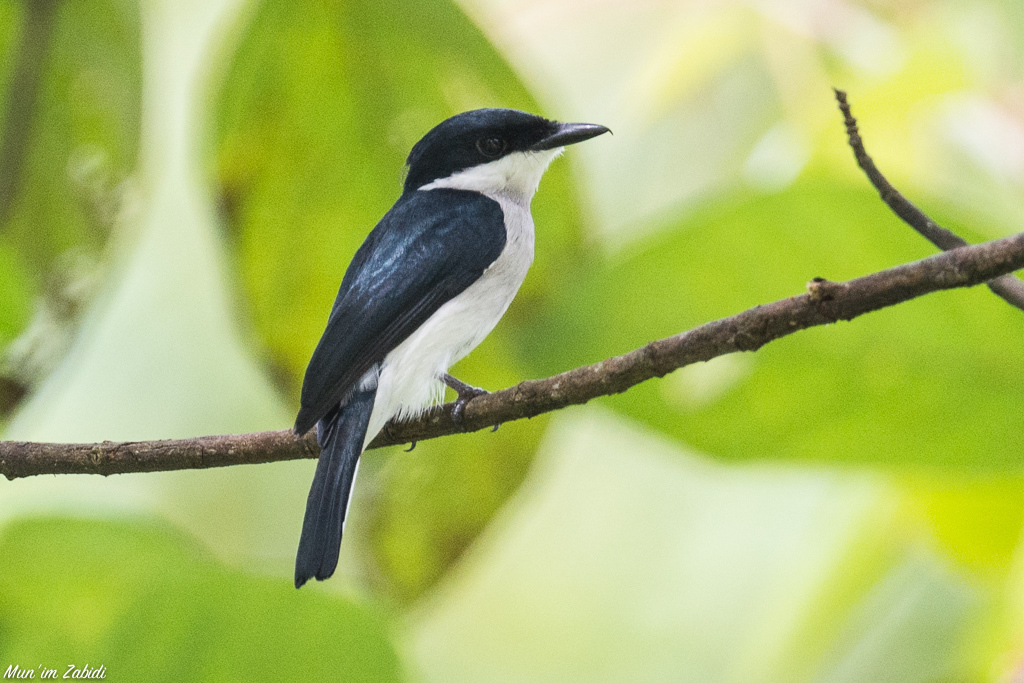
Black-winged Flycatcher-shrike
Live sightings near you, the range map, bar charts of when it is seen, and Macaulay Library photos and recordings.
Black-winged Flycatcher-shrike
Hemipus hirundinaceus
The black-winged flycatcher-shrike (Hemipus hirundinaceus) is a species of bird in the flycatcher-shrike genus, Hemipus. It is traditionally included in the cuckooshrike family, but most taxonomists place it with the woodshrikes. It is found in the Malay Peninsula and the Greater Sunda Islands, occurring in Brunei, Indonesia, Malaysia, Myanmar, and Thailand. Its natural habitats are subtropical or tropical moist lowland forests and subtropical or tropical mangrove forests.
From the article Black-winged flycatcher-shrike on Wikipedia (CC BY-SA), quoted section by section
Description
The black-winged flycatcher-shrike is about 15 cm (5.9 in) long. The male's head and upperparts are black, having a green sheen. The rump has black and white bars, and the tail is black. The chin and upper throat are white, the lower throat and breast are gull grey, and the belly is white. The leg feathers are dark grey. The eyes are dark brown, and the beak and feet are black. The female's upperparts are sooty brown instead of black. The juvenile bird has a brownish black beak and sooty brown upperparts with buff fringes.
Range & habitat
This species ranges from the Malay Peninsula to Sumatra, Borneo, Java and Bali. A record from southern Tenasserim is not supported by evidence. It is found below 800 m (2,600 ft) in elevation and is more common below 300 m (980 ft); this is usually lower than the bar-winged flycatcher-shrike (Hemipus picatus). The black-winged flycatcher-shrike lives in the canopy of lowland forests and forest edges and along forest roads and streams, and it sometimes occurs in swamps, mangroves and secondary forest.
Wikipedia: “Distribution and habitat”
What it does
This flycatcher-shrike catches insects from the underside of leaves and in the air, often perching at an exposed location. It is most often found in pairs and also occurs singly, in small parties and in mixed-species foraging flocks. Its calls include a wirrawik and a sharp chisi-wik, and its song is a high-pitched twee wi-wi-wi-wi. Breeding has been inferred to occur from February to July. The cone-shaped nest is attached to a branch using cobweb. The male collects pieces of bark, lichen, fibres and cobweb, and the female shapes the nest by pressing its body against it. The bark camouflages the nest, making it hard to spot. The eggs are white, with dark brown spots. Moulting occurs from May to at least August. The primaries are replaced starting outwards from the innermost feathers.
Wikipedia: “Behaviour”
Listen
Looking for field recordings…
Where it lives
Recorded sightings
—
geo-referenced records in GBIF, from museums, herbaria and field observers.
Drag the globe to turn it. Dots are where records exist, not a range map; darker means more records.
In the stacks
Searching the stacks…
Every page naming Hemipus hirundinaceus in the Biodiversity Heritage Library →
This page is assembled live from iNaturalist, GBIF, Wikipedia, the Source Library and the Internet Archive. It is not yet part of the hand-edited codex. iNaturalist taxon 7848.