- Plants
- ›Vascular Plants
- ›flowering plants
- ›Dicots
- ›staff-vines and allies
- ›staff-vine family
- ›Parnassieae
- ›Parnassia
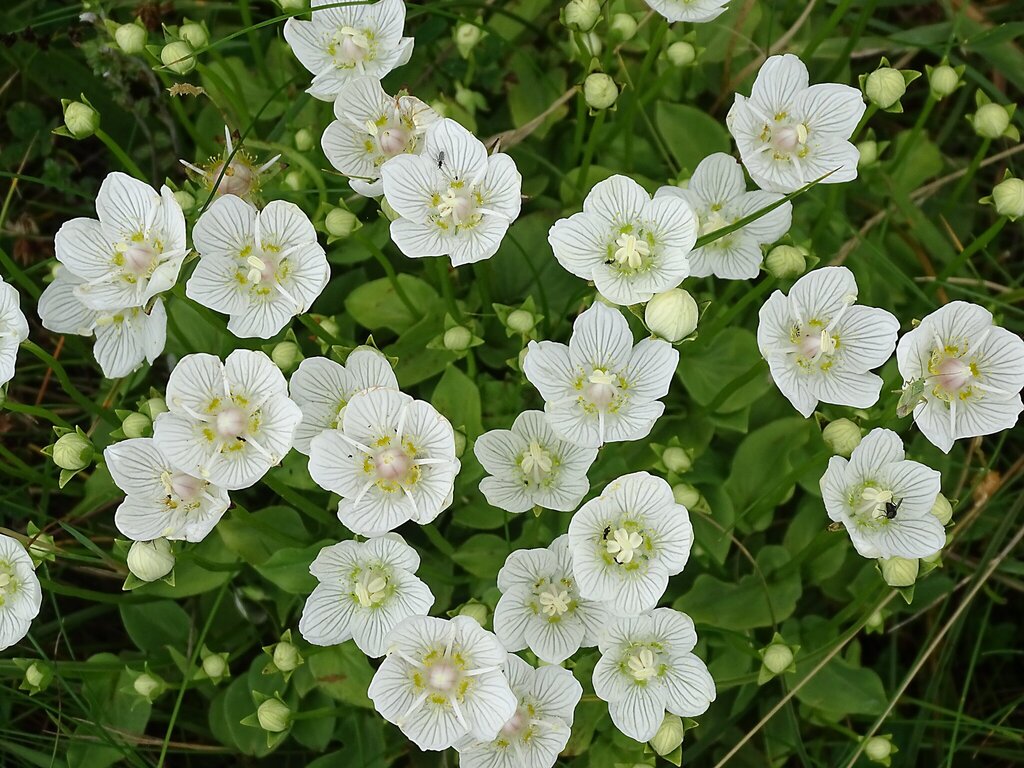
marsh grass-of-Parnassus
Parnassia palustris
Parnassia palustris, the marsh grass of Parnassus, northern grass-of-Parnassus, or just grass-of-Parnassus, and bog star, is a flowering plant in the staff-vine family Celastraceae.
It is the county flower of Cumberland in England, and appears on its flag.
From the article Parnassia palustris on Wikipedia (CC BY-SA), quoted section by section
Description
This perennial plant is not a grass, nor does it look like one, but grows from a short underground stem. It has long stemmed heart-shaped leaves, which are 4–12 in (10–30 cm) long. In the centre of the leaf, is the flowering stem. The stem holds a solitary white flower, blooming between July and October. The flower has 5 stamens around the centre. The flower produces a honey-like scent to attract pollinators.
Range & habitat
Parnassia palustris is native to northern temperate parts of Eurasia where it is found in wet moorlands and marshes. It is now extinct in Algeria.
Wikipedia: “Range and distribution”
At the table
It was once used in herbal medicines, to treat disorders of the liver. An infusion of the leaves, (similar to a tea) was also used to treat indigestion. When added to wine or water, the leaves are claimed to dissolve kidney stones. It is also seen in the Cumberland flag, which is a historic English county and is within County Cumbria.
Wikipedia: “Uses”
In human culture
While finishing his schooling in the School of Mines at Freiberg from June 14, 1791, to February 26, 1792, Alexander von Humboldt published three articles on plants in the Annalen der Botanik. These were his first of what the world famous explorer would produce. Notably, one was concerning "On the Motion of the Filaments of the Parnassia Palustris."
Wikipedia: “History”
Where it lives
Recorded sightings
—
geo-referenced records in GBIF, from museums, herbaria and field observers.
Drag the globe to turn it. Dots are where records exist, not a range map; darker means more records.
In the old herbals & bestiaries

In the stacks
Searching the stacks…
Every page naming Parnassia palustris in the Biodiversity Heritage Library →
This page is assembled live from iNaturalist, GBIF, Wikipedia, the Source Library and the Internet Archive. It is not yet part of the hand-edited codex. iNaturalist taxon 78352.