- Plants
- ›Vascular Plants
- ›flowering plants
- ›Dicots
- ›pinks, cactuses, and allies
- ›cacti
- ›Opuntioideae
- ›Opuntieae
- ›Opuntia
- ›Opuntia engelmannii
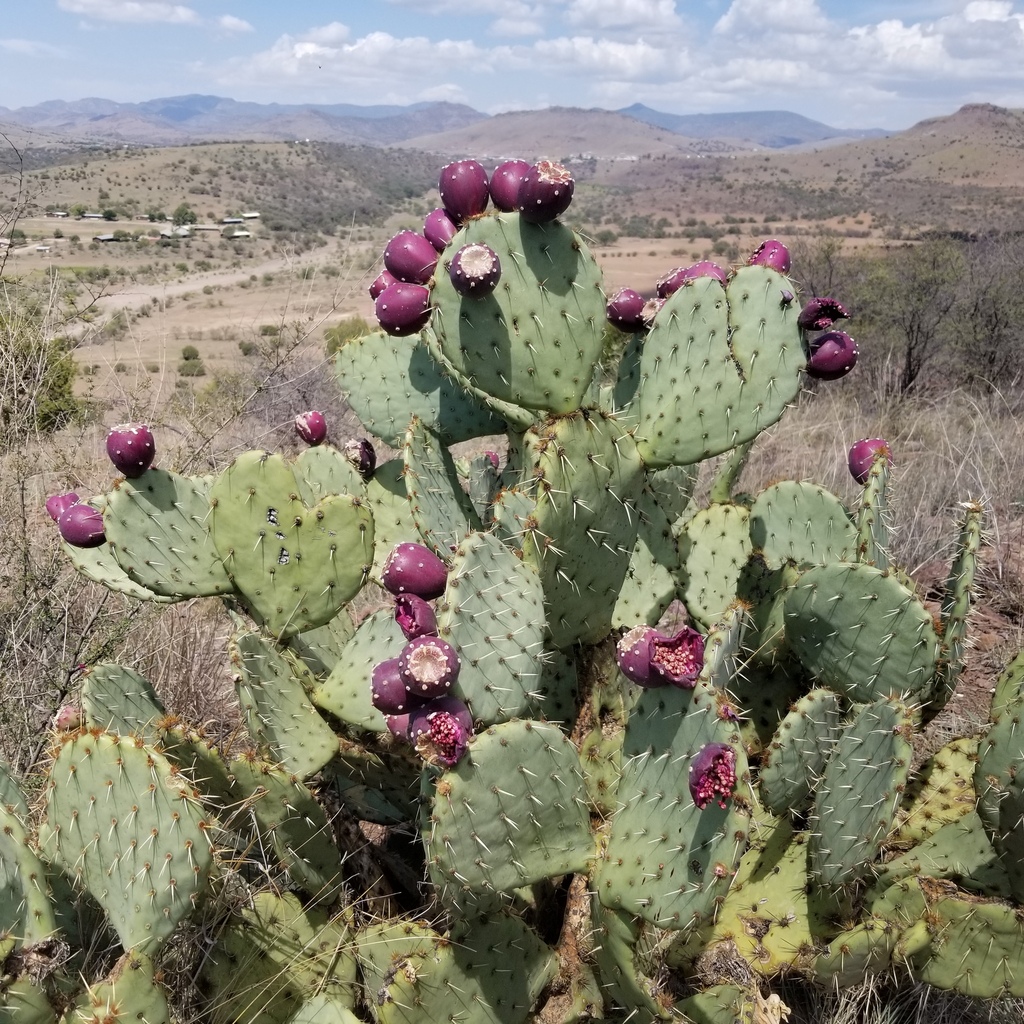
Engelmann's Pricklypear
Opuntia engelmannii
Opuntia engelmannii is a prickly pear common across the south-central and Southwestern United States and northern Mexico. It goes by a variety of common names, including desert prickly pear, discus prickly pear, Engelmann's prickly pear in the US, and nopal, abrojo, joconostle, and vela de coyote in Mexico.
The nomenclatural history of this species is somewhat complicated due to the varieties, as well as its habit of hybridizing with Opuntia phaeacantha. It differs from O. phaeacantha by being green year round instead of turning reddish purple during winter or dry seasons, as well as having yellow flowers with red centers.
From the article Opuntia engelmannii on Wikipedia (CC BY-SA), quoted section by section
Description
O. engelmannii is generally shrubby, with dense clumps up to 3.5 metres (11 ft) high, usually with no apparent trunk. The pads, or cladodes, are green (rarely blue-green), obovate to round, about 15–30 cm long and 12–20 cm wide. In the Sonoran Desert, terminal pads face predominantly east-west, so as to maximize the absorption of solar radiation during summer rains. The cladodes make up the stem and are the primary photosynthetic structure. O. engelmannii typically grows in high altitude desert, where lower atmospheric pressure increases water stress and may make gas exchange difficult , leading to a reliance on CAM photosynthesis for more efficient gas exchange and less water lost in the process . The glochids are initially yellow and brown with age. Cactus spines are nonvascularized, modified leaves that arise from areoles and are usually in clumps. Spines are extremely variable, with anywhere from 1-8 per areole, and are often absent from lower areoles; they are yellow to white, slightly flattened, and 1–6 cm long. Spines harden from the top down and develop a waxy cuticle. The spines do not photosynthesize. The spines primarily serve as defense. …
Range & habitat
O. engelmannii is native to sub-tropical regions of North America. It prefers hot, dry conditions, but is more frost-tolerant than other species of Opuntia. O. engelmannii range extends from California to Louisiana in the United States, and from Sonora (state) and Chihuahua (state), to the Tamaulipan matorral in north and central Tamaulipas. Although found occasionally in the Mojave Desert, it tends to be replaced by Opuntia basilaris, which does not need the summer rain. Naturalised in southern and eastern Africa, including Loisaba in Kenya, where they are considered invasive. O. engelmannii was also reported in Spain in the early 2000s and remains invasive.
Wikipedia: “Distribution”
At the table
The fruits were a reliable summer food for Native American tribes. The Tohono O'odham of the Sonoran Desert in particular classified the fruits by color, time of ripening, and how well they kept in storage. O. engelmannii is cultivated as an ornamental plant, for use in drought tolerant gardens, container plantings, and natural landscaping projects. O. engelmannii has also been used as a living hedge and cattle fodder. These functions, paired with a capacity to survive drought, led to its import to various locations in Africa.
Wikipedia: “Uses”
Where it lives
Recorded sightings
—
geo-referenced records in GBIF, from museums, herbaria and field observers.
Drag the globe to turn it. Dots are where records exist, not a range map; darker means more records.
In the stacks
Searching the stacks…
Every page naming Opuntia engelmannii in the Biodiversity Heritage Library →
This page is assembled live from iNaturalist, GBIF, Wikipedia, the Source Library and the Internet Archive. It is not yet part of the hand-edited codex. iNaturalist taxon 78264.