- Plants
- ›Vascular Plants
- ›flowering plants
- ›Dicots
- ›myrtles, evening primroses, and allies
- ›myrtle family
- ›Myrtoideae
- ›Melaleuceae
- ›Melaleuca
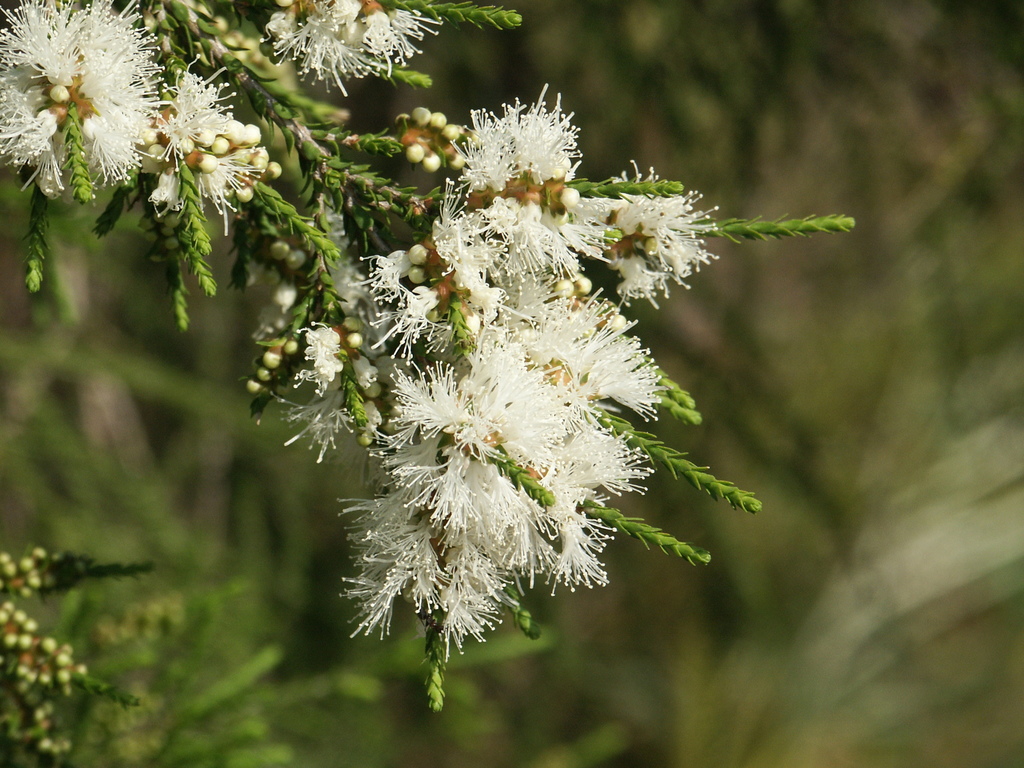
weeping paperbark
Melaleuca irbyana
Melaleuca irbyana, commonly known as weeping paperbark, bushhouse paperbark and swamp paperbark, is a plant in the myrtle family Myrtaceae and is endemic to New South Wales and Queensland in Australia. It is a shrub or small tree, often growing in pure stands in poorly drained areas. Its distribution is limited and it has been classified as an endangered species under legislation in both states and the forest as critically endangered under Australian government legislation.
From the article Melaleuca irbyana on Wikipedia (CC BY-SA), quoted section by section
Description
Melaleuca irbyana is a large shrub or small tree with thick, spongy, papery bark, growing to a height of 10 m (30 ft). It has a dense, rounded canopy and fine, weeping foliage. The leaves are stalkless, 2–7 mm (0.08–0.3 in) but usually less than 4 mm (0.2 in) long and 1–2 mm (0.04–0.08 in) wide, oval or narrowly oval in shape tapering to a point and pressed against the branchlets. The flowers are white and scented and arranged in spikes at, or near the ends of branches which continue to grow after flowering. The spikes are up to 14 mm (0.6 in) in diameter and contain 3 to 12 individual flowers. The petals are 1.5–1.9 mm (0.06–0.07 in) long and fall off as the flower ages. The stamens are arranged in five bundles around the flower, each bundle containing between 6 and 11 stamens. Flowers appear between September and January. The fruit are woody capsules, 3.5–4 mm (0.1–0.2 in) long, shaped like flattened spheres, arranged in loose clusters along the branches. Unlike many other melaleucas, the seeds are not retained in the capsules for more than a year.
Range & habitat
Melaleuca irbyana is found in only a few places in New South Wales and Queensland. In New South Wales those places include Coraki, Casino and Coutts Crossing. Only two populations are recorded in conservation areas, in Warragai Creek Nature Reserve and Bungawalbin National Park. In Queensland there are populations near Ipswich, Jimboomba, Waterford West, and the Lockyer Valley It grows in pure stands and in open eucalypt forest in clay, sandstone or alluvial soils.
Wikipedia: “Distribution and habitat”
What it does
Melaleuca irbyana often occurs in association with eucalypt trees including E. crebra, E. melanophloia, E. moluccana or E. tereticornis. The understorey is sparse and comprises grasses, sedges and herbs with few shrubs and vines. Swamp paperbark forest provides habitat for a range of plants and animals including the nationally threatened slender milkvine plant (Marsdenia coronata). It provides shelter and nesting sites for a range of bird species and on the ground, fallen logs provide shelter for reptiles and temporary ponds provide breeding habitat for frogs and other pond life. Koalas, echidnas and wallabies also occur in this forest association.
Wikipedia: “Ecology”
Where it lives
Recorded sightings
—
geo-referenced records in GBIF, from museums, herbaria and field observers.
Drag the globe to turn it. Dots are where records exist, not a range map; darker means more records.
In the stacks
Searching the stacks…
Every page naming Melaleuca irbyana in the Biodiversity Heritage Library →
This page is assembled live from iNaturalist, GBIF, Wikipedia, the Source Library and the Internet Archive. It is not yet part of the hand-edited codex. iNaturalist taxon 782283.