- Animals
- ›Arthropods
- ›Hexapods
- ›Insects
- ›Winged and Once-winged Insects
- ›Grasshoppers, Crickets, and Katydids
- ›Katydids, Crickets, and Allies
- ›Katydids, wētā, and allies
- ›Tettigonioidea
- ›Katydids
- ›Shieldback Katydids
- ›Platycleidini
- ›Sepiana
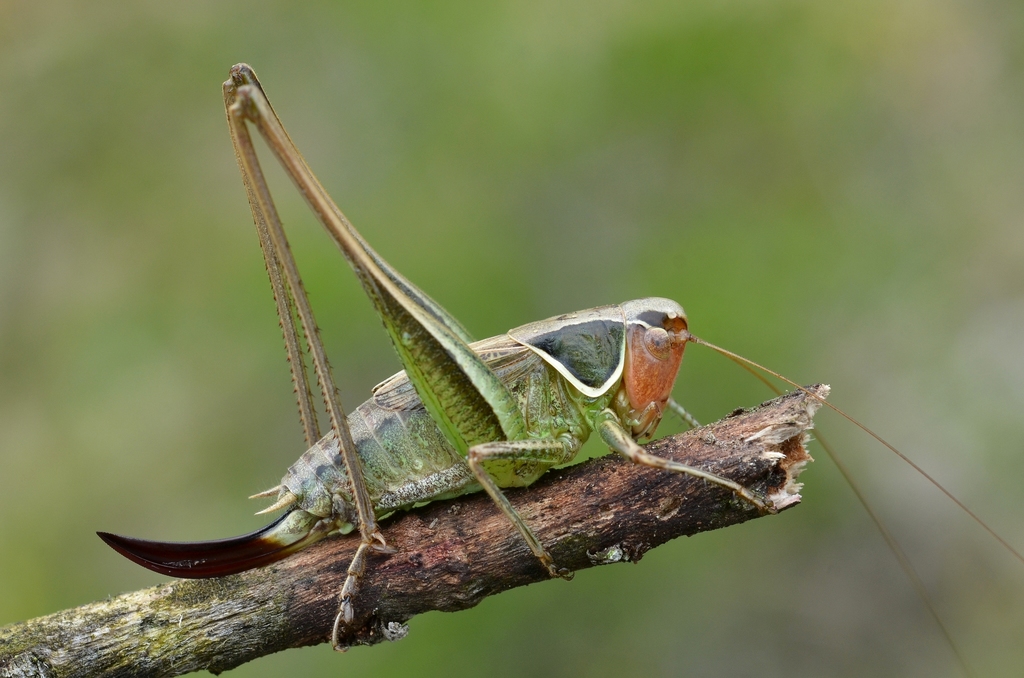
Red-faced Bush-cricket
Sepiana sepium
Sepiana sepium, common name sepia bush-cricket, is a species of bush crickets belonging to the tribe Platycleidini and genus group Platycleis. It is the only species within the monotypic genus Sepiana.
From the article Sepiana on Wikipedia (CC BY-SA), quoted section by section
Description
Sepiana sepium can reach a length of 20–27 millimetres (0.79–1.06 in). The ovopositor reaches 10–15 millimetres (0.39–0.59 in). These bush crickets have very long enlarged hind legs, with small spines on the lower legs. The ground colour of the body ranges from gray-brown to reddish. The sides of the pronotum are almost triangular-shaped, usually black or dark brown, and they are clearly delineated by a bright longitudinal line. The head is usually reddish coloured. Above the eyes there is a dark patch, which is crossed by a whitish line. The legs are dark brown or dark gray. On the hind legs there is a dark brown stripe. The cerci of the males are flattened. In the females the 6th and 7th abdominal segments have a pair of cusps. This species is quite similar to Metrioptera roeselii. The bush crickets of this species, similarly to the species within the genus Platycleis, have the largest testicles in proportion to body mass of any animal recorded.
Range & habitat
This widespread species is present from southwestern to southeastern Europe and in the Near East. It can be found from Portugal and Spain, southern France, Italy and the Balkan Peninsula along the Black Sea to Turkey and to south-west Russia.
Wikipedia: “Distribution”
Listen
Looking for field recordings…
Where it lives
Recorded sightings
—
geo-referenced records in GBIF, from museums, herbaria and field observers.
Drag the globe to turn it. Dots are where records exist, not a range map; darker means more records.
In the stacks
Searching the stacks…
Every page naming Sepiana sepium in the Biodiversity Heritage Library →
This page is assembled live from iNaturalist, GBIF, Wikipedia, the Source Library and the Internet Archive. It is not yet part of the hand-edited codex. iNaturalist taxon 780476.